
VDMA panel discussion
Plug & Smile!
Embedded vision is increasingly a "must have" in the embedded community. What is the status quo of the technology and future developments? This was the topic of a VDMA panel discussion at embedded world 2022.
"Integration of Embedded Vision: Plug & Play or Plug & Pray?" - This was the slightly provocative title of the panel discussion organized by the trade fair organizers and the VDMA Machine Vision department. The discussion between Gion-Pitschen Gross (Allied Vision), Jan Jongboom (Edge Impulse), Dr. Olaf Munkelt (MVTec Software), Jan-Erik Schmitt (Vision Components) and Dr. Frederik Schönebeck (Framos) initially focused on the question of the differences between traditional image processing and embedded vision. At first glance, both approaches seem similar: A camera captures images, which are then analyzed.
However, the two architectures have to meet very different requirements. While PC-based vision systems have access to almost unlimited computing resources and storage capacity, for example by outsourcing parts of the image processing to a GPU, other computers in the network or data to the cloud, developers of embedded vision systems are faced with various limitations: The generally very small size of embedded vision systems requires the use of small modules with the lowest possible power consumption in order to ensure sufficient operating time, especially for battery-powered devices.
Lower power consumption also reduces system heating, which has a negative impact on image quality. At the same time, embedded processors have undergone constant further development in recent years, meaning that they are now barely inferior to PC-based systems in terms of computing power and functionality.

When asked where standards for embedded vision are most needed, Jan Jongboom has a clear answer: "As a software manufacturer, I would like to have an API to get captured images into the system in a simple way, regardless of which of the numerous pieces of hardware available on the market they were acquired with." It is not least this lack of standards that makes it difficult for users to deploy embedded vision technology. But why is it so difficult to define standards in the field of embedded vision?
Jan-Erik Schmitt formulates the answer to this question as follows: "Large processor manufacturers have a certain technological advantage with their products and development tools and want to maintain this. That's why they are not open to standards that would force them to cede part of their lead to their competitors." The experts also agree that standards are helpful because they bring advantages such as easier access for users. On the other hand, in certain cases they can also lead to a certain amount of overhead in embedded vision systems, which stands in the way of an optimal system design.

Jan Jongboom from Edge Impulse: I would like to see an API that makes it easy to get captured images into the system, regardless of the hardware used to acquire them.
© NurembergFair"To implement a standard in a system, you usually need additional layers that reduce the performance of the system," explains Jan-Erik Schmitt. "In the PC world, this is less of a problem, as increased performance requirements can still be met by selecting more powerful components, as resource optimization is not usually the focus - in contrast to highly optimized embedded vision solutions."
Another reason for the difficulty in defining suitable standards for embedded vision in all segments, according to the experts, is that embedded vision systems must naturally be more scalable than conventional image processing systems.
Dr. Olaf Munkelt mentions one possible approach that would render many standards obsolete: "Apple recently introduced the M1 processor, a chip that provides extremely high computing power with very low power consumption. This chip contains powerful SoCs for various tasks, which can also mean an enormous increase in performance for embedded vision systems. If all players in the industry were to agree on this direction, it would simplify many problems, especially as Apple also provides the necessary software tools." However, it is unlikely that all embedded vision players will commit to this Apple platform.
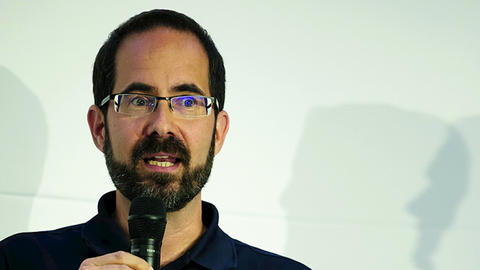
Jan-Erik Schmitt from Vision Components: "Today, young people leave university and are already BV experts because they have already dealt with this topic during their training.
© NurembergFairAI fuels embedded vision
Artificial intelligence methods are currently being used more and more in almost every technical field. The panel also sees this as a clear trend in the field of embedded vision, as Jan Jongboom explains: "From the user's point of view, AI makes it easier to develop systems that generalize well. The use of transfer learning, in which a large number of images already learned from other applications serve as the basis for training a system and only a relatively small number of new images of a specific use case are added, minimizes the effort for users enormously. For example, you can very quickly take a few images of good and faulty parts in production and train the system with them as a supplement. It then independently understands the difference between OK and NOK. This revolutionizes the way in which image processing systems are programmed and dramatically lowers the hurdle for the development of practical models: just a few years ago, it was necessary to collect and train an extremely large number of images."
However, there is also a negative aspect of AI methods, as Dr. Olaf Munkelt points out: "Industrial users usually want an explanation as to why a part is classified as faulty or why a certain decision was made. AI systems are very powerful, but they are not very good at explaining why they made a decision. This statement is completely independent of the topic of embedded vision and means that trust is a core problem when using AI. We invest quite a lot of time in building user trust in these types of algorithms, because users won't use them unless they have that trust."
According to Munckelt, this applies in particular to applications in which very precise results are required: "If there is a larger tolerance range in which inspected parts are rated as good, this makes it easier to gain acceptance for the use of AI algorithms. In other applications, however, this does not work so easily." There is also the fact that AI-based systems can only deliver good results if the previous training was correspondingly good.

Dr. Frederik Schönebeck from Framos: We have to provide architectures that are scalable and still allow easy access.
© NurembergFairNevertheless, according to Munkelt, the positive possibilities of AI outweigh the disadvantages, as AI accelerators, among other things, help to simplify the use of embedded vision. MVTec has provided an abstraction layer in its software that makes it easier for developers to work with AI accelerators such as TensorFlow, OpenVINO or other products. "Users really appreciate this because they no longer have to worry about coding all the bits and bytes," says the MVTec CEO.
Is embedded vision too complicated?
Embedded vision generally has a reputation for being a relatively complicated technology. "Plug & play" seemed unattainable in this area for a long time, and in fact the technology was often only suitable for experts due to a lack of tools. Things have changed in the meantime. Jan-Erik Schmitt sees a similar development to that of deep learning: "There are now also tools that are much easier to understand, and a lot has changed in recent years. The tools for implementing embedded vision systems are also evolving because hardware and software are constantly becoming more powerful. This constantly gives rise to new ideas as to where the technology can be used. With the numerous embedded vision applications that have emerged over the past 20 years, there are also more and more people who are interested in this topic and want to delve further into the technology."

In addition, until a few years ago, mathematicians, physicists or engineers were required to create image processing applications and could only gain the necessary experience through practical use of the technology. "Today, young people leave university and are already machine vision experts because they have already dealt with this topic during their education," says Schmitt. "There are therefore many more image processing experts today than in the past."
In combination with the simplifications that have now been achieved in the use of embedded vision, Schmitt describes the current state of the technology as "plug & smile" rather than "plug & pray". According to Gion-Pitschen Gross, the use of open source software also simplifies the use of embedded vision for users: "Much of it is very easily available today and can be adapted to the respective application with little effort. This trend is still relatively new, but manufacturers such as Allied Vision are now making their drivers available as open source so that users can adapt them to their application and use prepared examples. This also makes it easier for users to implement their applications."

Experts agree that the use of embedded vision in industry is benefiting greatly from technological developments in the consumer sector and the increasing computing power of embedded systems. For these reasons, devices equipped with embedded vision, such as mobile barcode or data code scanners, drones, self-driving vehicles, delivery robots, self-driving transportation systems and many other applications, continue to see very positive development.


You might also be interested in
Statement by Thilo Brodtmann, VDMA
"Nuclear power plant compromise only helps if other measures also work"
Extending the operating life of nuclear power plants is not enough, says VDMA Managing Director Thilo Brodtmann. He is calling for further measures.
 read more...
Growth in industrial image processing
Machine vision in Germany is expected to grow by 8% in 2022. This was announced by the VDMA Machine Vision department at the opening of the VISION 2022 trade fair in Stuttgart.
read more...Incoming orders stagnate in August
The economic consequences of the war in Ukraine are dampening the business of machinery and plant manufacturers in Germany. Adjusted for price increases (in real terms), incoming orders stagnated in August compared to the same month last year,...
read more...Deep learning bundle from MVTec, AAEON and Basler
MVTec Software, international software provider for machine vision, together with its partners AAEON Technology and Basler, presents an easy-to-use machine vision bundle with integrated deep learning technologies.
read more...On the advance
Falling prices and rising performance - the perfect basis for embedded vision technology. Six experts discussed this and more during Embedded World 2020 at the panel discussion 'Embedded Vision everywhere? ' organized by the VDMA Machine Vision...
read more...Dynamic OCR Inspection
Due to strict compliance regulations, packaging containing medical products must be correctly labeled before it is delivered to customers. The Chinese company Shenzhen Jiangrun Xuneng Technology has developed a sophisticated image processing...
read more...Dr. Olaf Munkelt becomes new Chairman
Dr. Olaf Munkelt, co-founder and Managing Director of MVTec Software, is the new Chairman of the VDMA Robotics + Automation Association. He succeeds Dr. Dietmar Ley, former CEO of Basler, who stepped down from the board for statutory reasons.
read more...SWIR hyperspectral camera for industrial high-speed inspection
Teledyne Dalsa launches 'Kaleido', a hyperspectral camera for use in the shortwave infrared (SWIR) range, designed to overcome the existing integration and performance limitations of industrial sorting processes.
read more...Machine vision industry expects turnaround in 2026
After difficult years, the European machine vision industry is sending out the first signs of recovery: growth is expected again in 2026 - driven by global demand, AI and automation. However, uncertainties and weak investment in Europe continue to...
read more...