
Systec
More color information please!
Precise compliance with color specifications is an important quality feature in many industries. Multispectral cameras for photometric analyses with high resolution and short measurement times are helpful in this respect.
A look at the automotive industry quickly illustrates the importance of controlling color specifications: Manufacturers here place extreme importance on ensuring that control and display elements as well as cockpit and ambient lighting in their vehicles are precisely color-coordinated. In medical technology, LED operating theater lights and many other components must comply with precise specifications in order to meet the strict requirements of this industry. Before assembling decorative plastic components such as panels on devices and systems, it is often necessary to ensure that the colors used match, and not just for aesthetic reasons, as the added value increases with each assembly step - and replacing parts that are out of line in terms of color at a later process step becomes increasingly expensive or even impossible.
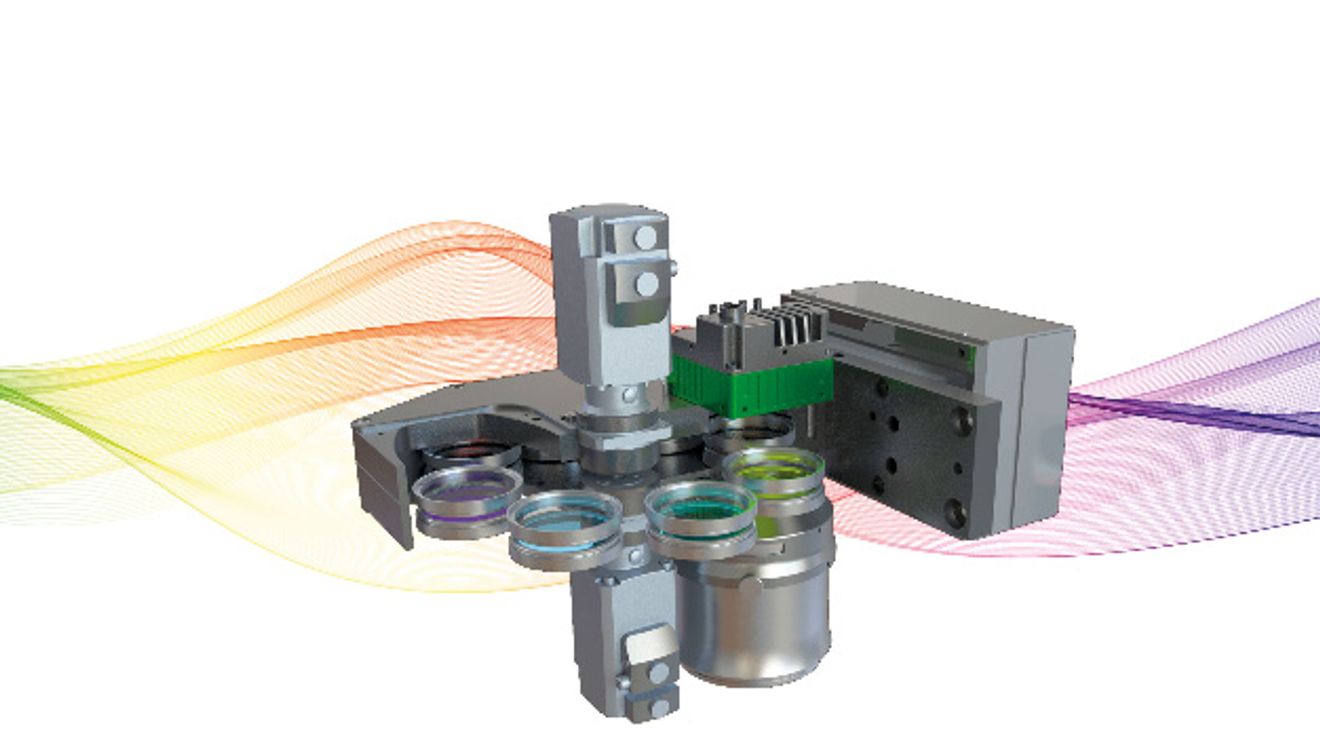
Systec has already developed systems for such tasks in the past, with which color location, luminance and optical homogeneity can be checked. Now, with the 'MSC 8X8' multispectral camera, a further development for photometric analyses is coming onto the market. Thanks to the use of a special double filter wheel, users have two sets of eight superimposed filters at their disposal, which can be automatically brought into the beam path. This results in 64 different filter combinations.
A second key element of the development is a Spark CMOS industrial camera from the Danish manufacturer JAI. This has a resolution of 45 megapixels and a bit depth of 14 bits and works with an HDR mode (High Dynamic Range). In combination with the filters of the MSC 8X8, these features enable precise photometric analyses to determine values such as luminance, dominant wavelength and color location.
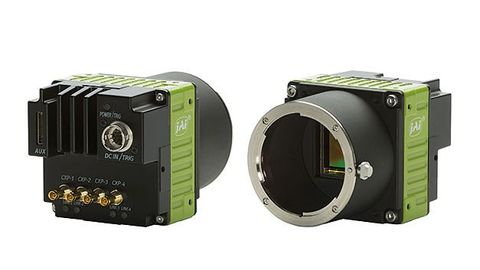
45 megapixel resolution, a high recording speed and the fast CoaXPress interface of the JAI Spark ensure the performance of the multispectral camera from Systec.
© JAIThe system is suitable for inline use in continuous production systems as well as for offline applications, for example in laboratories or for random sample testing. However, the original motivation came from inline operation, which is why Systec chose a Spark version with global shutter, a maximum image acquisition frequency of 38 images/s and a CoaXPress interface with two or four channels, which enables a data transfer rate of up to 6.25 Gbps per channel to the evaluating computer. Depending on the set exposure time and the desired output parameters, cycle times from 0.5 s can be achieved for different exposure strengths
JAI supported Systec not only in the selection of a suitable camera model, but also in the choice of lens, the appropriate lens flange and the correct distance between lens and camera. Optimum thermal management was also required in order to record images with as little noise as possible and thus create the basis for high-quality photometric analyses. A Peltier cooling unit therefore ensures active cooling of the entire system in the multispectral camera, including the camera sensor.
Flexible in use
The multispectral camera system is first assembled and calibrated with different filter combinations based on the requirements of the respective application. There are currently two configurations of the two filter wheels, in which either three CIE tristimulus filters or several filters for multispectral measurements are used. Individual configurations according to customer requirements are also possible.
Depending on the required output parameters, the associated software then performs an automated snap sequence with various filter combinations. The RAW image data is converted into valid physical-technical units, i.e. measured values, using the calibration functions stored for the respective camera/filter combination. The algorithms for all necessary calculations are already integrated in the associated software, so that users can use their system without lengthy preparations.
The system is currently designed for integration into Systec test systems. This provides customers with a complete solution tailored to their needs, including the software. Users with image processing expertise can also purchase the system separately and integrate it into their own applications or use it as a stand-alone system in the laboratory.
Meaningful results
In use, the multispectral camera system provides measured values for the illuminance distribution, the luminous intensity distribution, the color coordinates, the dominant wavelength, the discrete spectral characteristics and the correlated color temperature. This information enables meaningful tests in incoming goods inspection, for quality assurance in production and many other applications.

One example: the supplier of a German sports car manufacturer uses the system in an end-of-line test system for cockpit components. It ensures that no products are delivered with incorrectly fitted lighting components such as LEDs with the wrong wavelength or brightness, which would lead to customer complaints. It also eliminates the risk of drivers being dazzled by incorrect measurement or calibration if the maximum brightness limits are exceeded at night.
It is also very important for monitors in medical technology that luminance and homogeneity meet the requirements: when displaying X-ray images, they replace the classic images in front of a fluorescent screen and must not show any fluctuations in homogeneity, as this can lead to misinterpretation by the doctor in the worst case.


You might also be interested in
SWIR hyperspectral camera for industrial high-speed inspection
Teledyne Dalsa launches 'Kaleido', a hyperspectral camera for use in the shortwave infrared (SWIR) range, designed to overcome the existing integration and performance limitations of industrial sorting processes.
 read more...
IDS and Prophesee intensify partnership
IDS and Prophesee are intensifying their partnership for the next generation of event-based industrial cameras. Together they want to explore new sensor architectures that combine classic imaging with Prophesee's event-based 'Metavision' technology.
read more...Dual leadership in Shanghai
Stefan Becker has been appointed Managing Director of Eckelmann Automation Technology in Shanghai and will manage the subsidiary together with Zhongwei Huang.
read more...IDS Imaging Development Systems
Camera series for streaming, monitoring and event recording
IDS Imaging Development Systems launches the 'uEye Live' camera series with the 'uEye SCP' and 'uEye SLE' product ranges. They specialize in monitoring tasks, deliver various live streams and also enable event recording.
read more...AI and streaming meet robustness
IDS Imaging Development Systems is expanding its range of AI cameras with the 'IDS NXT oslo'. The model combines artificial intelligence with video streaming and recording functions in a compact, industrial-grade housing.
read more...With real-time data against disasters
A digital twin is more than just a two- or three-dimensional digital copy. It combines precise data with intelligent analysis and solves complex challenges. With locations in Paderborn and other cities, Eviden relies on the combination of artificial...
read more...Sold to Exaktera
AutoVimation will be part of Exaktera LLC, a portfolio company of Union Park Capital, based in Boston.
read more...Young Professional Award 2024 announced
The EMVA Young Professional Award is an annual prize worth 1500 euros that recognizes the outstanding and innovative work of a student or young professional in the field of machine vision or image processing.
read more...IDS Imaging Development Systems
Design freedom for board cameras
IDS has developed the 'uEye ACP' series, whose modular design principle makes a wide range of camera variants possible. The online configurator can be used to put together models that are available directly from stock.
read more...