
Image processing
Embedded PC instead of intelligent cameras
In the case of aluminum containers, which are used for packaging pet food and foodstuffs, among other things, quality assurance must be seamless and reliable - this can be achieved with the help of image processing and embedded PCs, for example.

The Swiss company Leuthold Mechanik (HLM) builds systems for the production of aluminum containers, which are used for packaging pet food or foodstuffs, among other things. One of the reasons why aluminum is a suitable material for such containers is that it is gas-tight and the contents can therefore be stored for longer. In addition, aluminum is recyclable and therefore more sustainable than plastic, which is not gas-tight and cannot be classified as harmless to health due to the addition of plasticizers. As the aluminum cans are also coated, the food does not come into direct contact with the aluminum.
"However, our systems not only produce containers for pet food, but also various forms of aluminum trays for holding jams, pâtés or coffee powder, among other things," explains Mathias Leuthold, who is responsible for the management of toolmaking and mechanical engineering in the family business. The company has also developed systems for completely different substances such as fuel pastes or packaging for medical products such as inhalers.
High-quality aluminum foil material is a prerequisite for punching thin-walled containers, the dimensions of which can vary between 60 and 120 mm in width and between 60 and 200 mm in length. The finished punched containers are transported inline to the modularly integrated inspection and stacking systems.
Quality control essential

The system module for quality control consists of four parallel lines with staggered image processing stations.
© Leuthold MechanicsThe ram of the press in HLM's competence center lifts and lowers 120 times per minute in 3-shift operation and spits out four finished pet food containers after each stroke. Such a system thus produces 480 aluminum containers per minute. After the containers have been shaped in the press in a single stroke, they are blown out and transported inline via conveyor belts and mechanical tracks to the modules where quality control takes place. "Aluminum is a relatively expensive base material, so the containers should be as thin-walled as possible to keep costs down. On the other hand, as the material thickness decreases, there is an increased risk of holes forming during the forming process due to inclusions in the raw material or excessive stresses during forming, which could make the container leaky and therefore unusable," says Mathias Leuthold, explaining the reason why every single container has to be checked. "We have to identify and sort out every faulty container, as otherwise there is a risk of the contents spoiling, for example with pet food or food in general."
Due to the high production speeds and the 100% inspection required, image processing is used as a quality inspection tool. HLM has been using this technology for over 20 years: "There is no longer a system in which image processing is not used as a central element of the inspection stations," confirms Mathias Leuthold.
Image processing with embedded PC

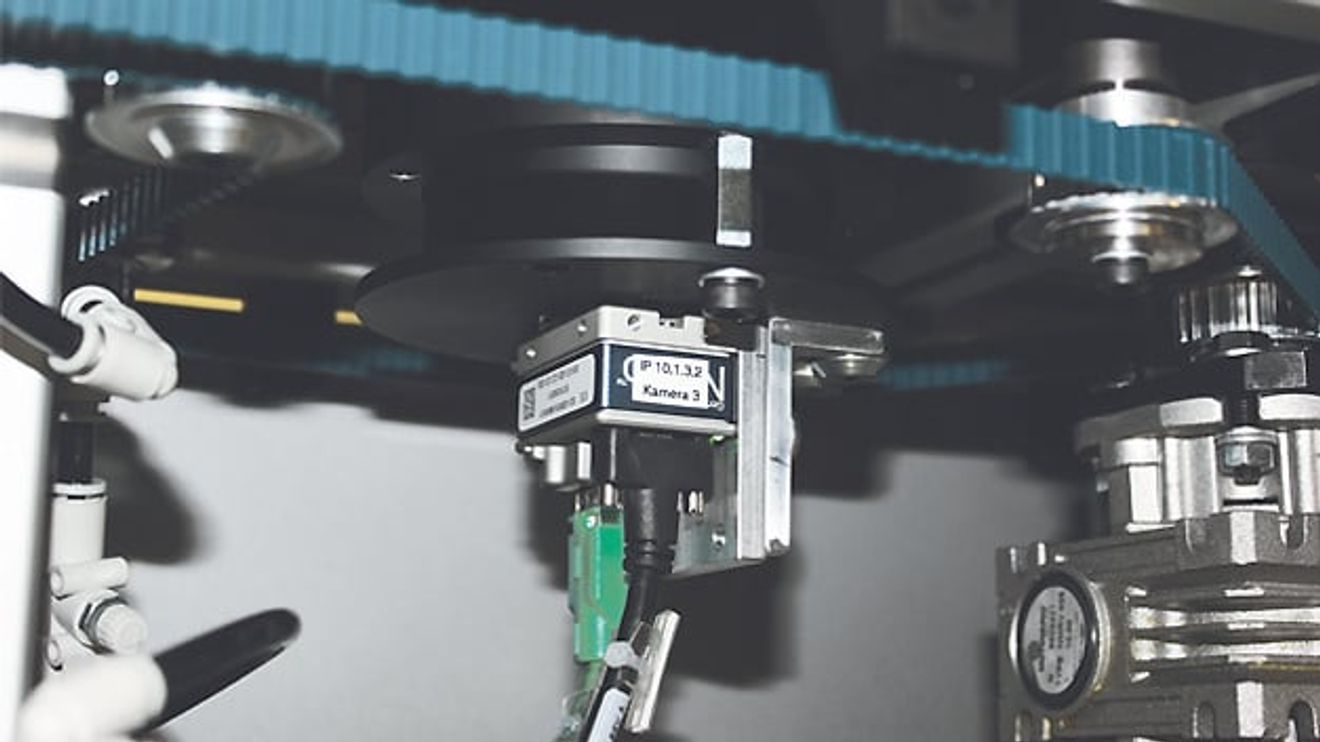
... images of the containers using the transmitted light method. The LED lights are located above the conveyor belt.
© Leuthold MechanicsWith the latest generation of systems, the Swiss company no longer relies on intelligent camera systems as before, but on an embedded PC image processing system. "With the previous architecture with intelligent cameras, a PC first had to be connected to the system in order to display fault images or carry out statistical evaluations. This was the only way to check, for example, whether there were more faults on one of the lines or whether a certain type of fault occurred more frequently. Now the operator can identify such trends more easily and quickly via a monitor directly on the system and thus eliminate the sources of errors in a shorter time."
This option was implemented using a ring buffer that stores the last 20 error images in the embedded system and displays them on demand. In addition to current result images, the user can also view statistics on fault types and their frequency, the distribution of rejects across the various lanes and images of faulty containers directly on the system screen, which helps to rectify faults more quickly by making suitable mechanical adjustments to the system.
Another advantage of the embedded vision system over the previous intelligent cameras is the improved connection to the user's MES systems, as this enables optimized production control and benefits in data acquisition.
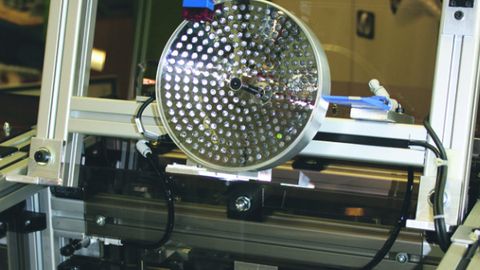
LED lighting is attached to the open flap of an inspection station, which - like the camera of each lane - is triggered by a light barrier.
© Leuthold MechanicsFrom an economic point of view, the costs for the previous intelligent camera systems were roughly the same as those for the embedded PC system.
Specifically, the new generation of systems uses the 'Genie Nano' camera from Teledyne Dalsa for each line, which is triggered via light barriers. Equipped with suitable optics from Lensation, these cameras are positioned underneath the conveyor belts. The LED lighting, which is also triggered by light barriers, is integrated into the systems above the inspection stations so that the containers can be inspected using the transmitted light method. The lighting was specially developed by Stemmer Imaging for the requirements at hand. "A certain size and a fixed lighting angle were required for this application. As there is no standard lighting that meets these requirements, we developed customized lighting for Leuthold Mechanik," says Claudio Sager, Managing Director of the Swiss branch of Stemmer Imaging, explaining this approach.
The embedded PC, which evaluates all the images from the four lines and also controls the system via the so-called 'Real Time Manager', is a custom-made product from the Swiss electronics manufacturer Worx. The computer has to evaluate 120 images per minute and lane and pass the results on to the ejection stations within a very short time so that faulty containers can be sorted out immediately. The images are evaluated using the image processing software 'Common Vision Blox' (CVB).
Author:
Peter Stiefenhöfer is a freelance editor specializing in image processing.


You might also be interested in
SWIR hyperspectral camera for industrial high-speed inspection
Teledyne Dalsa launches 'Kaleido', a hyperspectral camera for use in the shortwave infrared (SWIR) range, designed to overcome the existing integration and performance limitations of industrial sorting processes.
 read more...
IDS and Prophesee intensify partnership
IDS and Prophesee are intensifying their partnership for the next generation of event-based industrial cameras. Together they want to explore new sensor architectures that combine classic imaging with Prophesee's event-based 'Metavision' technology.
read more...Dual leadership in Shanghai
Stefan Becker has been appointed Managing Director of Eckelmann Automation Technology in Shanghai and will manage the subsidiary together with Zhongwei Huang.
read more...IDS Imaging Development Systems
Camera series for streaming, monitoring and event recording
IDS Imaging Development Systems launches the 'uEye Live' camera series with the 'uEye SCP' and 'uEye SLE' product ranges. They specialize in monitoring tasks, deliver various live streams and also enable event recording.
read more...AI and streaming meet robustness
IDS Imaging Development Systems is expanding its range of AI cameras with the 'IDS NXT oslo'. The model combines artificial intelligence with video streaming and recording functions in a compact, industrial-grade housing.
read more...With real-time data against disasters
A digital twin is more than just a two- or three-dimensional digital copy. It combines precise data with intelligent analysis and solves complex challenges. With locations in Paderborn and other cities, Eviden relies on the combination of artificial...
read more...Sold to Exaktera
AutoVimation will be part of Exaktera LLC, a portfolio company of Union Park Capital, based in Boston.
read more...Young Professional Award 2024 announced
The EMVA Young Professional Award is an annual prize worth 1500 euros that recognizes the outstanding and innovative work of a student or young professional in the field of machine vision or image processing.
read more...IDS Imaging Development Systems
Design freedom for board cameras
IDS has developed the 'uEye ACP' series, whose modular design principle makes a wide range of camera variants possible. The online configurator can be used to put together models that are available directly from stock.
read more...