

Murrelektronik
Decentralized for warehouse logistics
Incoming goods, material flow, order picking, storage, shipping - processes that need to be coordinated in intralogistics. The right machine vision concept can help plant operators to save time and reduce the susceptibility to errors.
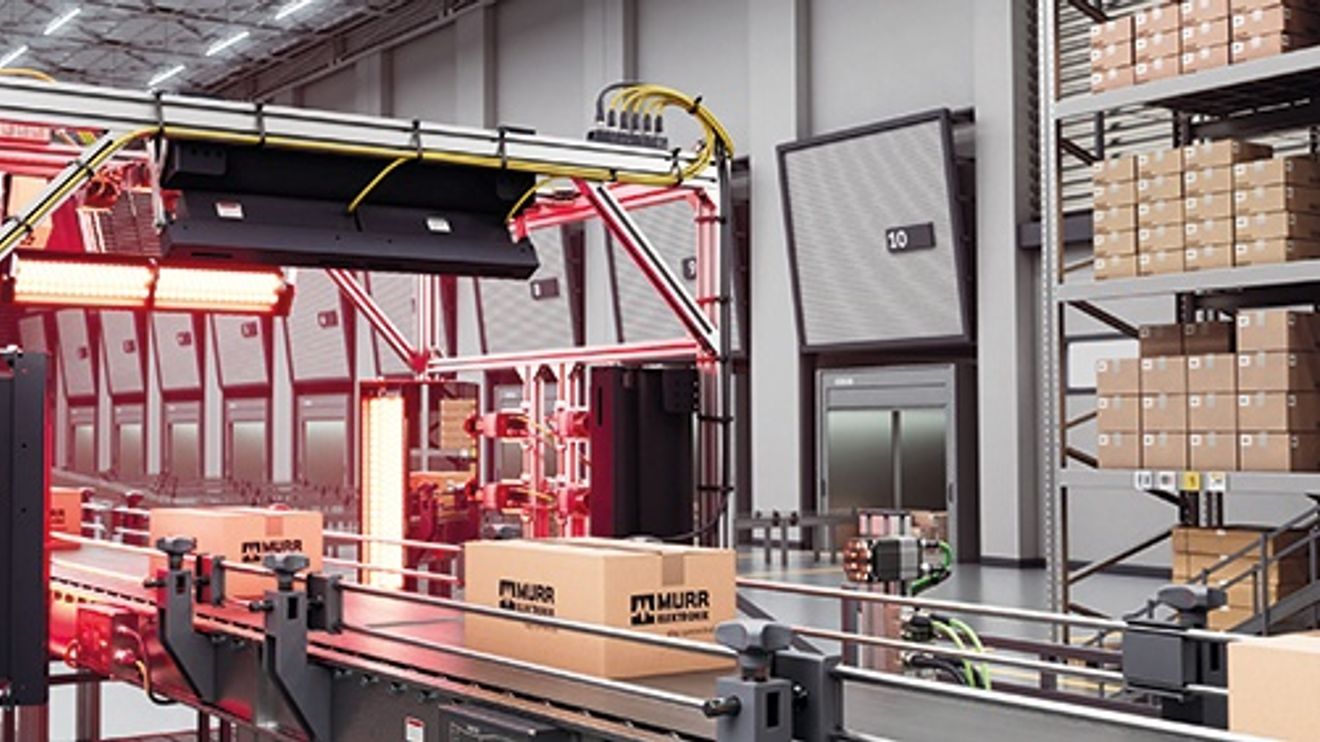
Labor shortages, expensive warehouse space, increasing process density and warehouses that need to be flexibly scalable in order to absorb seasonal and cyclical fluctuations are just a few of the reasons that are fuelling demand for automation in logistics and bringing industrial image processing solutions onto the scene. This is because automated logistics processes can be better networked, controlled and monitored and quality checks and measurements can be carried out more efficiently. Sensors and cameras protect against accidents on machines and robots, read barcodes, sort parcels, optimize stock levels and check for material defects.
Decentralized in the direct machine environment
This requires an installation concept that economically combines the sensors and actuators into one system and ensures reliable data communication and power supply. The advantage of decentralized assemblies that can be mounted and plugged directly into the machine environment is obvious: components such as IP67 IO modules can be attached directly to the machine or system in the field using pre-assembled M8 or M12 connectors. In this way, the entire sensor and actuator technology can also be connected to plug-in IO modules with protection class IP67. This is achieved without wiring errors via plug-and-play.
Decentralized means that the installation time is significantly reduced in contrast to point-to-point wiring. Instead of running many individual cables to the control cabinet, two cables are sufficient for fieldbus or Ethernet systems, one each for voltage and communication. This makes the cable architecture leaner and clearer. Time-consuming installation work such as stripping, crimping wire end sleeves and connecting to the control cabinet is no longer necessary.
The quick and easy installation frees up personnel capacity. Plug-and-play also reduces downtimes, as standard connectors can be stored in precisely assembled form. IP67 modules such as a hybrid switch also provide diagnostic data on voltage and current per port via a web interface, while LEDs on the module enable an initial visual fault diagnosis. This diagnostic data is sent to higher-level cloud systems so that the system operator has all the important information available immediately and can react quickly in an emergency. Predictive maintenance increases machine availability and shortens unexpected maintenance times.
Another aspect of decentralized warehouse automation that should not be underestimated is that users have the option of allowing machines to grow in line with their requirements without having to worry about limited control cabinet capacities or operating temperatures. This is because decentralized, modular installation concepts can always be scaled.
Flexible system structure

Application for ten cameras with continuous light in a complete IP67 installation solution.
© MurrelektronikA machine vision system requires three components: sensors, cameras to illuminate and record the objects and an industrial PC to process the data. Here too, robust IO technology with IP67 protection enables stable systems. Each sensor type can be linked to an IO fieldbus module and routed to the PLC via the communication cable. High currents can be realized via L-coded M12 connectors (16 A) and thus a large number of consumers can be supplied, for example switches and associated cameras. In addition to the Ethernet protocols Profinet, Ethernet/IP and Ethercat, fieldbus modules such as the 'MVK Pro' and 'Impact67 Pro' from Murrelektronik can also be used independently of the fieldbus via OPC UA, MQTT or JSON REST API. By networking with a bus protocol, future modules can also be connected, making it easy to expand the IO solutions in the field.
The multi-reader scan tunnel
A typical example of a machine vision application in intralogistics is a multi-reader scan tunnel: It consists of sensors that scan a product all around, sort it and forward it to the right place. The data is processed by an industrial PC and compared with the expected information. Murrelektronik has developed an IO solution for this application that allows the sensors to be connected via plug-and-play. The core is the hybrid switch of the 'Xelity' family with IP67 protection. It can be used to connect up to four cameras per switch. They receive power and communication connections via standard M12 ports, which enables larger applications with high energy requirements as well as expansions. In a multi-camera application with twelve cameras, for example, this solution can be supplied with power by using three hybrid switches. Thanks to the L-coded power cable, the power supply is up to 16 A. For twelve cameras with 1.5 A current each, two additional power supply units are required: A 16 A power supply unit that supplies the two hybrid switches for power-in and daisy chain and an 8 A power supply unit for the third switch.

The author: Simon Knapp is Solution Manager Machine Vision at Murrelektronik in Oppenweiler.
© MurrelektronikThis has an impact on the cable length and therefore on the costs: instead of running two cables over longer distances into the control cabinet for each camera, only the main cable for power and communication is fed back into the control cabinet. The cameras are installed in the field over a short distance. In the event of transportation, the system can be moved in modules thanks to defined plug-in points.


You might also be interested in
Imago Technologies at the SPS 2023
Touch panel for vision applications
Imago launches the all-in-one panel PC 'Vision Box Touch' on the market.
 read more...
Ankush Malhotra becomes new Group CEO
Ankush Malhotra has been appointed as the new Group CEO of the technology and automation company Element Logic. He succeeds Dag-Adler Blakseth, who co-founded the company almost 40 years ago.
read more...Partnership for networked manufacturing with 5G and real-time positioning
Telekom and Trumpf are further expanding their cooperation in the field of positioning systems for the networked industry. The agreement that has now been signed will facilitate the joint market launch.
read more...Technology alliance in transport robotics
Safelog and Stäubli launch a partnership to advance transportation robotics. From the second quarter of 2025, Safelog will expand its portfolio to include the 'FL1500' counterbalance truck and the 'PF3' mobile platform robot from Stäubli.
read more...Scaling of production output
Increasing production output is the goal of many companies. A flexible workpiece transport system that facilitates the parallelization of processes can offer high speed and precision with simultaneous scalability in the smallest of spaces.
read more...Intelligent software systems for intralogistics
System developers are increasingly focusing on the integration of artificial intelligence. At Logimat 2024, they will be showcasing their new developments to demonstrate how AI algorithms can be used to further automate many processes and increase...
read more...The palette of the future
The 'Pal2Rec' project, which was launched in February 2024, is investigating how (Euro) pallets can be independently integrated into logistics processes using sensor-based activity recognition.
read more...Conveyor technology and intralogistics
CIO of ek robotics takes over as CEO
Jan Drömer, Chief Information Officer (CIO) at ek robotics, is taking over the chairmanship of the VDMA Materials Handling and Intralogistics Association for the next two years.
read more...A look at the supply chain
Zebra has taken a closer look at the supply chain for the coming year: According to this, sensors and fixed infrastructures will play a decisive role in data collection and thus in the supply chain, and investments in automation solutions are also...
read more...