
Advertorial
All details at a glance thanks to up to 45 MP and 10 GigE
When it comes to optimizing automation processes, the main focus is on increasing efficiency and accuracy. 10GigE cameras, such as the uEye Warp10 camera family from IDS Imaging Development Systems GmbH, set standards here.

The 10 GigE cameras enable high-speed image processing in Gigabit Ethernet-based networks - and combine this with exceptional precision. What does this mean in practice? And what other technologies should companies be looking at?
The uEye Warp10 cameras offer up to ten times the transmission bandwidth of 1 GigE cameras and are around twice as fast as cameras with a USB3 interface. This gives them the edge when it comes to capturing, monitoring and analyzing high-speed applications. This is particularly true when motion blur must be excluded and the data needs to be available quickly on the network. A whole range of applications benefit from these advantages, including inspection systems on production lines with high cycle rates and quality controls in incoming goods and warehouses. Claudia Kirsch, Product Communication at IDS, summarizes the advantages: "The uEye Warp10 camera family offers a new level of precision and speed and can therefore significantly improve processes and performance in industrial plants."
10GigE industrial cameras now also with TFL mount

uEye Warp10 cameras are not only available with C-mount lens mounts, but also with TFL mount (M35 x 0.75) for the use of particularly high-resolution sensors. By combining the 10GigE interface and TFL mount, large-format sensors with up to 45 MP can be integrated.
© IDSIDS customers can already choose from a wide range of different sensors. These include, for example, models with the fourth generation Sony Pregius S sensors, IMX535 (12 MP), IMX536 (8 MP) and IMX537 (5 MP). What makes them special is the combination of global shutter and BSI technology, which means that the sensors deliver very good image quality. In addition, cameras with the onsemi global shutter sensors XGS20000 (20 MP, 1.3"), XGS30000 (30 MP, 1.5") and XGS45000 (45 MP, 2") are now available. The large-format onsemi XGS sensors require correspondingly large optics. Unlike the previous uEye+ Warp10 models, the new cameras are therefore equipped with a TFL mount (M35x0.75). TFL lenses can be firmly screwed to the cameras for secure mounting. The flange focal distance is standardized and, at 17.526 mm, is the same as for the previously available cameras with C-mount.
Smarter production thanks to artificial intelligence
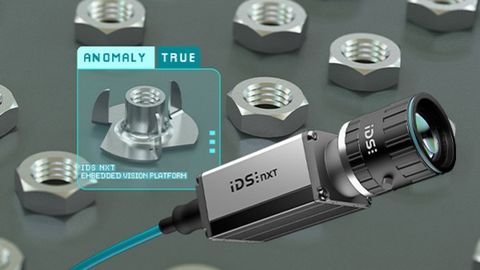
The cameras can precisely record high-speed processes and forward image information in the Gigabit Ethernet-based network without delay and demonstrate their strengths in inspection tasks, for example, when scenes need to be recorded, monitored and analyzed in full detail and without motion blur.
© IDSIndustrial cameras with artificial intelligence (AI) go one step further. They open up completely new fields of application that cannot be mastered with conventional image processing. While many robots do not understand their environment themselves and can only work command-based, AI-based systems enable them to react adaptively. This ability is necessary, for example, when recognizing and processing highly varying objects. Very high or hardly predictable variances are very difficult to realize with conventional image processing. Artificial intelligence, on the other hand, offers the necessary capabilities to solve such challenges. However, when it comes to AI in particular, many companies lack the necessary expertise and time to familiarize themselves with the topic and use the technology for their needs.
The IDS NXT AI image processing system is designed to remedy this situation, as it can be operated quickly and easily by any user group - even without in-depth knowledge of machine learning, image processing or application programming. Customers benefit from a complete system that includes both cameras and software.
The IDS NXT system is also characterized by user-friendly workflows: It provides step-by-step support, from the creation of the image to the training of the neural network and the realization of the application. IDS NXT therefore offers an excellent basis for the intelligent use of image processing. A few weeks ago, IDS also launched a groundbreaking product on the market: the new IDS NXT malibu can analyze images in real time and integrate results directly into compressed video streams. It combines on-camera AI with compression and streaming - a first in the industrial environment.
Follow IDS in the social networks


You might also be interested in
VDMA at the Hannover Messe 2026
Relocation concerns in mechanical engineering
The German mechanical and plant engineering industry is under increasing pressure from regulation, high costs and geopolitical risks. According to the VDMA, many companies are considering investing abroad. At the same time, the industry remains...
 read more...
RobCo at the Hannover Messe 2026
Robotic system for dynamic environments
RobCo is presenting a new industrial robotics system for dynamic tasks in industry at the Hannover Messe. With 'Autonomous Alfie', the company is opening up a new category of robotic solutions. This allows tasks in which processes, objects and...
read more...Fraunhofer at the Hannover Messe 2026
Data, AI and material innovations for the industry of tomorrow
Under the motto "Innovations for our Future", nine Fraunhofer Institutes and Groups and the Research Fab Microelectronics Germany (FMD) will be presenting concrete solutions for a resilient, digitally networked industry at Hannover Messe 2026.
read more...Funding project on embedded AI
The "Edge AI Platform" project is entering its third round of funding: three Fraunhofer Institutes are further developing the platform to version 3.0 in order to provide companies with even more efficient access to embedded artificial intelligence...
read more...automatica to be held in China for the first time in 2027
automatica is expanding its global brand strategy and will take place in China for the first time in 2027. automatica Shanghai 2027, organized by Messe München Shanghai and the VDMA Representative Office in Shanghai, will celebrate its premiere from...
read more...Generative AI delivers more than 300 picks per hour
Sereact presents the latest generation of the Vision-Language-Action (VLA) model 'Cortex' and the associated visual intelligence 'Lens'.
read more...World's largest robotics training center planned
The Munich Institute of Robotics and Machine Intelligence (TUM MIRMI) at the Technical University of Munich (TUM) and Neura Robotics are joining forces to create the world's largest research and training center for robotics in the scientific field....
read more...Dragos expands collaboration with Microsoft
Dragos, a global provider of cyber security for OT environments, is expanding its collaboration with Microsoft. The aim is to support companies in modernizing and securing their cyber-physical operating processes.
read more...Generalized physical AI pipeline for production automation
Vention launches 'GRIIP (Generalized Robotic Industrial Intelligence Pipeline)'. The end-to-end pipeline for physical AI enables the use of autonomous robot cells in highly unstructured manufacturing environments.
read more...