

Schunk
The smart gripper
Condition monitoring systems (CMS) detect changes and anomalies in the production process. Due to their 'closest-to-the-part' position, gripping systems and clamping devices are rapidly gaining in importance in this context.

Machines and systems, smart tools and components are already generating enormous amounts of data on the shop floors of manufacturing companies. However, only a very small proportion of this is actually used - estimates put the figure at only around 5%. Until now, the values recorded by sensors have hardly been given any importance, at best in the event of damage or when troubleshooting. By using the existing data comprehensively, systematically and, above all, in real time, smart manufacturing scenarios can be realized that promise considerable benefits. As the increasing degree of networking and digitalization is also associated with a rapid increase in data volumes, there is a risk that the connections to the cloud data centers will not be able to cope with the rapidly growing, immense data streams, leading to outages and high latency times.
A fundamentally new understanding of data is therefore at the heart of current development projects: it is no longer a question of simply collecting data as before, but of analyzing it on site and converting it into valuable information. The central question is how big data can be refined into smart data. For example, processed information is required on whether a system is running properly, ideally linked to corresponding recommendations for action.
Integrated component testing
This allows quality features of components to be checked during handling and IO/NIO decisions to be made directly in the gripper. The data recorded in the gripper is pre-processed and analyzed directly in the component in real time in order to trigger appropriate reactions. This reduces the volume of data to be transferred to the bare minimum, i.e. a sometimes confusing amount of data is channeled into meaningful key performance indicators (KPIs). In addition to the classic failure statistics, the most important KPIs are the capability parameters of the processes from the statistical process analysis and the overall equipment effectiveness. The latter measures three performance data and multiplies them into a holistically determined productivity indicator, the Overall Equipment Effectiveness (OEE).
Smart handling modules create the prerequisites for the full integration of production systems in the manufacturing environment in a simple way and open up their connection to cloud-based ecosystems in order to determine the overall equipment effectiveness OEE, the error statistics (MTBF, MTTR) and the medium-term process stability via the determined capability parameters. One such component is the 'EGL' parallel gripper from Schunk, a smart standard gripping module with integrated functions as standard, a certified Profinet interface and integrated electronics with a variable stroke and a gripping force adjustable between 50 and 600 N.
As an inline measuring system, the intelligent gripper uses its exposed position directly on the workpiece to collect data during 'smart gripping ' and evaluates it immediately using the edge technology integrated into the gripper. Each individual process step can be monitored in detail and forwarded to the plant control system, the higher-level ERP system, analysis databases and cloud solutions, for example. In this way, the gripper can systematically record and process information about the gripped part, the process and the components and react accordingly. This enables closed-loop quality control and direct monitoring of the production process in the production cycle.
Proactive trend detection
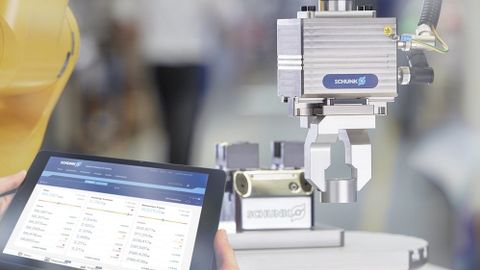
With smart gripping, intelligent grippers from Schunk measure, identify and monitor components and the ongoing production process.
© SchunkAbove all, the continuous real-time determination of long-term process capability for proactive trend detection and fault diagnosis has proven its worth with the gripper. Initiated control corrections take effect even before the specification limits are reached and enable significantly more stable process control. As part of a sensor fusion, several sensors can be used in parallel and their measured values analyzed in a linked manner in order to evaluate the current system status of the grippers and the access situation. This makes it possible to differentiate between gripping objects, but also to detect faults in the production process, such as differing raw material qualities, wearing tools, tolerance deviations or material bottlenecks. Real-time process analysis also makes it possible to evaluate trends and incorporate them immediately into the quality control of the production flow, for example on the basis of capability parameters. Correlation analyses also make it possible to identify complex correlations more quickly and eliminate more complicated error patterns.
Gripper takes over gripping planning

The smart tool holder 'Itendo' from Schunk uses built-in sensors to record accelerations and vibrations directly on the workpiece and transmits the data to the machine tool controller.
© SchunkIn the future, Schunk plans to automate tasks for controlling the entire kinematic chain, consisting of the robot and gripper, as well as monitoring their function, without the need for step-by-step programming or setting and continuously adjusting threshold values. The key to this autonomous gripping is the use of artificial intelligence (AI) methods and various sensors. In a pilot application, for example, cognitive intelligence methods are used to identify randomly arranged parts via a camera and then autonomously grab them from a transport box and feed them into the machining process. At the same time, deviations from the usual process (anomalies) and trends, such as the drifting of relevant process parameters, are learned. This sharpens the diagnostic instrumentsimplemented in the gripper without interrupting operations or requiring excessive training during system setup. The aim is for the gripper not only to grip, but also to take over the entire gripping planning, monitor the entire process using sensors and analyze it continuously. Edge and cloud computing complement each other here.
Example: Sensory tool holder
A first example is the 'Itendo' sensory tool holder from Schunk, which is equipped with a sensor, battery and transmitter unit. It records the process at 5000 Hz directly on the tool. An algorithm continuously determines a parameter for process stability. The so-called IFT value was specially developed for the tool holder and reflects the measured vibration as a numerical value on a defined intensity scale - similar to the Richter scale for earthquakes. If the cut becomes unstable, the integrated intelligence intervenes immediately in real time with a latency of around 20 ms and without the operator having to intervene: Depending on the situation, the process is then stopped, reduced to previously defined basic parameters or adapted, the infeed of tools is changed, sister tools are replaced or messages are sent to operators.
A web service can be used to define both the limit values and the corresponding reactions if they are exceeded, depending on the respective application. In the medium term, statistical evaluations should also be possible, such as Overall Equipment Effectiveness (OEE), process capability, Mean Time Between Failure or trend developments such as parameter drift or increases in failure rates.
Overall asset effectiveness as a key performance indicator
Three factors are relevant when determining the OEE (Overall Equipment Effectiveness):
- The performance level: This is a measure of the processing speed of a production system. It is based on the cycle times for the output interval of good parts or the quantity output. The performance level is shown in the form of cycle times and quantities, among other things.
- The degree of utilization (availability): It is a measure of the ability of a production system to fulfill a required function at the required time and is determined on the basis of operating times, failure rate, mean time between failure (MTBF) and mean down time. The latter includes maintenance time and repair time. Reliability indicates the probability that no failure will occur during a period of time that impairs the functionality of a unit. It is determined by the failure rate of the technical elements and quantified by the mean time between failures (MTBF).
- Quality performance: This is a measure of the ability of a production system to assemble/test within prescribed specification limits. Statistical quality assessment methods are used to analyze and evaluate the quality behavior of production processes. Sampling information is used to obtain information about the distribution time behavior, for example in the assembly process. The results of the investigation are the calculation of the 'short-term machine capability', the 'preliminary process capability' and the 'long-term process capability'.
The machine capability is a measure of the short-term characteristic dispersion emanating from the machine. Process capability is a meaningful measure of the stability of a process. It shows whether a process can fulfill the requirements placed on it. In such cases, one speaks of controllable production processes. At the same time, process capability provides information about the long-term behavior of the overall system under the prevailing framework conditions (man, machine, method, working environment).
Process capability characterizes the ability of a machine or a process to realize specified characteristics whose frequency distribution lies within the required tolerances. The ratio between the statistical distribution of a measurable quality characteristic and the tolerance range specified for this characteristic is formed for this purpose. Process capability parameters react very sensitively to changes and trend developments. They are therefore particularly suitable for medium-term range forecasting and predictive maintenance.


You might also be interested in
Targeted preselection of the right system
With the intelligent calculation and design tool Gripping, Schunk simplifies and accelerates the engineering of handling systems.
 read more...
The hand as a yardstick
The human hand is still considered the benchmark when it comes to the flexibility of gripping tools. In service and assistance robotics in particular, humanoid manipulators that enable a wide range of gripping variants will be increasingly in demand...
read more...Schunk receives the Hermes Award 2024
Schunk was honored with the Hermes Award for its AI-based project during the opening ceremony of the Hannover Messe.
read more...Schunk at the Hannover Messe 2024
Digital and automated for healthy production
Schunk is focusing on two key topics in Hanover: 'The Healthy Factory' and 'Innovation through Collaboration'. The aim is to design a healthy and economically successful production for people and the environment.
read more...Automation of separation processes
With the Solution Kit Part Separation with 2D Grasping Kit, fruitcore robotics and Schunk present a solution for the vision-based separation of non-layer-oriented workpieces.
read more...Safe handling of heavy pallets
Schunk has further expanded its range of pneumatic robot couplings for pallet handling. The 'Vero-S NSR3 138' robot coupling handles heavy pallet weights reliably.
read more...Products of the year - The e-paper special
"Products of the Year 2023" goes interactive: the new e-paper including video news is here! The winners of the readers' poll have been chosen and in our interactive special edition you will find all the winning products at a glance and exclusive...
read more...Robotics - The winners
Robotics is regarded as one of the key technologies for coping with demographic change. Cobots in particular are predestined for human-robot collaboration. But cobots are nothing without the right gripper, as the winners in the 'Robotics' category...
read more...Products of the year 2023 - your vote counts!
96 products in 12 categories are up for election for the "Products of the Year 2023"! Take part and win Saturn vouchers worth €500, among other things!
read more...