

Project from it's OWL
The 'AI marketplace' becomes a start-up
The 'AI Marketplace' project initiated by it's OWL and funded by the Federal Ministry for Economic Affairs and Climate Protection has come to an end. To enable companies to benefit from the findings, the project team is continuing as the start-up 'AI Marketplace'.
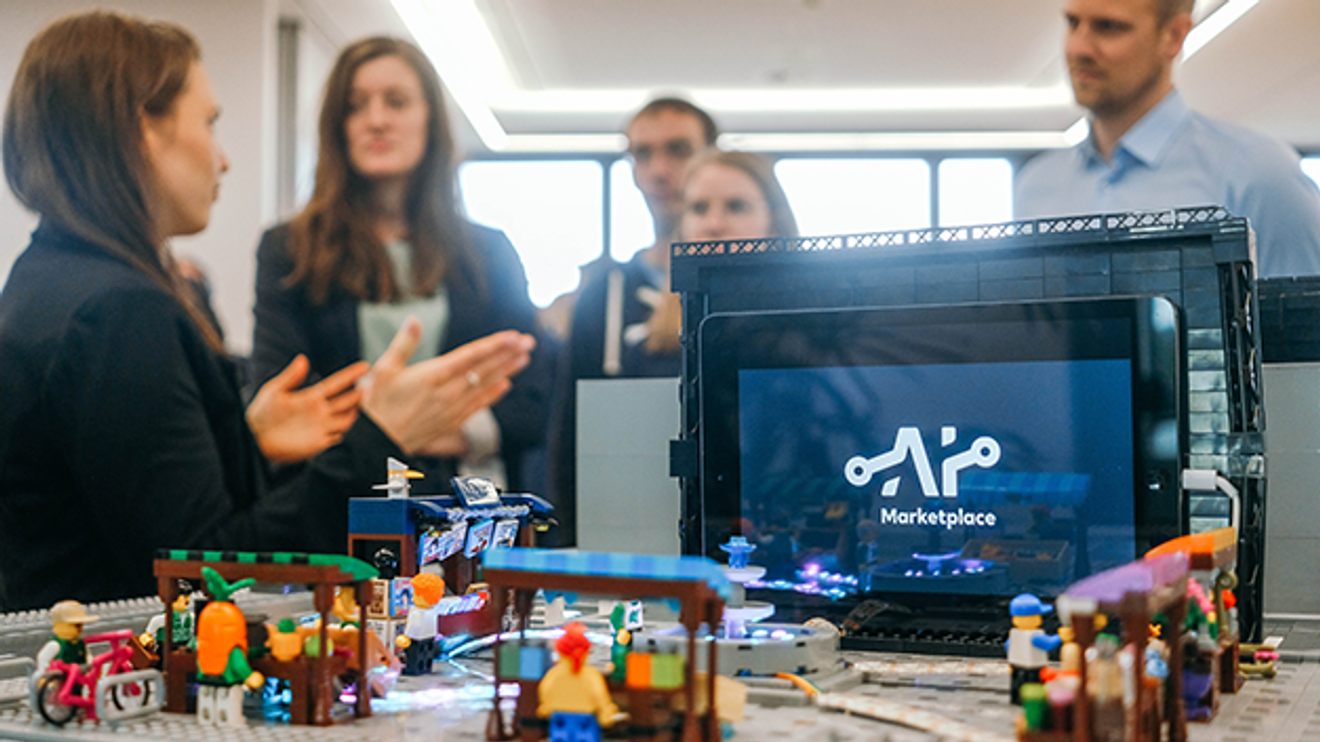
A Lego demonstrator playfully shows the added value that the AI marketplace offers - both on the provider and user side.
© it's OWLShortening development times, reducing costs and increasing productivity at the same time: the 'AI Marketplace' project, funded by the Federal Ministry for Economic Affairs and Climate Protection and initiated by the it's OWL technology network, has shown why companies should look into artificial intelligence (AI) in engineering. Companies such as Claas and düspohl have benefited from the three-year research project. With the help of the AI marketplace, the combine harvester manufacturer has found a way to drastically reduce its construction costs. To enable other companies to benefit from the advantages of AI in engineering, the project team led by Prof. Dr. Roman Dumitrescu, Leon Özcan and Ruslan Bernijazov founded the start-up 'AI Marketplace GmbH' of the same name. The start-up offers free web checks and other consulting formats for getting started with AI in engineering. The range of services also includes an app and service store that gives users easy access to AI applications from third-party providers.
"AI in engineering holds great potential for increasing productivity and economic growth. Whether it is the automation of technology scouting or the optimization of design data - the potential of artificial intelligence in engineering is manifold. However, manufacturing companies often lack sufficient expertise to tap into this potential. We want to change this with the AI marketplace," says Prof. Dr. Roman Dumitrescu, Director at Fraunhofer IEM. "With the AI marketplace, we are offering companies a central location where they can discover the potential of AI in engineering and where they can solve their challenges with the help of AI," adds Ruslan Bernijazov, who co-led the project.
First applications
The AI Marketplace project was funded from January 2020 to June 2023 in the innovation competition "Artificial intelligence as a driver for economically relevant ecosystems" organized by the Federal Ministry of Economics and Climate Protection (BMWK). The project volume amounted to 16.60 million euros. The project consortium consisted of 20 research institutions, networks and companies, with the leading-edge cluster it's OWL at its core.
The project team relied on the expertise of AI providers CITEC (Cluster of Excellence Cognitive Interaction Technology), the Institute for Industrial Information Technology (inIT) and Ubermetrics, while AI users included Claas, Diebold Nixdorf, düspohl Maschinenbau, Hella Gutmann and westaflex. The companies benefited from the expertise from research, while the research partners took advantage of the opportunity to work on real use cases with real data.
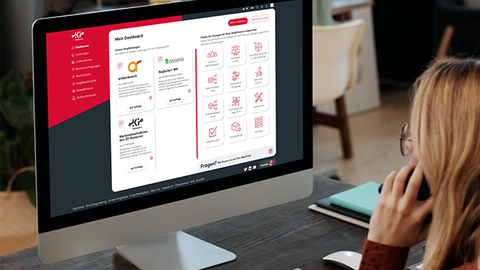
The start-up offers free web checks and other consulting formats for getting started with AI in engineering.
© it's OWL
The platform created in the project was largely designed by the organizations Contact Software and inno-focus, the Fraunhofer Institutes IEM, IOSB-INA and IPK, the FIWARE Foundation, the Heinz Nixdorf Institute, the International Data Spaces Association, prostep ivip e.V. and Unity.
The first applications for the store were developed during the three years of the research project. In six pilot projects, 20 companies and research institutions worked with 72 associated partners of the AI marketplace on AI solutions for specific use cases. The topics ranged from intelligent product monitoring and fault diagnosis to AI-supported manufacturability analysis. Claas, Diebold Nixdorf, düspohl, Hella Gutmann, westaflex and Ubermetrics took part in the pilot projects.
The applications from the pilot project

In pilot projects of the AI marketplace, 20 companies and research institutions worked on AI solutions for specific use cases.
© it's OWLThe agricultural machinery manufacturer Claas has integrated artificial intelligence into computer-aided design (CAD) through the project. The result is a knowledge database with CAD models for intelligent common parts management that can be used to find identical and similar parts. "Thanks to the database, an engineer can search through millions of parts in just 13 seconds, which drastically increases search efficiency. Once the application is in production, we expect to break even within the next few months," says Roger Tiako Poungue, Domain Lead CAD Mechanics at Claas. Thanks to the database and the fast search, components can be reused and do not have to be redesigned, which saves manufacturing, development and storage costs.
AI reduces production margin by 27 percent
Automotive supplier westaflex has also identified potential savings. Thanks to the AI marketplace, the company has reduced its production time, i.e. the time it takes to complete a specific task or project, by 27%. This is because software at westaflex now uses artificial intelligence to plan the order in which orders are produced. Based on ERP, machine and real-time data from production, the AI suggests a sequence plan, replacing analog planning boards and spreadsheets. "Thanks to the work in the AI marketplace, we have been able to drastically reduce our planning time and significantly increase the efficiency of our processes," says Olaf Knospe, Head of Research and Development at westaflex.
AI-supported diagnostic software launched on the market
The manufacturer of diagnostics and workshop equipment, Hella Gutmann, has developed and launched 'Automated Diagnostics' with the involvement of the AI marketplace. Traditionally, potentially defective components in vehicles are identified using fault codes and sensor values.
Currently, a mechanic needs a lot of time and knowledge in the workshop to create a well-founded diagnosis based on read-out error codes or measured sensor values. In the 'Automated Diagnosis' developed, the artificial intelligence initially works with data from two billion error codes read out and around five million causalities recorded by Hella Gutmann's call center.
With the help of this large amount of data, defective components can be identified with a high probability in over 80 percent of the automated diagnoses. In addition, the system continuously improves itself by using and integrating feedback from automotive experts.
Product monitoring with artificial intelligence
Analyzing and processing feedback is also part of Ubermetrics Technologies GmbH's business. The company has automated its evaluation of digital product feedback in the AI marketplace. AI applications help Ubermetrics to extract and analyze relevant product information from unstructured texts such as press releases or social media posts. Companies can use the software to find out how existing and new products are perceived by customers, to identify requirements for new product ideas and to assess market opportunities.
"The functionalities developed for product monitoring will have a major impact on our customers, as we will be able to offer a better service and optimize the cost structure for all customers," says Jakob Tesch, Research Manager at Ubermetrics.
With the help of the solutions developed in the AI marketplace, the company can reduce the estimated costs of connecting data sources by 80 percent. The number of monitored entities can be increased many times over.
AI knows the optimum machine settings
düspohl Maschinenbau GmbH wraps wooden, metal or plastic profiles intelligently with the help of the 'RoboWrap' profile wrapping machine. The experts from the AI marketplace helped the company to optimize the system's set-up process. With success: thanks to AI, the set-up time of the machine was reduced from up to 16 hours of manual work to just 10 minutes - a time saving of up to 99%. In addition, the prototype developed has a high level of accuracy, with the AI suggesting the correct setup of the 'RoboWrap' in around 91 percent of all cases. The company can fall back on the AI's settings and knowledge at any time. The high level of accuracy also means that significantly fewer errors occur during setup than with manual setup - the scrap rate can be reduced by around 50 percent.
AI saves time during servicing
The ATM manufacturer Diebold Nixdorf has reduced the processing time of service cases for technician deployments in the project. The company uses developed AI algorithms to recognize patterns based on machine and service data that occur in the event of a fault in the device. This allows the cause of a fault to be localized before technicians even arrive at the machine. This not only saves time in the event of a service call, but also helps to reduce the service call rate.


You might also be interested in
AI is what we make of it
Everyone is talking about generative artificial intelligence. But what added value does it bring? How can it be integrated into industrial processes? An assessment from Microsoft.
 read more...
Digital ministers want to regulate AI quickly but moderately
The federal and state digital ministers are calling for rapid but moderate regulation of artificial intelligence in Europe. Without AI, there would be no competitiveness in the future, said Federal Digital Minister Volker Wissing (FDP).
read more...Experts urge focus on the risks of AI
A number of leading experts on artificial intelligence see the technology as a potential threat to humanity and have called for the risks to be taken seriously.
read more...No digital (industrial) future without artificial intelligence
High energy costs, uncertainties in the energy supply chain and the strong focus on China as an export country are calling into question the future viability of Germany's (export) business model. The transition to a smarter, more intelligent...
read more...E-Paper: HANNOVER MESSE DAILY Day 5
The top news of the issue on the fifth day of the trade fair in Hanover: First summary of Hannover Messe 2023 +++ Interview: Bosch Rexroth +++ Igus: manus awards presented +++ Interview with Markus Asch, Rittal +++ The trade fair partner country 2025
read more...SPS Connect 26.11. - 14:40 - 15:00
Industrial DC grids: On the way to the DC factory
In the presentation, the manufacturer-independent industrial direct current network (DC network) from DC-Industrie will be presented as a solution to the upcoming challenges of industrial energy supply.
read more...Leading-edge cluster it's OWL shows new approaches
Companies and research institutions in the leading-edge cluster it's OWL are developing new approaches to machine learning for SMEs. The cluster is now showcasing exemplary solutions at the joint stand in Hall 16 A04 at Hannover Messe 2019.
read more...The digital twin
The properties of Ethernet TSN entail a high level of system complexity. How can a digital twin help to better deal with this complexity?
read more...Five flagship projects for new fields of technology
In five flagship projects, companies and research institutions in the it's OWL leading-edge cluster aim to develop new fields of technology for German SMEs. The focus is on machine intelligence, digital platforms, digital twins and the working world...
read more...