
TSN
The digital twin
The properties of Ethernet TSN entail a high level of system complexity. How can a digital twin help to better deal with this complexity?

Industrial automation is one of the operational technologies (OT) of a factory in which fieldbuses and real-time Ethernet are used today. These are based on IEEE 802.1 and IEEE 802.3 Ethernet elements that have been supplemented with IEC standards for the necessary real-time capability. The systems (Profinet, Sercos III, Ethercat) are not interoperable with each other.
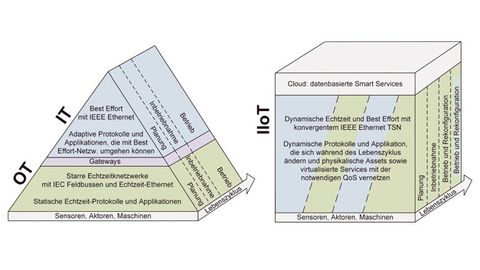
The current (left) and future automation architecture with the corresponding application and communication features.
© Fraunhofer IOSB-INAIT technologies such as Ethernet and TCP/IP, which work according to the best-effort principle, are used for networking at the higher functional levels of a factory. Coupling to the field level takes place via gateways. Communication relationships and the assignment of variables between communication systems and applications are configured manually and statically.
Industry 4.0 applications require end-to-end networking from the sensor to the cloud that is flexible and allows seamless reconfiguration during runtime. The architecture designed to achieve this is known as the Industrial Internet of Things (IIoT) and replaces the hierarchically organized automation pyramid. IEEE 802.1 Ethernet TSN (Time-Sensitive Networking) is seen as a candidate for the communication infrastructure that can achieve this, as various time-sensitive and non-time-sensitive IT and OT protocols can use the network simultaneously. In addition to the desired IT/OT convergence, Ethernet TSN enables flexibility (bumpless reconfiguration) and scalable communication performance with bandwidths from 10 Mbit/s to 10 bit/s.
Ethernet TSN is essentially a new or extended IEEE 802.1 Ethernet bridging standard. Various interest groups and user organizations combine Ethernet TSN with communication protocols and device modelling and configuration methods to create complete solutions. Examples include the Profibus user organization (Profinet over TSN), Sercos International (Sercos over TSN), the OPC Foundation (OPC UA with TSN) or the CPLA (CC-Link IE TSN).
In order to offer the user a practicable solution, individual mechanisms are selected from these IEEE 802.1 standards (preemption, traffic shapers, link speeds) and resources are defined (number of stream entries, memory, latency, queues, timestamp resolution). In order to ensure the convergence of a solution for industrial automation, the IEEE and IEC are working on a joint TSN profile (IEC/IEEE 60802 TSN-IA), which defines the TSN mechanisms and resources for the industrial automation application field and on which the protocols can then be based. Ethernet TSN is therefore intended to make network technology in industrial automation more standardized and therefore interoperable. However, a homogeneous profile cannot be achieved due to the range of applications from the sensor to the cloud, as covering the different areas of application in line with requirements requires correspondingly distinctive components: For example, a high transmission speed (bandwidth) today is usually accompanied by a higher power loss, which in turn has an impact on size, device protection classes and also manufacturing costs. For this reason, special attention must be paid to the planning of Ethernet TSN networks.
IT and OT network planning
What is different when planning an Ethernet TSN network compared to pure IT or OT network planning?
In IT network planning, a topology and overall architecture, a security concept, the quality of service (QoS), an addressing scheme and availability concepts are defined on the basis of requirements. However, the networks basically only provide communication according to the best-effort principle or with simple priority classes. For example, applications that use TCP/IP are generally elastic and use the bandwidth that is available. Other applications, such as multimedia, require a certain minimum bandwidth. This makes planning comparatively simple, as the data streams for the individual applications do not need to be planned at all or only roughly.
When planning an OT network, requirements such as timeliness and high availability of data transmission must be taken into account. The required resources must therefore be correctly dimensioned during network planning. Classic cyclical process communication with fieldbuses between a controller and decentralized field devices in a functional unit makes it easy for the user: only a few details are required, such as the topology, the number of participants, the amount of data per participant and the minimum cycle time, in order to carry out network planning. These functional units are then linked together via gateways for secure, comprehensive vertical and horizontal communication requirements. This type of planning is simple and pragmatic, but inflexible in the event of changes or adjustments to a machine or system during its life cycle.
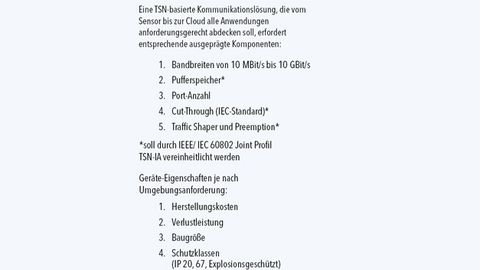
Therefore, these network transitions with their manual configuration requirements should be eliminated in IIoT and enable the simple and reconfigurable networking mentioned above. Ethernet TSN is a solution for this, as its protocols can be used consistently and convergently in a network. Due to the described characteristics of components for Ethernet TSN (bandwidths, buffer memory, number of ports, cut-through, traffic shaper and pre-emption) and a free choice of topology (line, star, ring), TSN can be adapted very well to the requirements. As the individual data streams must be explicitly configured with TSN and the TSN components can have different capabilities, configuration and planning become more complex.
The network part of the twin
The interoperable exchange of information between the life cycle phases of machines and systems that can be interpreted automatically is generally considered to have great potential for increasing efficiency and flexibility. Data and models, such as CAD and simulation models, configurations for machines or optimization of resource consumption, are already being generated throughout the life cycle. However, these are available in different data formats with different data structures and in different tools. In the future, a digital twin should enable a holistic view of products and production systems throughout their life cycle. In the it's OWL lighthouse project 'Technical Infrastructure for Digital Twins', such systems are being developed and tested under the coordination of Fraunhofer IOSB-INA.

Network technology is part of a production system. Therefore, support during the planning phase of an Ethernet TSN network not only forms the basis for network management over the entire life cycle, but is also part of the digital twin. The (Ethernet TSN-based) network part of a machine's digital twin consists of three basic components: a model of the communication requirements, a model of the physical network and a model of the Ethernet TSN configuration including the scheduler that is to be used at runtime.
The application consists of the machine control program and the distributed components, such as drives, units and IO stations. The data exchange between the devices (end points) required for the function is also of particular interest. The necessary data exchange includes the amount of data to be transmitted, the cycle time/update time - with which the data is updated - as well as the requirements for transmission delay, synchronization with the application and bumpless media redundancy.

The digital twin of a machine also includes the Ethernet TSN network including scheduler.
© Fraunhofer IOSB-INAIn order to reliably and precisely determine in the planning phase whether the resources of a TSN network are sufficient, the same scheduler that is to be used later in the real system is also required here. If this is not available or if other parts of the digital twin of the Ethernet TSN network are incomplete, more resources can also be planned (over provisioning): for example, higher bandwidths and more switches in order to be able to adapt the topology. This results in correspondingly higher acquisition costs. In addition, it is not possible to use components that are not designed with the high resources due to their size and power loss (e.g. gigabit interfaces). The precision of the models available at the time of planning therefore determines how precisely the components can be selected.
The device properties can be taken from digital data sheets or device description files (eCl@ss, GSDML) during the planning phase (offline) or read in via the network during the commissioning or reconfiguration phase (online) (SNMP MIB, YANG, OPC UA information model). The network topology must be planned manually during the planning phase.
The tools
Network planning tools are already familiar from automation technology manufacturers. For example, Profinet IRT, which is related to Ethernet TSN, can be planned offline with all device details and the corresponding scheduler, including the guarantee that the network will function in exactly the same way online. However, as the Profinet IRT mechanisms do not provide for bumpless reconfiguration, active online network management with plug-and-play services during commissioning, operation or reconfiguration is not necessary and therefore cannot be compared with the use of digital network modeling with a digital twin.
Fraunhofer IOSB-INA is working on the implementation of a central network management environment for time-sensitive and secure networks in the BMBF project FlexSi-Pro (flexibility and security in the production plant of the future). The project is part of the BMBF's 5G Industrial Internet Initiative. The implementation of the digital twin of the physical network (device modeling) is carried out here as an OPC UA information model. The individual devices use an OPC UA server that enables online access to the digital twins (life cycle phases: commissioning, operation, reconfiguration). The open source SDN controller Open Dayligth is used as the basis for a network management environment. This was initially extended with a plug-and-play configuration mechanism for device addresses and routes. In this implementation, the bridges are configured using the OpenFlow protocol. This solution therefore does not yet contain any time-sensitive protocols. In the next step, Ethernet TSN scheduling procedures designed at Fraunhofer IOSB-INA are to be integrated with the aim of making them as easy to use as possible and enabling access to Ethernet TSN scheduled traffic.
The development and use of digital twins for network management is therefore in full swing. However, there is no standardized implementation to date. The IEEE is currently working on YANG models for the representation of TSN functions, for example P802.1Qcw - YANG Data Models for Scheduled Traffic, Frame Preemption, and Per-Stream Filtering and Policing. In the IEC/IEEE 60802 Joint TSN-Industrial Profile, the Digital Twin is included as Use Case 34 with the requirements for 'Reliable planning, development, testing, simulation and optimization'.
At Fraunhofer IOSB-INA, the interoperable embedding of network management models in the digital twins of machines and systems is being considered in the it's OWL lighthouse project 'Technical Infrastructure for Digital Twins', among others.
Authors:
Prof. Dr. Jürgen Jasperneite is head of Fraunhofer IOSB-INA in Lemgo, board member of the Institute for Industrial Information Technology (inIT) and Professor of Computer Networks at the Ostwestfalen-Lippe University of Applied Sciences;
Sebastian Schriegel heads the Industrial Communication Systems and IoT working group at Fraunhofer IOSB-INA in Lemgo.


You might also be interested in
Wago gears up for Time Sensitive Networking (TSN)
In the future, Ethernet TSN will enable continuous communication in machine and plant engineering without gateways and interruptions. Wago is launching two new automation systems on the market for the SPS, with which users can take advantage of all...
 read more...
Arrive in reality!
Time Sensitive Networking has firmly established itself in the vocabulary of the automation industry. All well-known suppliers have started activities to evaluate or even introduce TSN. But where exactly are the goals for the use of TSN and what is...
read more...OPC UA and DDS combined
To date, OPC UA and DDS have often been presented as competitors. Competitors that will both be based on the Ethernet standard TSN. - However, the key to successful automation in the future lies in a combination of the three standards DDS, OPC UA...
read more...The interaction of Ethernet TSN, OPC UA and 5G
Only the reliable and structured interaction of all units in an ant colony ensures its survival. Data communication in a modern industrial network works no differently in a figurative sense.
read more...Where there are still problems with 5G
5G in automation - a hot topic at the moment. How quickly can we actually expect 5G to be used in industry? What obstacles still need to be overcome? Thomas Schildknecht summarizes the key points in this interview.
read more...Data pipeline ASi-5
High data width, short cycle times, improved integration of intelligent sensors and actuators using IO-Link and cloud connectivity via OPC UA - ASi-5 makes AS-Interface fit for the requirements of digitalization.
read more...OPC UA - a must for the industry (Part 2)
OPC UA is regarded as the new communication standard for industrial automation. Part 1 explained why a new communication technology is needed in automation and described the OPC UA methods. Part 2 deals with the OPC UA pub/sub methods and the power...
read more...OPC UA, MQTT and co.
The Industrial Internet of Things (IIoT) covers very different areas of application. The available connectivity technologies and standards are just as diverse as the application areas. How can the right technology be filtered out in each case?
read more...The question of licenses
Will OPC UA in combination with TSN become 'the' standard for industrial communication? What role do licenses play in this question and what part does OSADL play?
read more...