
5th Industry
Focus on the employee
Digitalization in production has been a hotly debated topic for years. And yet, despite the fourth industrial revolution, digitalization is still non-existent in many places.

The concept of Industry 4.0 - the fourth industrial revolution - was introduced ten years ago with key promises aimed particularly at the manufacturing industry. At its core, it stands for the intelligent networking of machines and processes in industry with the help of information and communication technologies. This should create new opportunities: Flexible and better planned production, the changeable factory with modular production systems, bringing consumers and producers closer together, optimized logistics, the use of data for new business models and a resource-conserving circular economy.
Focus on process or people?
However, there is a central problem at the heart of the implementation of Industry 4.0: production and its digital landscape are conceived from the perspective of technology, from the process - and not from the perspective of people. This continues to result in rigid technical landscapes that do not meet people's needs, or do so only inadequately. The consequences are complex: from a lack of innovation speed and increasing change fatigue to the frustration of employees and managers with the status quo and the development of fears and aversions to future technologies - often noticeable in the example of AI.
No wonder, when you consider how IT projects in production are often structured: Long requirements analyses and specification phases - often only manageable with external consultant support. Lengthy steering groups and steering committees with lots of slides. Followed by lengthy development and complex training processes. In the end, the result is monolithic software and future users shake their heads. Changes are costly and very time-consuming. The result: operational units try to avoid such projects and if it is unavoidable, at least the requirements have to be right - because on average, new software is in use for around ten years. This is a cycle that is as understandable as it is harmful: after all, standing still is poison for continuous improvement, and highly efficient factories thrive on this in particular.
Putting the focus on people
Some companies show very impressively that this can be done differently: employees who are actively involved in the further development of their digital working environment, in an adaptable and modular IT landscape. In a culture that is characterized by trust and personal responsibility. These are precisely the companies where new technologies such as machine learning and artificial intelligence are being used on the basis of employee initiatives - and where digitalization is enabling the next quantum leaps in efficiency and productivity. Such companies are rightly regarded by employees and customers as "digital leaders".
The decisive factor is that a paradigm shift is needed. Working methods, technology and culture must be considered together to ensure that the digital transformation actually succeeds. Factories and their processes must be thought of as a versatile socio-technical ecosystem. Adaptability is a key design criterion. The focus is on people.
The following technical, organizational and cultural aspects characterize working in a more employee-friendly industry:
The cloud as the backbone
The cloud forms the backbone of the human-centered digital ecosystem. In a flexible and dynamic infrastructure, solutions for the challenges of daily work are created step by step. As the backbone, the cloud brings together data from different systems, i.e. data from ERP and MES systems. However, this can also be the local or central databases that have grown over time in many plants and that map the functionalities of individual processes. From tool life information to measurement data from coordinate measuring machines. The cloud consolidates all data and makes it centrally available so that it can be accessed efficiently and securely at any time and from anywhere. For every user who needs the data. The consistent rejection of data silos whose data can only be accessed by third-party systems with great effort. This results in a certain data democracy.
Trust in digital expertise
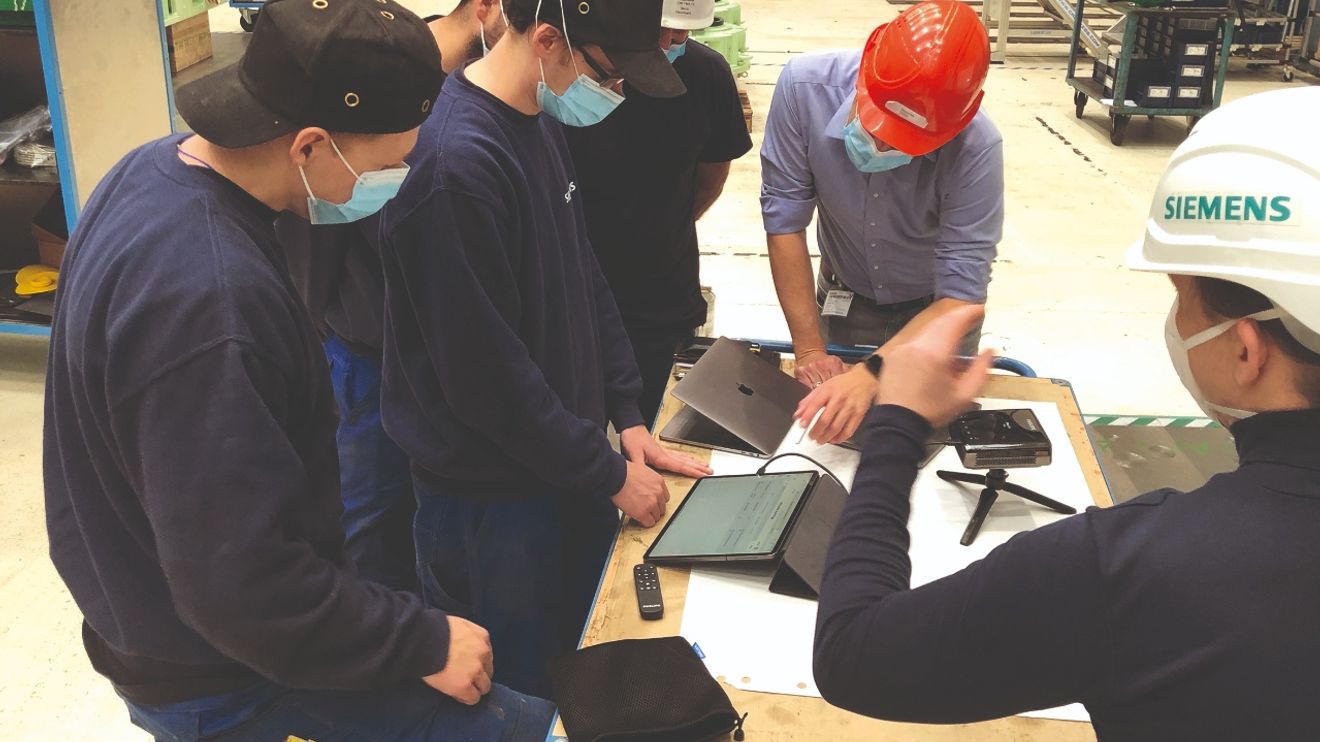
"Try things out, get into action quickly." - An aspect that is extremely important for successful change processes. Because the dynamics of change make development fun, make change tangible and create a desire for more. This also includes the use of rapid prototyping technologies, such as the short-cycle development of mock-ups directly together with the future users of an application. In this way, clickable application interfaces can be created, iteratively developed and interactively optimized within just a few days. Working in this way also means a new dimension of fault tolerance. This is because it is possible to replace yesterday's solution with something better. Requirements change, processes change and people learn. The modular design of the digital landscape, also known as "composable IT architecture", makes it possible to add new functions just as easily as deliberately switching off a function that is no longer required or an obsolete function module.
Using software-as-a-service
Factories should concentrate on what they do particularly well: Producing. The development, operation and continuous further development of modular IT applications can be better handled by specialized suppliers and, thanks to scalable business models, generally also significantly more cost-effective. Purchasing software as a service, only paying for what is actually used and being able to change providers without major transformation projects: This paradigm forms the basis for adaptability and cost efficiency.
Launch of the adaptable digital ecosystem
Getting started in the adaptable digital ecosystem does not have to be difficult or costly. After all, change processes also need to be rethought. A concrete start can be made with an orientation meeting. What is the vision for the digitalization of a plant? What successes have already been achieved? What are the biggest pains of the operating units? Is there a digitalization roadmap? Many plants already have very specific plans in place.
If not, the first step is to jointly develop a vision and prioritize the fields of action. A structured workshop format has been established for this purpose, which is successful both as a face-to-face event and purely virtually: Managers and experts from the operational areas come together in an interdisciplinary setup - from production, quality assurance, logistics and IT. Together with experts, the current status and a desired target status can be determined based on typical fields of action. Prioritization and the formulation of concrete project descriptions as one-pagers are carried out on this basis. After two half days, the participants know very clearly where they stand and which goals they will tackle next.
The practical application
As a rule, the first benefits can be realized directly with the implementation of an available app from the Manufacturing Excellence Cloud. The experts consistently rely on a small-step approach: The company-wide roll-out should therefore deliberately not be planned immediately. Significantly better experiences can be recognized in the application in pilot areas. The most suitable teams are those with a high level of suffering on the one hand and an openness to digital solutions on the other. Once they have been won over as pilot users, a roll-out and adoption by other areas can take place without much effort.

If the required application is not available or configurable, the next step is a co-creation process. Involving the end users is crucial for this. Together with the users, a common understanding of the requirements for a solution is developed in short-cycle sprints in accordance with design thinking. And this is done without extensive documentation and lengthy meetings. We start directly with a rapid prototyping process in which the individual modules of an application are developed as mockups by the experts together with customer representatives and iteratively optimized. The end result is a prototype that is accepted by all participants. This represents the complete user experience, but does not yet have any technical functionalities. The next step is implementation up to the minimum viable product (MVP). A modular approach is also advisable for app development. This allows a feature to be tested in practice and further developed on the basis of real user experience, thus enabling evolutionary optimization.


You might also be interested in
followed up! With Prof. Rahman Jamal
10 years of Industry 4.0 - and now?
The future-oriented Industry 4.0 project was officially launched at Hannover Messe 2011. What has already been achieved after ten years? What should the next important steps be? Prof. Rahman Jamal has witnessed the entire development and sums it up.
 read more...
Smooth human-machine interaction
Machines and systems have many different functions. This complexity must be mastered. User-friendly visualization is crucial here.
read more...Individual employee training 4.0
Vizendo uses the digital training environment from Siemens to train automotive employees on new models long before the first prototype is produced. This accelerates the time-to-market after product and process changes.
read more...Embedded community votes for favorites
In addition to the coveted 'embedded award', the 'community choice award' will also be presented for the first time at embedded world. The special feature: The award winner is determined by the embedded community.
read more...Preview on embedded world 2024
Inference can be as Compute Intensive as the Training
With CPUs, GPUs and FPGAs, AMD has all architectures that are used for AI. embedded world Keynote Speaker Dr. Salil Raje shares his view on AI.
read more...International meeting places for the embedded community
From April 9 to 11, the embedded industry will meet in Nuremberg - but not only there, because embedded world will also take place in China and the USA in 2024. How did it go in China? What can we expect in Nuremberg? And a look ahead to the 1st...
read more...In focus: Artificial intelligence
The e-paper of the January 2024 issue
ChatGPT has given artificial intelligence a huge boost over the past year - especially in terms of public perception. In this issue, we want to take a closer look at AI and categorize it in more detail for potential industrial users.
read more...AI boosts the performance of software engineers
New "superpower" for software developers: An AI-supported programming assistant is set to revolutionize the development landscape.
read more...ERP trend forecast for 2024
Unit4 forecasts the most important ERP trends for the year 2024. Claus Jepsen, Chief Product and Technology Officer, names nine points that he considers relevant.
read more...