
Bitkom on International Women's Day
Lack of women, lost opportunities: IT professions still in the hands of men
Whether programming, cloud architecture or AI development - IT and digital professions are still a male domain. The proportion of women is vanishingly low and, from the perspective of the German economy, this jeopardizes the country's innovative strength and competitiveness.
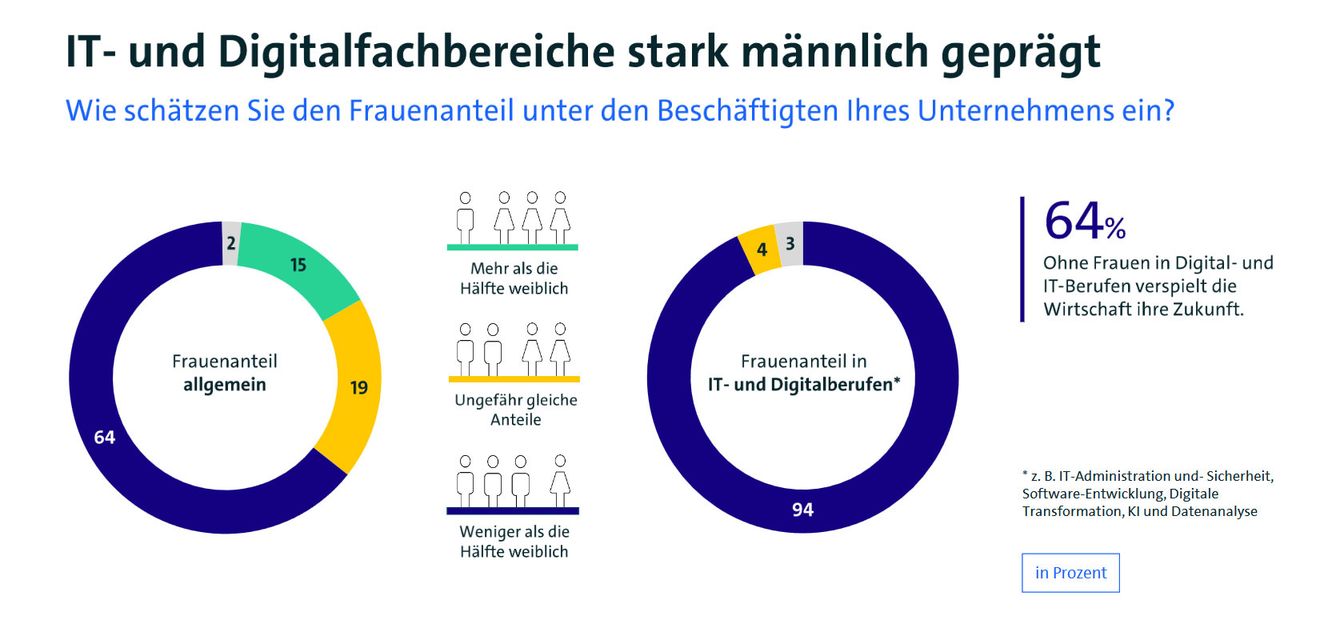
From AI experts and programmers to cloud architects - women are still severely underrepresented in IT and digital professions. From the point of view of the German economy, changing this is also a question of competitiveness: almost two thirds, 64%, of German companies say that without women in digital and IT professions, the German economy is gambling away its future. 59 percent see the German economy as one of the international laggards when it comes to the proportion of women in digital and IT professions, while 23 percent even say that the German economy has missed the boat. In contrast, 15 percent see the German economy as a pioneer and only 1 percent as a leader. These are the results of a study conducted by the digital association Bitkom on the occasion of International Women's Day on March 8, for which more than 600 representative companies from all sectors were surveyed.
When it comes to the general proportion of women in the workforce of German companies, women make up less than half of the workforce in 64% of companies. 19 percent have roughly equal proportions of women and men in the workforce. 15 percent more women than men. Looking specifically at the IT departments within companies, in 94 percent of German companies less than half of IT and digital positions are held by women. In a further 4 percent, the gender ratio in these professions is roughly equal.
"Women bring new perspectives and different experiences to companies. This diversity not only strengthens technological innovation and competitiveness," says Bitkom CEO Dr. Bernhard Rohleder.
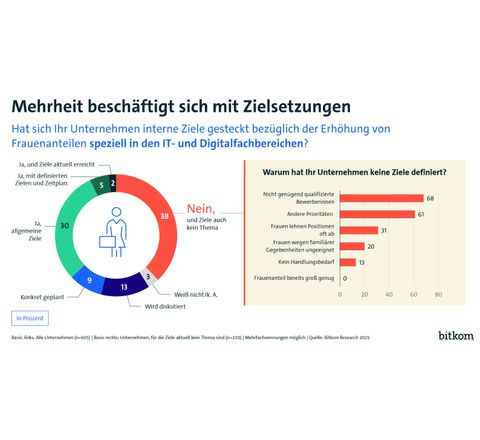
However, it is not clear that the economy wants more women in these areas and is doing something about it: 37% of companies have set internal targets to increase the proportion of women in IT and digital professions in particular. In contrast, 38 percent of companies have no targets in this regard. Most of these companies cite not having enough qualified female applicants (68%) or other priorities (61%) as reasons for not having set any targets to date. Rohleder: "Good intentions are often not enough, only clearly defined goals and responsibilities ensure movement. Companies need to take a strategic approach to recruiting women if they want to be future-proof and resilient."
Hurdles in the companies
There are many reasons why the proportion of women in IT and digital professions is not higher: 59% of companies see barriers to re-entry as a reason, such as a lack of further training during parental leave, 53% traditional role models in companies, 52% a lack of networks for women. At the same time, half (50 percent) also say that a male-dominated culture in IT and digital professions puts women off.

For example, while more than two thirds (69%) of companies say that IT and digital professions need to become more attractive for women, 39% also believe that men are generally better suited to IT and digital professions. "Anyone who subscribes to such misconceptions should not be surprised by the shortage of skilled workers. Digitalization and IT know no gender," says Rohleder. "Women should not be held back by stereotypes, but should consciously take advantage of the career opportunities in these future-oriented professions."
Encouraging curiosity about technology
However, reasons for the low proportion are also attributed to politics and women themselves. Half (50 percent) see insufficient qualification of female applicants as a reason, 46 percent believe it is due to the poorer self-marketing of women. In addition, 55 percent of companies see the lack of support infrastructure as a reason for the low proportion of women in IT and digital professions.
52 percent observe barriers to lateral entry, for example, employment agencies are less likely to recommend IT-specific training to women. Almost every second company (46%) cites clichéd training or career guidance at schools as a reason. Rohleder: "In addition to the parental home, schools and universities play an important role in later career choices. This makes it all the more important to encourage girls' and young women's curiosity about technology and digitalization there."
Initiative #SheTransformsIT
Bitkom and other partners are involved in the #SheTransformsIT initiative to inspire women to pursue careers in the digital economy and to support politicians and companies in better promoting female specialists and managers. This interdisciplinary alliance of business, science, politics and civil society is committed to empowering girls and women in the digital world.
Methodological note: The data is based on a survey conducted by Bitkom Research on behalf of the digital association Bitkom. This involved a telephone survey of 605 companies with 20 or more employees in Germany. The overall survey is representative. The interviews were conducted with management, decision-makers and HR managers. The survey took place in the period from week 51 2024 to week 6 2025.


You might also be interested in
Labor market and infrastructure
Lack of engineers jeopardizes infrastructure projects worldwide
According to a study, 73% of employers worldwide cannot find enough qualified engineers. Infrastructure, energy and semiconductor projects are particularly affected. In Europe, demographic developments are exacerbating the situation.
 read more...
AI in the year 2026: Innovation meets pragmatism
AI is evolving from technology hype to an efficiency booster. According to IFS, practical criteria such as productivity, security and measurable results will come to the fore in 2026. This will increase the pressure on companies to productively...
read more...Study on the working world of tomorrow
Merging technical skills and soft skills
AI is profoundly changing jobs, but at the same time it is making human skills indispensable. The new Skills Economy Report 2026 from SkyHive by Cornerstone shows that roles in the future will require both technical skills and soft skills.
read more...SEW-Eurodrive opens training center
"DriveEducation" as an investment in the skilled workers of tomorrow
SEW-EURODRIVE opens "DriveEducation" training center. SEW-EURODRIVE is thus investing over 30 million euros in the specialists of tomorrow. The new training center in Graben-Neudorf combines the promotion of young talent, training and further...
read more...Change is not a technology project
Every structural and strategic change in companies also affects the corporate culture. Without taking this into account, the desired success is rarely achieved. A reorganization is therefore much more than a technical restructuring: it is a profound...
read more...Find your dream employer - without applying
For every ten vacancies in Germany, only three are currently filled via job advertisements and seven via the so-called hidden job market or networks. But what is the hidden job market and how can it be used?
read more...Facereading as a success factor?
Why are some people able to connect with others effortlessly, while others encounter resistance? Why is communication easy for some and so much harder for others? One key lies in the ability to read people correctly - keyword: facereading. In this...
read more...Lutz-Jesco on International Women's Day
"The technology sector needs more female engineers"
The list of beliefs that make it difficult for many women with a passion for technology to enter the male-dominated technology sector is long. Yet the reality is usually much more progressive, says a female engineer from Lutz-Jesco.
read more...Majority want Technology from Europe
A large majority in Germany would like more digital independence. According to the Bitkom survey, 99% consider more sovereignty to be important, while at the same time many feel that switching to European providers is too time-consuming.
read more...