
Power supplies
The underestimated risk
Voltage dips and fluctuations cannot be avoided even in modern energy supply networks. However, they are often underestimated as a risk for industrial production processes - even disruptions lasting just 20 ms can cause production problems.
The German Energy and Power Industry Association (VIK) reported back in 2012 that 72% of supply disruptions are shorter than one second. They are caused by short circuits in the distribution grid, lightning strikes, power plants being switched on or off or volatile energy generators such as wind and solar parks, among other things. According to a study by the Bavarian Chamber of Industry and Commerce, companies are reporting an increase in operational disruptions - with new systems tending to be affected more frequently than older ones. The cause is often to be found in the increasing sensitivity of the control electronics. This is because voltage dips, voltage fluctuations and frequency deviations are highly problematic for sensitive electronic devices.
This means that even brief voltage dips can lead to an immediate reaction chain in the energy distribution grid: The utility company's circuit breakers trip - the typical response time is between 100 and 150 ms - and local events spread throughout the widely meshed supply grid. In the event of voltage dips, sensors often detect incorrect values and frequency converters can trip.
Such instabilities in the supply voltage jeopardize the operational safety of industrial processes because, for example, control units react negatively to short voltage dips of just tenths of a second and cause malfunctions or interruptions in production. Overvoltages and undervoltages can also lead to undesirable fluctuations in system performance - sometimes with serious disadvantages for product quality or the service life of the systems.

Danger due to voltage dips
As a rule of thumb, the more modern a system and the more electronics are installed, the more problematic voltage dips are. With a residual voltage of less than 85 % of the rated mains voltage, major problems must be expected with frequency converters and switching power supplies (IEC 61000 2-8). Commercially available contactors switch to an undefined state at a residual voltage of less than 80 %, even if the voltage dip only lasts one mains period (20 ms). Even with robust loads such as asynchronous motors, faults occur if the voltage drops below 75% of the rated voltage over several mains periods.

... of the limit values (blue/red line) and lead to machine failure (below the red line).
© Eisenmann/RuhstratVoltage fluctuations generally pose a risk to all high-tech production lines and almost every process in which the torque and speed of motors have to be kept stable at the same time.
The consequences of a prolonged interruption to production include, above all, downtime costs. These are made up of the restart costs for resetting or restarting machines, logistics problems with extremely coordinated processes, maintenance and repair costs in the event of damage and possible additional costs for rework. According to scientific studies, the amount of costs per break-in varies between a few thousand euros in the case of simple industrial production and rises into the six-figure range for highly sensitive production areas, such as the semiconductor or pharmaceutical industry.
Inadequate protection concepts

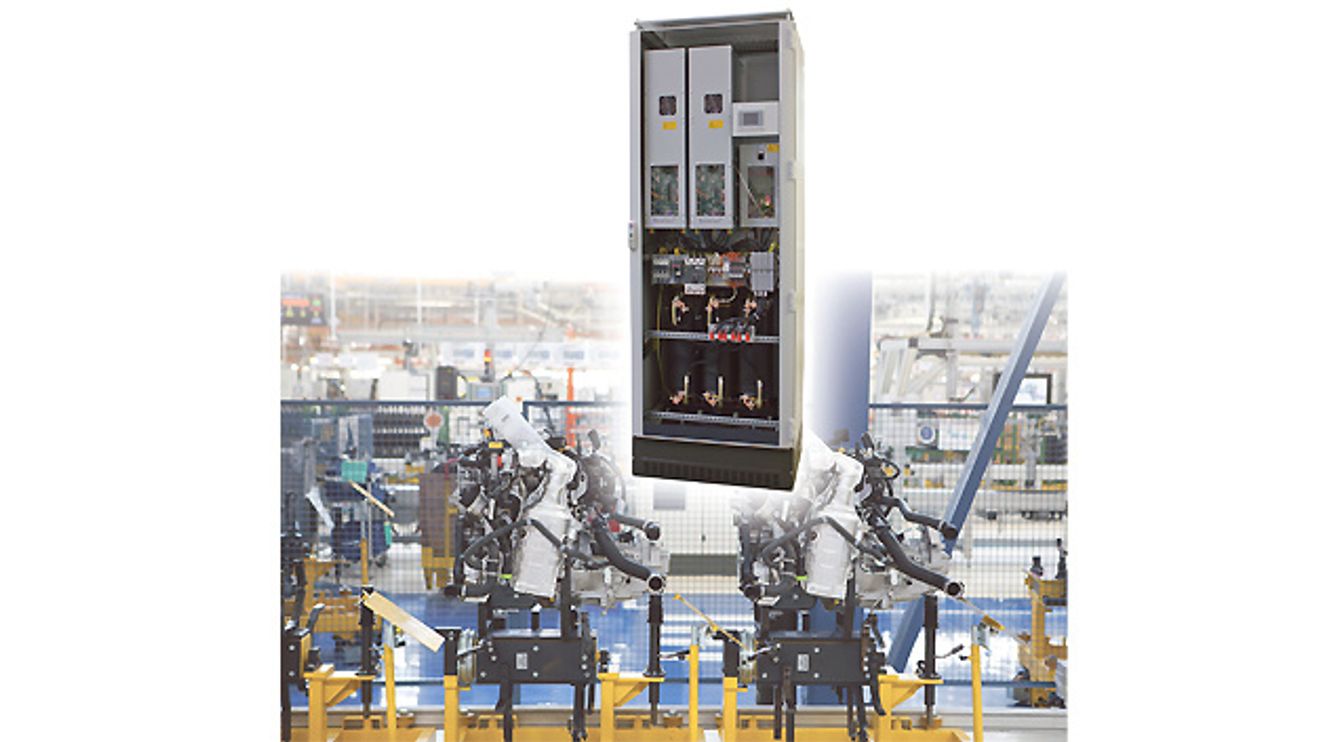
The 'Oliver' protective device can be used to compensate for short-term voltage dips and stabilize permanent voltage fluctuations.
© Eisenmann/RuhstratPrevious protection concepts against voltage fluctuations are less and less able to meet these requirements. They react too slowly or cause excessive costs.
Energy network operators can rely on compliance with the EN 50160 standard. It defines that voltage differences of ±10 % UN must only be maintained for the 10-minute average value. This means that short-term voltage dips >10% are not objectionable - although they pose a considerable risk to industrial systems.
Eisenmann Thermal Solutions/ Ruhstrat is pursuing a new approach with the 'Oliver' (Online Voltage Regulation) system for voltage optimization for the operational safety of industrial systems. This system protects against an unstable mains supply by acting like an online system. Voltage deviations are corrected in real time (<1 ms). The system is easier to integrate into the industrial environment than a UPS system, for example: To protect sensitive loads, 'Oliver' is connected in series between the supply transformer and the load. A transformer developed by Ruhstrat (Uk ≤2 %) ensures that the mains short-circuit power is hardly changed and existing protective measures such as fuses and circuit breakers can continue to be operated without modification.
Reliable 400 V
Oliver' keeps the mains voltage continuously at the setpoint value. The system reacts to deviations from the setpoint voltage within 140 µs and regulates the voltage back to the setpoint within ≤10 ms (settling time). This ensures an uninterrupted voltage curve, voltage dips are buffered and voltage increases are absorbed. This not only compensates for short-term voltage dips, the protective device also ensures the continuous stabilization of permanent voltage fluctuations. Voltage dips (up to 30 s) of ±30 % and permanent voltage fluctuations of ±10 % are compensated.
Mains short-circuit power is maintained

Measurement results from practice show reliable protection against short-term and permanent voltage dips. The result of the regulated output voltage with 'Oliver' only shows a difference of approx. 0.625 % to the set value (under load).
© Eisenmann/RuhstratOne of the key quality features of a power supply system is the available short-circuit power. The higher the mains short-circuit power in a network section under consideration, the easier it is to correctly dimension fuses and circuit breakers according to selectivity criteria. Motors start up more reliably in networks with a high short-circuit power. Harmonic currents lead to a smaller voltage distortion the higher the mains short-circuit power. The injection transformer from 'Oliver' has a Uk of approx. 2 %, which, in contrast to a UPS system, only leads to a slight reduction in the mains short-circuit power.
The mains short-circuit power is of particular importance in the event of a fault. In the event of a short-circuit in the customer grid or a fault in 'Oliver', it is absolutely essential that the maximum possible grid short-circuit power is produced by bridging the power electronics. To ensure this under all circumstances, the Eisenmann system has a multi-redundant bypass system consisting of a thyristor switch (for fast short-circuit bridging) and contactor (delayed short-circuit bridge for high loads).
Author:
Martin Ortgies is a technology journalist from Hanover.


You might also be interested in
Getting to the bottom of cable asymmetry
Many faults in industrial networks and systems are caused by electromagnetic compatibility (EMC). However, it is often not known exactly what these are - such as interference currents due to asymmetrical supply lines.
 read more...
Innovation Prize 2024 awarded
This year's AMA Innovation Award from the AMA Association for Sensors and Measurement (AMA) honors the development team around Stanislav Aksarin. The prize was awarded at Sensor+Test 2024 in Nuremberg.
read more...Full power of attorney in management
Block Transformatoren-Elektronik has been run by an eight-strong management team for six years. Now all members of the team have been appointed authorized signatories.
read more...IO-Link functionality for Industry 4.0
The 'Omniplus-F' is a versatile thermal flow sensor from GHM Messtechnik that measures the flow velocity, temperature and volume of liquid media in a single device.
read more...Schneider Electric takes over climate protection consultant EcoAct
With the acquisition of EcoAct from Atos, Schneider Electric is further expanding its range of sustainability consulting services.
read more...Installation behind the safety edges
Redur launches the 4R21.3 plug-in cable transformer. The 4R21 small signal converters from the 'Regulus' series are available for primary rated currents from 50 to 500 A and a round conductor dimension of 21 mm.
read more...Problems at Gamesa again and again
Record loss for Siemens Energy
The problems with wind power are causing Siemens Energy record losses. Perhaps too much speed is also to blame, they say. Many answers about the future will now take until November.
read more...Fast-reacting, continuous gas flow monitoring
Innovative Sensor Technology IST is expanding its product portfolio to include the 'SFS Flow Module', a linearized mass flow module for gases that is implemented ready for use in the application.
read more...The e-paper for the special issue
Sensor & Vision 2023
Intelligent sensor technology always requires smooth interaction with software and surrounding systems. The examples in this e-paper demonstrate what this can look like in individual cases. This shows that team play counts - in sensor technology as...
read more...