
UPS systems
Flywheel versus Li-Ion
High-performance UPS systems require very high discharge currents with short autonomies. Li-ion batteries are an alternative to the flywheel technology introduced on the market. A system comparison.

Various storage technologies are available for UPS systems: In addition to the classic VRLA battery, supercapacitors and flywheel technology have become established. Li-ion batteries, such as those offered by Yuasa, are an alternative to the previously known solutions. The systems are compared below.
Li-ion versus flywheel
The optimum autonomy range of an energy storage system is defined by factors such as price, weight, dimensions, performance and efficiency. The autonomy window of the flywheel is very small at 10 to 60 seconds. The 'LIM25H' from Yuasa also covers this range, but provides up to five minutes of autonomy beyond this. It can also cover autonomies above five minutes, whereby the more cost-effective variant in this range is a VRLA battery. The space requirement criterion is interesting: While a flywheel UPS with 100 kW requires an area of approximately 0.6 m², a UPS system with the Li-ion battery with an output of 300 kW only needs 0.5 m². This means that a significantly higher energy density can be achieved with a Li-ion battery with the same surface area.
When it comes to the power that can be called up by the respective technology, the power potential of the Li-ion solution exceeds the flywheel approach tenfold. In terms of energy efficiency, which describes the losses of the storage technology in standby mode, the Li-ion battery has almost no losses. The flywheel, on the other hand, has a relatively high energy requirement due to the supply of the vacuum system and the support of the magnetic bearing.
In terms of operational reliability, both systems are in a good position. Operational reliability is measured by the availability of the data collected, which provides information on the status of the system at all times. This applies to the Li-ion battery: At module level, sensors and control circuits of the integrated Battery Management System (BMS) monitor the charge status of each individual cell and the entire module. At system level, a higher-level master BMS monitors operation and simultaneously controls the molded case circuit breaker (MCCB) integrated in the cabinet to interrupt the circuit in the event of a conflict.
Maintenance and loading
The maintenance of a Li-ion battery is essentially limited to reading and evaluating the data from the BMS. While flywheels have moving parts that need to be regularly serviced and replaced by specialists, the Li-ion modules have an integrated multi-level BMS that enables the battery to be monitored remotely.
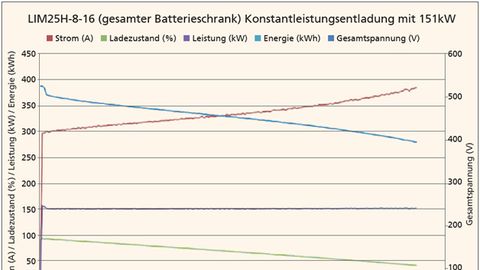
Performance parameters at 151 kW output: Even with a very high constant power draw of 151 kW over 170 seconds, the current and voltage curves of the Li-ion battery are harmonious.
© Yuasa Battery (Europe)As far as the charging aspect is concerned, the time that the storage medium requires for recharging must be set in relation to the capacity removed. Due to the special technology, a flywheel reaches full capacity again within a few minutes. Depending on the depth of discharge, the Li-ion battery requires a few minutes to a few hours to restore 100% of its capacity.
In principle, the number of charge/discharge cycles that a storage medium provides depends initially on the depth of discharge. The more capacity is removed per cycle, the fewer cycles a battery will provide - calculated over the entire service life - and vice versa. In a conventional battery, this process is accompanied by an electrochemical process that simultaneously limits it. These electrochemical processes and electrochemical corrosion do not take place in the flywheel. For this reason, the flywheel is the uncrowned king of the cycle.
But: Cycling is irrelevant in UPS applications, as the battery is not constantly charged and discharged in normal UPS operation, but is only used when the power actually fails. The capacity then removed is negligible in terms of a cycle.
Comparison with other solutions
Yuasa's Li-ion solution is also ahead of other storage media in terms of weight, volume and cost. It requires only a tenth of the weight of a VRLA battery and a third of the weight of a corresponding supercapacitor to achieve an autonomy of 30 seconds. The LIM25H builds on this weight advantage with higher autonomies: From an autonomy of 30 seconds, the solution already achieves a significant volume advantage over a supercapacitor. If only the costs of the lithium-ion battery and supercapacitor storage media are considered, the cost situation is similar at around 30 seconds of autonomy. The VRLA battery appears to have the better cost-benefit ratio with increasing autonomy. Taking into account the high space rents, the use of air conditioning and ventilation technology and the restrictions regarding building statics, the Li-ion solution is probably more advantageous in individual cases.
Structure of a Li-ion module

The Li-ion cell 'LIM25H' in a prismatic design in an aluminum housing. The opposing pole arrangement minimizes the risk of short-circuiting the Li-ion cell and facilitates cell connection within the module.
© Yuasa Battery (Europe)The LIM25H Li-ion cell has a prismatic design in an aluminum housing. This cell design enables modules to be assembled more cost-effectively than with any other cell design. In addition, the design enables optimum utilization of the available space within the module, resulting in a higher module energy density than would be the case with cylindrical cells, for example.
The opposing pole arrangement minimizes the risk of short-circuiting the Li-ion battery and facilitates cell connection within the module. While cylindrical cells with both poles on one end face have a high short-circuit risk, cylindrical cells with plus and minus on one end face each require significantly more assembly work. Compared to the pouch cell design, the prismatic construction requires no additional mounting frame and fewer welded connections; the intercell connections are also easier to make. Each Yuasa cell also has an integrated BMS connection. The aluminum housing supports heat dissipation.
Eight Li-ion cells are combined in battery modules with a nominal capacity of 25 Ah and a nominal voltage of 28.8 V. The module, which weighs 17.5 kg, can be charged and discharged with a maximum current of 600 A and achieves 11,000 charge/discharge cycles in cyclic operation. Depending on the discharge power, these data enable extreme charging times of less than 15 minutes and autonomies of a few minutes to several hours.
Use in the battery cabinet

A battery cabinet from Yuasa for UPS systems, equipped with 16 LIM25H-8 modules.
© Yuasa Battery (Europe)As the modules comply with the 19-inch industry standard, they can be installed in corresponding battery cabinets without any adaptation problems. A complete UPS system, for example, is equipped with 16 LIM25H-8 modules and weighs 490 kg as a compact cabinet. The system has an output of 235 kW and can be expanded to 20 modules if required, which corresponds to an output of 290 kW. Depending on the current, the battery can be charged in less than 15 minutes. Integrated interfaces such as RS232C, RS485/Modbus and CAN-Bus2.0b ensure communication between the UPS system and the user's equipment.
Author:
Raphael Eckert is Group Sales Manager at Yuasa Battery (Europe) in Düsseldorf.


You might also be interested in
New products for Logimat 2019
What is currently happening on the market in the areas of material flow and process management? Computer&AUTOMATION has compiled an excerpt of what exhibitors are showing at the Logimat 2019 logistics trade fair in Stuttgart in a series of...
 read more...
Series comprises eight types
With the FXH series, Yuasa offers valve regulated lead-acid batteries (VRLA) for use in uninterruptible power supplies, including applications in telecommunications and data centers.
read more...New power supply products
In a product picture series, Computer&AUTOMATION presents the latest power supply products - from industrial power supply units to load-break switches.
read more...New products in the area of power supplies
In a product picture series, Computer&AUTOMATION presents the latest power supply products - from desktop power supply units and insulation monitors to explosion-protected power distribution.
read more...Collaboration on Open Energy Standards
Weidmüller Joins the EEBus Initiative
Weidmüller has joined the EEBus Initiative. Together, they aim to further promote the international EEBus communication standard for smart grids and intelligent energy management.
read more...AI Platform Aims to Enable Energy Sharing in Industry
As part of the EU project FlexBit, Fraunhofer IFF is developing an AI-powered platform to optimize energy storage systems and manage industrial energy-sharing systems. The concept is being tested in an Industrial Energy Community in Magdeburg and is...
read more...EMC and radio testing in Germany and worldwide
In a world filled with smartphones, connected cars, medical devices and smart appliances, supporting optimal electromagnetic compatibility (EMC) and wireless performance to minimize interference between electronic products is critical.
read more...Marco Geiser becomes new Vice President Secure Power DACH
Marco Geiser has held the position of Vice President of Secure Power DACH since April 1, 2026. In this role, he will strategically develop the Secure Power business in Germany, Austria and Switzerland, strengthen it operationally and focus it on...
read more...Promoting the use of direct current
Current/OS and the Open Direct Current Alliance (ODCA) have agreed a strategic partnership aimed at accelerating the creation of a coherent and interoperable ecosystem for direct current (DC). A Memorandum of Understanding (MoU) has been signed by...
read more...