
Preventive maintenance
Fault-free power supply
Wear - a sensitive issue, even with correctly executed system installations. In the beverage industry in particular, where the electrical insulation is constantly in contact with cleaning agents, constant monitoring is required.

Reliable production requires a reliable power supply, which in turn needs a well-maintained system. Electrical currents should only flow along the paths intended for them, as the use of unwanted current paths is both undesirable and ultimately dangerous for people and equipment.
Random, occasional measurements of insulation resistance do not provide any information about the availability of a system, but rather only represent a snapshot that can simulate safety. Only when monitoring devices are used that can measure and evaluate insulation conditions during operation and process and signal defined limit values can we speak of real system protection.
Insulation faults - only a matter of time
Even correctly designed system installations are subject to wear and tear - especially in the beverage industry: excessive contact with cleaning agents puts the electrical insulation of the system at particular risk. The range of liquids used to remove labels, caps and contaminants alone extends from relatively harmless water to aggressive cleaning liquids. For electrical insulation, this means an extremely high load; resulting insulation faults are only a matter of time: as all known materials for electrical insulation withstand the aggressive effects of etching and cleaning liquids in the medium term at best, their destruction is unavoidable in the long term. Intelligent and permanent monitoring of the entire system detects impending insulation faults at an early stage. This means that worn insulation can be replaced during service and maintenance work before serious faults occur.
Unearthed versus earthed grid

Unearthed and earthed power supply systems: The overview shows the different types of network.
© BenderThe main circuit provides the energy for supplying the buildings with their lighting systems and drives (e.g. conveyor belts), and the required energy is converted, transported, distributed and switched. The main circuit is designed either as an unearthed system (IT system) or an earthed system (TN-S or TT system).
Particularly in production, the IT system proves to be the better power supply to monitor due to its maximum availability. As no active conductor is directly connected to earth here, only a small residual current, essentially caused by the system leakage capacitance, flows in the event of an insulation fault. The upstream fuse does not respond, the power supply and therefore continued operation remain guaranteed. Immediate information about a possible hazard can be provided by an insulation monitoring device - such as the 'Isometer' from Bender, which enables continuous monitoring of the insulation condition during operation and helps to detect the insulation fault using an insulation fault location system (the company's 'EDS system'). The fault location is reported promptly during operation so that faults can be rectified immediately and shutdowns prevented.
Predictive maintenance
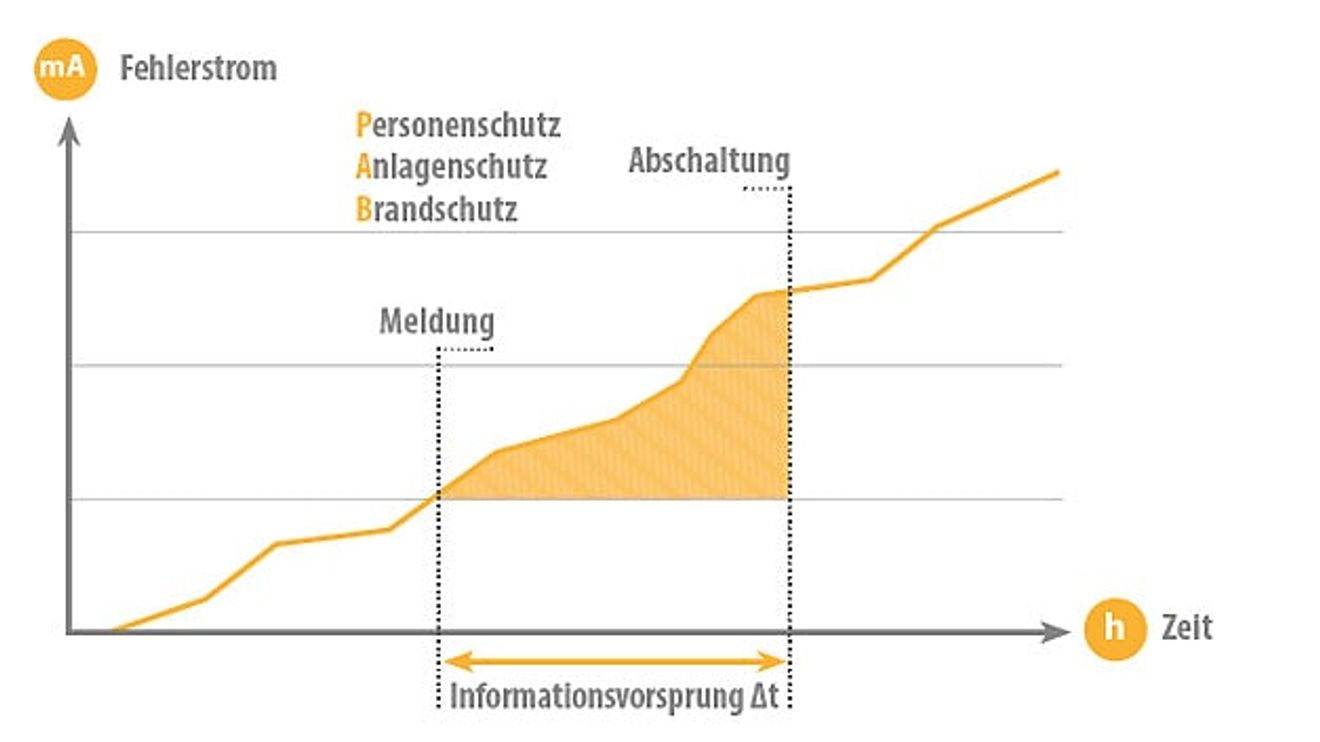
Preventive maintenance through residual current monitoring in the earthed system (TN-S/TT system) and ...
© BenderIf an earthed power supply system (TN-S system) is installed, the solution is permanent residual current monitoring, such as the residual current monitoring devices from Bender. This involves permanently measuring the total or residual current at particularly important or neuralgic points in the network. If the residual or fault current that is critical for this part of the system becomes too high, the monitoring device sends an alarm. System technicians can then react immediately so that shutdowns and system downtimes or even fires caused by insulation faults are a thing of the past.

Getting started with residual current monitoring is possible with little effort if measurement data is tapped at eight to twelve measuring points and thought is given to evaluating and forwarding the information. The space for this can usually be found in existing switch cabinets.
For control and auxiliary circuits in which, for example, commands are issued or measured, opened, locked, signaled, heated or cooled, the operational safety of the system is paramount. The production plant only runs when specific control voltages are applied. In IT systems, insulation monitoring devices provide information about the insulation status of the system. In TN-S systems, residual current monitoring devices measure and display the insulation level. Current values can be read off at any time and impermissible deterioration is reported in good time.
A look at the standard
There are numerous laws, regulations and standards that define the framework for safe system operation. A key aspect of this is the periodic testing of the electrical system. This can largely be carried out during operation (e.g. by visual inspection) - with the exception of the insulation resistance measurement (DIN VDE 0100-600:2008-06 Erection of low-voltage installations - Part 6 Tests: 61.3.3 Insulation resistance of the electrical installation) and the measurement of the earthing resistance; both can only be carried out when the system is switched off.
However, switching off the power supply is often associated with high downtime costs and costly restarting of the systems or is completely impossible, such as in the complex system parts of the beverage industry. However, standards such as DIN VDE 0105-100:2015-10 (Operation of electrical systems) and DGUV Regulation 3 (Electrical systems and equipment, formerly BGV A3) offer two alternatives for the safe operation of systems that must always be available - without having to be switched off:
- permanent monitoring of the insulation resistance in the IT system and
- permanent residual current measurement in the TN-S system.
Permanent monitoring of the insulation level of the electrical system (standard DIN VDE 0105-100:2015-10) allows the electrician to adjust the test intervals for recurring insulation measurement if this procedure is approved by the property insurer. DGUV Regulation 3 also allows the possibility of adjusting the intervals for tests to maintain the proper condition of the system through continuous monitoring.
In the IT system, it is therefore possible to permanently monitor the insulation resistance of the system using an insulation monitoring device. Another option is the residual current monitoring system in the TN-S system, which continuously measures and evaluates the residual currents of the entire system. Deterioration of the insulation resistance is detected and reported. In both cases, it is not necessary to switch off the system for insulation resistance measurement during periodic testing.
Communication variants

All-current sensitive transformers with residual current monitoring systems, such as the RCMS460 and RCMA423 series (from left) from Bender, are ideal for permanent residual current monitoring.
© BenderWith the monitoring systems mentioned above, messages can be communicated centrally in both unearthed and earthed networks - either via TCP/IP protocol to any network-compatible computer or via e-mail or cell phone; operating, warning or fault messages can be sent to almost any location. In this way, early information about the cause and location of faults enables the technology to carry out service calls in a cost-optimized manner and minimize consequential damage to expensive system components or machines.
The web-based software solution 'Powerscout' from Bender also provides further possibilities for predictive maintenance. It provides insight into the complete data of the system, as all measured values are automatically and continuously saved. The tool creates easy-to-understand visualizations, records data across all locations and simultaneously supports the analysis of device data. It thus documents the condition of the electrical system. With such a well-founded database, trends can be displayed in order to identify faults and correlations at an early stage and eliminate the causes. The software tool also creates and saves the residual current test logs. This automated report forms the basis for measuring without switching off in accordance with DGUV Regulation 3.
Authors:
Hans-Joachim Feigl was Sales Manager Germany at Bender in Grünberg and is now retired;
Marita Schwarz-Bierbach is responsible for press relations and customer communication at Bender in Grünberg.


You might also be interested in
Systematic monitoring of network quality
Non-linear equipment such as frequency converters, switching power supplies, UPS systems or electronic ballasts are often the cause of mains faults in power supply networks. What means can be used to systematically monitor the power quality?
 read more...
News from the Software & IT sector
Software & IT is also becoming increasingly essential for manufacturing. As a result, numerous products with this focus are coming onto the market - as the following series of images shows:
read more...The latest products
Collecting and analyzing data: These are the basic requirements for condition monitoring and predictive maintenance solutions. Computer&AUTOMATION presents new products from these areas.
read more...Insights into the electrical installation
Bender will be presenting the web-based Powerscout software and residual current monitoring in a live demonstration.
read more...New products in Nuremberg
What new products will exhibitors be presenting at SPS IPC Drives 2017? Computer&AUTOMATION provides an overview of what can be seen in the Nuremberg exhibition halls this year.
read more...Unearthed versus earthed
Compared to the TN or TT system - the "earthed system" - the IT system as an "unearthed system" is a rarely used form of network in terms of power supply. However, its advantages cannot be denied. A plea.
read more...Seminar: The unearthed system
The IT system as an "unearthed system" is a little-known form of grid in the power supply sector. An expert seminar at Bender's new building in Grünberg, Hesse, provides information about its advantages.
read more...Efficient and safe troubleshooting
Localizing insulation faults can be time-consuming and costly in power supply systems with a large number of branches. Equipment for insulation fault location, such as that offered by Bender with the 'Isometer iso685D-P', helps to solve this problem.
read more...New management at Bender in Grünberg
On April 1, 2017, Markus Schyboll (46) took over as the new CEO of the Bender Group in Grünberg. He succeeds Dr. Dirk Pieler in this role.
read more...