
Temperature control
Dosing energy with pinpoint accuracy
In highly sensitive industrial applications, two-point control is often still the order of the day for temperature control. An alternative are power controllers, which are much more precise.
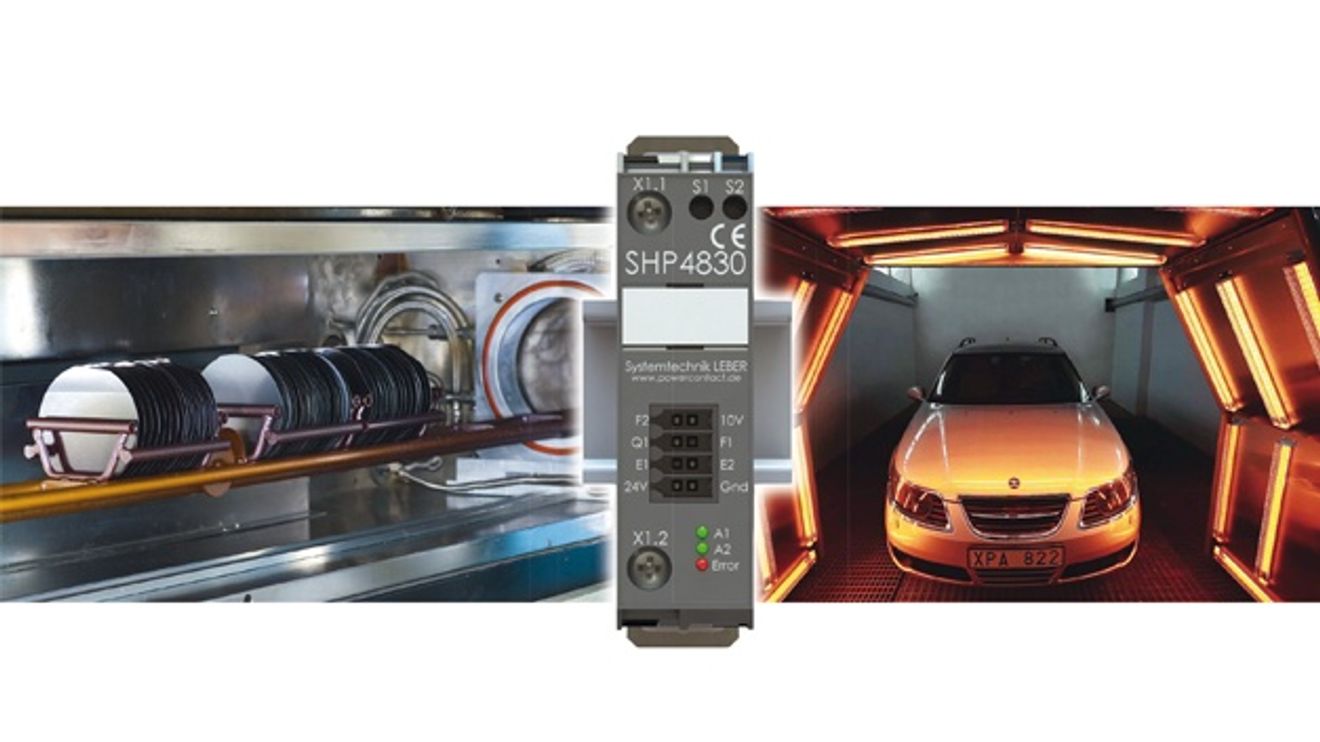
The number of industrial applications in which precise temperature control is of crucial importance is large - for example in the thermal processing of metallic materials, plastics and foodstuffs, in paint drying stations in the automotive industry, in drying systems in the paper or printing industry or in extrusion and blowing systems in the plastics industry. Traditionally, two-point controllers are often used here as the simplest and most cost-effective method of temperature control. However, two-point control is also the least accurate. The principle of two-point control is simply 'on' or 'off'. This means that the power and therefore the temperature is either 100% present or not present at all. This is not ideal for highly sensitive materials, as there is a hysteresis between the two switching points, i.e. the time it takes for the heating element to cool down or heat up before it switches on or off again. In sensitive processes and in the laboratory environment, such 'unsteady' control can lead to unsatisfactory results due to its inaccuracy or is simply not applicable. Power or thyristor controllers, which only provide the power and therefore the temperature that is actually required, are suitable here instead.
A specific application illustrates the problem: several tunnel kilns are used in the production of wafers for photovoltaic modules. The wafers are produced from polycrystalline silicon blocks from which they are cut. This means that the production process starts with a block that is sawn into thin slices. After further production steps, the solar cells are metallized by short-wave IR emitters in several infrared zones. The wafer thus passes through several temperature zones. The final step is a controlled cooling process. Such precise temperature control requires a correspondingly sophisticated technological approach - a simple two-point controller reaches its limits here, as the hysteresis and the resulting temperature fluctuation would have negative consequences for the efficiency of the solar modules.
Power controller instead of two-position controller
Ideally, the power controller should be matched to both the processes and the heating element in use, as these differ in terms of their properties.
Simple heating elements are frequently used, which are wrapped around a workpiece such as a plastic mold or a stamp using ceramic insulators or are immersed directly in a medium - for example oil or granulate - as an insulated rod. This type takes a long time to heat the workpiece or medium and is therefore only suitable for thermally inert processes.
Ceramic heaters reach the target temperature more quickly and emit long-wave infrared radiation.
Infrared halogen and NIR emitters are best suited for thermal processes as they heat up very quickly.
Thyristor controllers also differ in terms of their type of control:
- ON/OFF: Similar to solid state relays, the load is switched here. The thyristor controller also performs mains synchronization, which means that it switches ON at the zero crossing of the voltage and OFF at the zero crossing of the current.
- With pulse width modulation, the power is determined by the ratio of duty cycle to pause duration during a fixed period.
- Pulse packet control or pulse group operation ensures the targeted switching of individual full waves of the network with the aim of avoiding long ON or OFF phases.
- Power control in the form of a sine wave controller regulates the amplitude. This is the most technically demanding type of control and also the most expensive and therefore not suitable for most applications.
- Finally, with phase control, each individual half-wave of the mains voltage is cut directly. The controller therefore cuts pre-selected segments out of the sine wave so that only the remaining voltage/time area is provided as power. The current flows from the ignition point to the next zero crossing, at which point the thyristor automatically goes out again. This is the most precise and fastest type of AC control.
All-in-one models
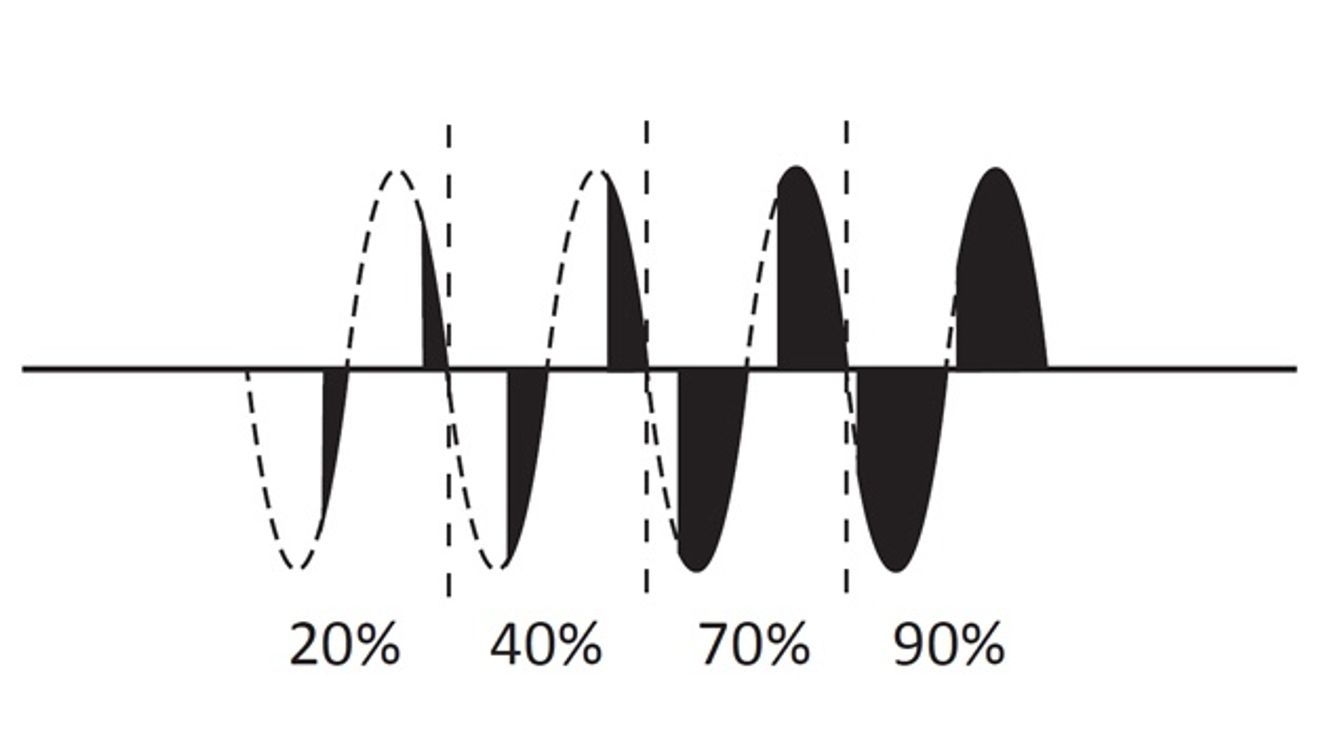
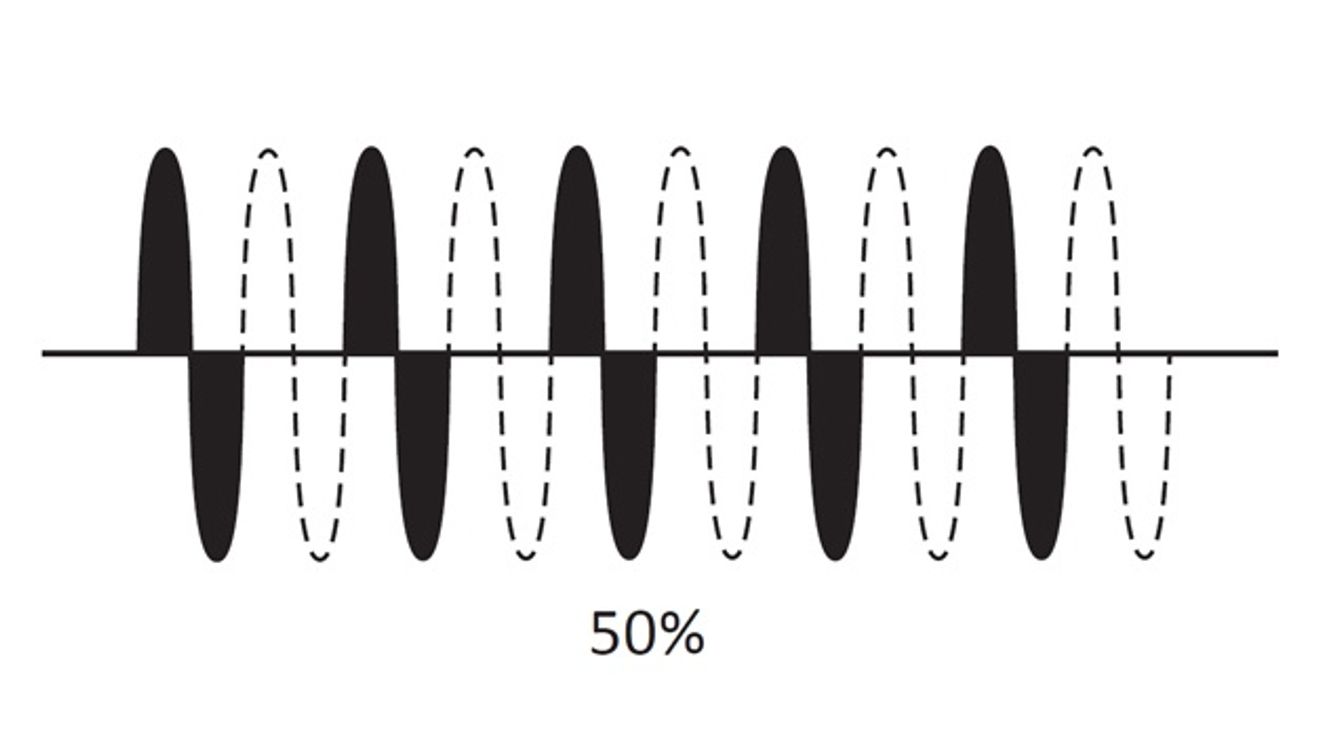
Pulse packet control: Complete sine waves of the mains voltage are switched through or blocked.
© System technology LeberMany of the thyristor controllers on the market now offer an average of two of these functions in combination, for example phase control, pulse width modulation, pulse packet control, soft start, load monitoring, wire break detection, power failure detection, zero switching and bus control.
However, as processes and systems become increasingly complex, and therefore precise control is becoming more and more important, the functions of these controllers are often not sufficient. If additional functions are required, these must be retrofitted in the form of additional modules. In addition to money, these cost additional space in the control cabinet. The additional modules often require even more space in the control cabinet than the actual thyristor controller. For example, up to 100 thyristor controllers are now used to control the temperature of halogen or infrared radiators in a painting line in the automotive industry. In the area of bonding point attachment in dashboard production, there are up to 60, as the number of so-called holding points for airbags, sockets, etc. has almost tripled in recent years. These holding points are attached using the melting process, with each heating element requiring its own controller. And almost 100 thyristor controllers are also installed in modern stretch blow molding systems. As a result, the control cabinets are gradually becoming cramped.
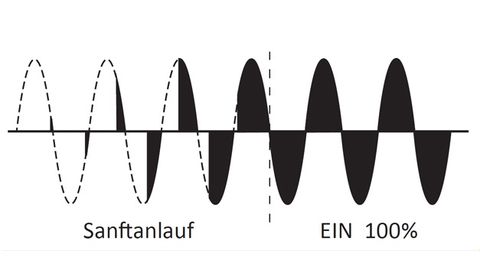
So-called all-in-one thyristor controllers such as the 'SHP controller' from Systemtechnik Leber offer a solution to this dilemma. Here, common functions are stored in a single device via software and can be selected by the user using DIP switches. If it turns out during the project planning phase that parameters such as the response behavior of error messages or the characteristic curve of the soft start need to be changed, this can also be done by changing the firmware.
If you want it to be even more precise
In some applications, even the thyristor solution is not the optimum solution - especially when network fluctuations affect the production process and, in particular, the production result.
Fluctuations in the mains voltage always lead to fluctuations in the electrical energy supply. If the mains voltage changes by 5 %, the power supply also changes by 5 %. As a result, the output changes by 10 %. And while the resulting heat changes by 10 % for pure resistance heating elements, complex loads such as NIR radiators result in considerably greater changes in the process energy. Such radiators do not have a linear relationship between electrical energy and process energy. The NIR radiation is only emitted in a certain electrical window and the characteristic curve has a high gradient towards the end. So if the electrical energy changes by 10 %, this means a change of around 20 % for the process energy.
For applications in which such fluctuations cannot be tolerated, the use of a power controller instead of a thyristor controller is recommended. Systemtechnik Leber offers 'UP power controllers', for example, which can be used with a supply voltage of 230 V(AC) as well as 400 V(AC) and for a load current of 16 to 75 A. These devices also regulate network fluctuations. These devices also regulate network fluctuations.
A concrete example: A control signal of 70 % results in an effective load voltage of 280 V at 400 V mains voltage. Regardless of whether the current supply voltage is 360 V or 400 V, the power controller ensures a constant load voltage of 280 V. It is particularly effective if the load voltage can be measured very quickly and corrective measures are initiated after each sine half-wave if deviations are detected.
The control
A common method for controlling solid state relays, power controllers and regulators is analog control with 0 to 10 V via a PLC. This requires an analog output for each individual switching element and an additional digital enable output for the entire system. Another option is control via industrial buses such as Profibus or Modbus. Both methods are relatively complex or oversized and usually incur considerable costs.
An alternative is to transmit the analog control values by means of a serial data telegram via digital outputs. Digital outputs of a PLC are less expensive than analog outputs and reduce the overall costs of the system. Most of Systemtechnik Leber's power controllers and regulators are designed for the use of this telegram. A free driver is available for 'Simatic' controllers from Siemens; a customized solution can be developed for controllers from other suppliers.
Author:
Denny Vogel is an expert for power supplies and power controllers at Systemtechnik Leber in Schwaig near Nuremberg.


You might also be interested in
Sascha Niederhagen becomes part of the management team
On July 1, 2025, Sascha Niederhagen took over the position of Executive Vice President EMEAI in the Wika Group.
 read more...
Temperature transmitter with true drift detection
Just one year after its market launch, the digital temperature transmitter 'Type T38' from Wika already has all the important international approvals and is therefore available worldwide.
read more...Flow meter for conductive liquids
The 'Flowtrans MAG H20' from Jumo measures conductive media with high precision - even drop by drop - and can be used flexibly in a wide variety of processes.
read more...Award for sustainability management
Sick has received a platinum medal in the EcoVadis sustainability ranking. This puts the provider of sensor-based automation solutions in the top 1 percent of more than 130,000 companies worldwide that have been assessed over the past twelve months.
read more...Up to 12.5 m measuring range
Gefran has extended the measuring range of the 'GSH-A' series so that the latest draw-wire sensor in the range can realize a stroke of 10 to 12.5 m.
read more...Largest construction project in the company's history launched
The Endress+Hauser Group's oldest and largest production site in Maulburg is being extensively modernized and expanded. To this end, the provider of measurement technology and automation solutions is investing more than 100 million euros in the...
read more...Endress+Hauser Liquid Analysis
New managing director from October 2024
Dr. Thomas Buer will become Managing Director of Endress+Hauser Liquid Analysis on October 1, 2024. He succeeds Dr. Manfred Jagiella, who is retiring at the end of September after 17 years at the helm of the competence center for liquid analysis.
read more...Automated real-time measurement of ship emissions
'Digitization and Verification of Marine Live Emission Data' is the name of a research project launched by a consortium led by Sick. The aim is to develop a solution with which emission data from ships can be digitally collected and verified in real...
read more...AMA Association for Sensors and Measurement
Positive development in the 1st quarter
In the first quarter of 2024, sensor and measurement technology companies generated sales growth of 2% compared to the previous quarter. This was the result of the quarterly survey of the AMA Association's 450 members on economic development.
read more...