
Energy transition
ABB manufactures CO2-neutral at the Lüdenscheid site
After a two-year planning and construction phase, ABB has presented its first CO2-neutral site in Germany to the public. As a visible sign of this, a solar power plant officially went into operation at the subsidiary Busch-Jaeger in Lüdenscheid on May 8.
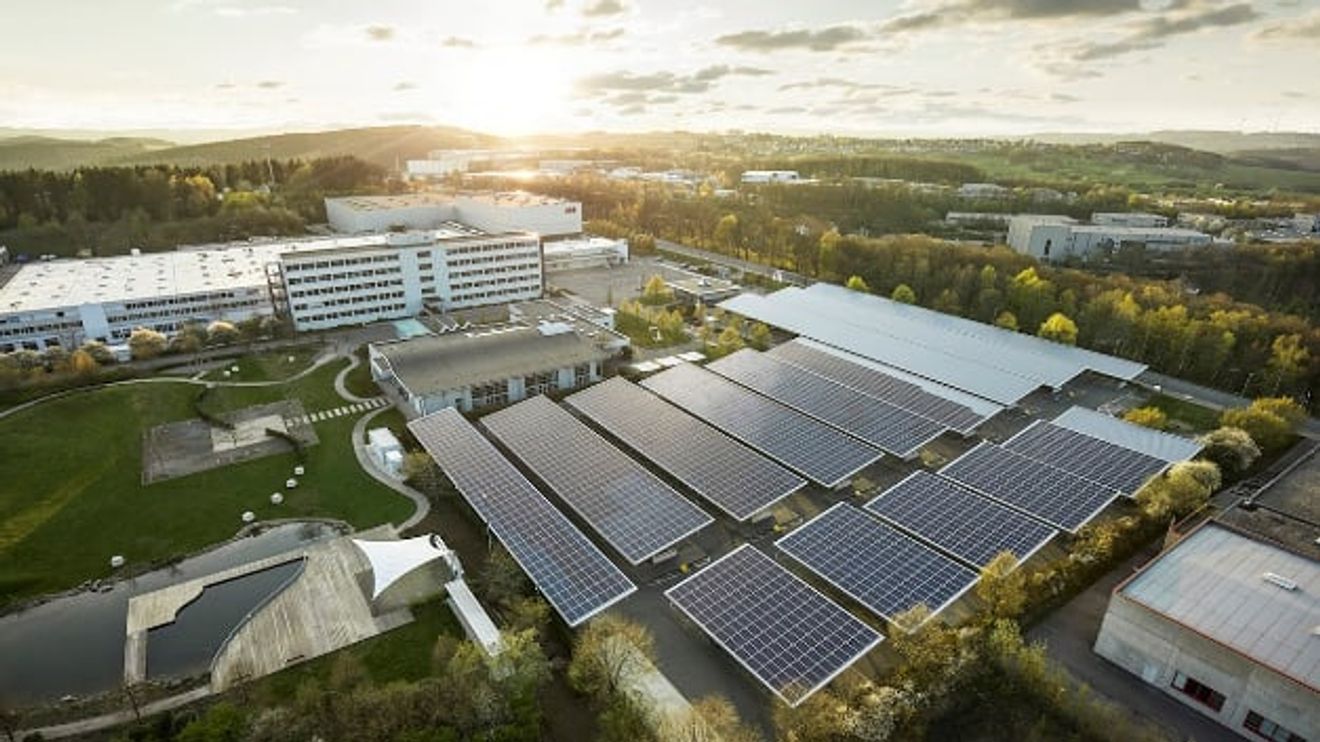
The photovoltaic system is part of a holistic solution that covers all aspects of energy generation and distribution and, according to Hans-Georg Krabbe, CEO of ABB Germany, will cover up to 100 percent of the electricity demand in Lüdenscheid on sunny days: "With this flagship project, we are demonstrating the advantages that arise when you create a system in which all components are digitally networked with each other and can be controlled in terms of energy efficiency, sustainability and resource conservation." The factory of the manufacturer of building automation solutions is the ABB Group's first CO2-neutral and energy self-sufficient factory worldwide.
The 3500 square meter photovoltaic system installed above the parking spaces on the company premises will supply around 1100 MWh of climate-neutral solar power per year - roughly the annual requirements of 3360 private households. In combination with a combined heat and power plant, which operates with twice the energy efficiency of a coal-fired power plant, around 14% more energy can be generated than is required at the site. The surplus production is fed into the public power grid. To cover peak demand, additional green energy is purchased from MVV Energie, which, according to Krabbe, guarantees 100% CO2-neutral production.
In addition to the energy management system and the photovoltaic system with inverters, the overall system combines other technologies from ABB that are digitally networked with each other. For example, a BESS (Battery Engine Storage System) battery storage system with an output of 200 kW and a capacity of 275 kWh is responsible for energy storage. In addition, charging stations, where employees and visitors can charge their electric vehicles free of charge, further improve the regional eco-balance.
In total, the showcase site will save around 630 tons of CO2 per year.


You might also be interested in
Greenhouse gas emissions at their lowest level since the 1950s
Germany is emitting fewer greenhouse gases than it has for a long time. This is the assumption of experts from the Agora Energiewende think tank. But that sounds better than it is.
 read more...
ABB sells solar inverter division
The ABB Group has sold its solar inverter business to the Italian company Fimer. With this transaction, ABB is continuing to systematically focus its business portfolio on other growth markets.
read more...Renewable energies cover 44 % of electricity demand
According to the ZSW and BDEW, renewable energies accounted for 44% of electricity demand in Germany for the first time. Compared to the previous year, the share of green electricity thus increased by 5%.
read more...Remotely monitored salmon farm for offshore
ABB has received an order from Arctic Offshore Farming to supply its first remotely maintainable underwater salmon farm in the Arctic Ocean with energy. The new farming concept is Norwegian salmon production's response to rising demand.
read more...Strong growth in two areas
According to the company, the German ABB performed very well in terms of order intake and sales in the 2018 financial year. The company benefited in particular from business development in the areas of robotics and drives as well as industrial...
read more...CEO Ulrich Spiesshofer steps down
ABB announced today that CEO Ulrich Spiesshofer (55) is stepping down from the position he has held since 2013. The Chairman of the Board of Directors, Peter Voser (61), will also assume the position of interim CEO with immediate effect.
read more...ABB and Dassault Systèmes agree partnership
ABB has entered into a partnership to combine its 'Ability' digitalization portfolio with the '3DExperience' platform from Dassault Systèmes. The focus is on factory automation and robotics, building automation and the process industry.
read more...The realignment
In mid-December 2018, ABB announced fundamental measures to focus its business and strengthen its technology leadership in digital industries. The company has now provided a strategy update.
read more...ABB - 4th quarter and full year 2018
Solid growth and lower profit
ABB has now announced its figures for the 2018 financial year: With growth of 8% in order intake and 4% in sales, Group management is very satisfied.
read more...