
Electromechanics
Plugging instead of wiring
The modularization of machines and systems will further increase the importance of connectors in industry. What do these components have to do to meet the demand for ever more flexible use?

Flexibility is one of the key buzzwords when it comes to modern machine and system concepts. This means that production machines must be as easy as possible to convert or adjust to individual workpieces. For high availability, it is also important to be able to replace or repair system components quickly - this applies to components such as sensors or drives as well as complete units, including feeding or handling systems. Using plug-in connectors for wiring opens up completely new possibilities when setting up previously hard-wired system components and connecting drives or power supplies.

Figure 1: Shielding attenuation values: The shielding attenuation is improved by around 30 dB thanks to conductive seals and conductive surfaces compared to conventional industrial connectors.
© Phoenix ContactRectangular connectors are now standard equipment in almost all industrial sectors. Those who can concentrate on a standard size when using them benefit from numerous advantages. Plug&play components, for example, allow handling assemblies to be changed quickly, and convenient replacement without special tools is also no problem. This also increases availability, as downtimes are reduced and functional groups or system parts can be pre-assembled and tested more quickly. Last but not least, procurement, logistics and warehousing are simplified.
In simple terms, the structure of a connector is divided into the functional areas of connection technology, contact arrangement and transmission, locking technology, cable connection and component protection. The connector housing is responsible for component protection.
The abundance of these functions requires a lot of space, and there is hardly enough available today. A compact design without sacrificing functionality is therefore what connectors have to offer today.
The example of the new Heavycon D7 rectangular connector series from Phoenix Contact illustrates how these trends and requirements are taken into account. The housings of these connectors are available in two versions: Metal and plastic. The metal housings are made of seawater-resistant aluminum, while the plastic housings also have high rigidity and strength. In other words, the housings meet all requirements against mechanical stress, especially impact stress. The chosen glass fiber reinforced plastic ensures good electrical insulation.
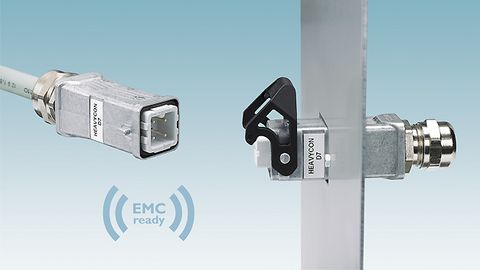
Figure 2: The EMC gland turns the standard metal housing into an EMC housing: the wall bushing makes installation easier and protects the contact insert when plugged in - ensuring continuous shielding.
© Phoenix ContactBasically, all housings have a mounting side and a cable side. Grommet enclosures are used for the cable side. The seal between the enclosure and the cable is provided by a gland, which is screwed into the corresponding thread of the enclosure in the metal enclosures. This screw connection is already integrated in the plastic enclosures of the series. When the nut is tightened, the internal cone is pressed against the cable sheath enclosed by the seal. This creates a reliable seal and strain relief - for cables with diameters from 4 to 17 mm.
On the device side, surface-mounted housings are ideal for wall feed-throughs on the control cabinet or terminal box. Base enclosures for mounting on the machine frame are also part of the D7 range. The flat screw-on housings allow cables to be routed parallel to the rack or frame. Feed-through enclosures are also being used more and more frequently in automation and system technology. In the case of the D7 series, the housings are mounted at right angles to the mounting surface, which considerably simplifies installation(Fig. 2). This allows plug connectors to be arranged tightly and cost-effectively. The surface-mounted and base-mounted housings can be attached to the device, the switch cabinet or the terminal box using the usual two screws. If high mechanical loads are to be expected, four screws are used for fastening. Universal flanges even allow both. Appropriate coupling housings also simplify the extension of cables - for example, for system expansions. This means that a connector solution with an IP67 degree of protection is available for almost every application - the connectors are dust-tight, keep water out and thus protect the electrical connection.
The cable-plug contact connection
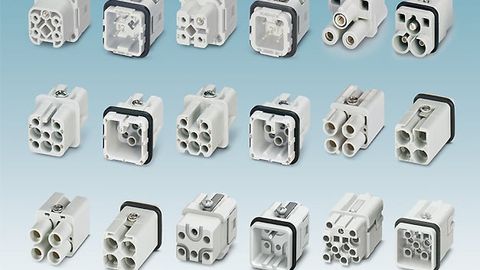
Figure 3: Examples of square contact inserts for signals and power - the seal is always mounted on the pin contact carrier.
© Phoenix ContactThe technical requirements for the contact inserts are just as varied as those for the housings themselves: How many contacts are needed? What voltages and currents does the respective application work with? What cross-section do the conductors have? Like the contact inserts already available in other Heavycon series, the new D7 contact inserts are made of polycarbonate - a material that has become widely accepted for industrial connectors. Numerous properties - such as high rigidity and strength as well as good insulation - predestine this material for use in almost all industrial applications, including railroad technology.
Contact inserts with up to 12 power contacts at 250 V and 10 A are inserted into the housings. The Q12 high-pole connector - Q means square here - is standardized in the ISO 23570 standard. It is used, for example, in compact motors or as a signal connector. Where square connectors are required, the 5-pole Q5 connector is available - with rated voltages of 230/400 V and rated currents of up to 24 A per contact. Contact inserts are also used for high currents. The 2-pole HC-Q2 plug connector can be used for voltages up to 400 V and currents up to 40 A. With the Q3, an additional power contact is available with the same technical properties.
To prevent mismating, the contact inserts for the housings can be equipped with plastic coding - at least four coding positions are possible. This applies to the contact inserts from the Heavycon Q series with 2, 3, 4, 7 and 12 poles as well as to all contact inserts from the Heavycon A3 and A4 series. These contact inserts are used in both metal and plastic housings. The Q4 has a special feature: the 4-pole contact inserts for 830 V / 40 A are coded in such a way that they can only be used in plastic housings.
Authors:
Hartmut Schwettmann is Head of Product Marketing in the Industrial Field Connectivity division at Phoenix Contact;
Thomas Wolting works in Product Marketing Industrial Field Connectivity at Phoenix Contact as Senior Product Manager.


You might also be interested in
New Automation Management Board strengthened
New Automation, the training association for industrial companies in the field of automation technology, has expanded its board and set up new projects for young talent.
 read more...
Monitor and protect DC microgrids
Sustainable production using renewable energies begins with the establishment of an industrial DC grid. A multifunctional DC switching device is responsible for switching, protecting, monitoring and precharging DC sectors.
read more...The e-paper of issue 08/2024
How can data centers be cooled for AI? How successful is malware programmed with WormGPT? And how can virtualized control systems be integrated into production using TSN? Computer&Automation issue 08/2024 provides answers to these questions and...
read more...Frank Stührenberg hands over to Dirk Görlitzer
Frank Stührenberg will hand over the chairmanship of the Phoenix Contact management board to Dirk Görlitzer at the end of the year. Until then, there will be dual leadership.
read more...Frank Stührenberg hands over to Dirk Görlitzer
At the end of the year, Frank Stührenberg will hand over the position of CEO of Phoenix Contact to Dirk Görlitzer. Until then, there will be dual leadership.
read more...New production facility in Mexico
In order to meet the growth potential of the North American market, Phoenix Contact is planning a new building for electronic and electromechanical production in Mexico. Production is scheduled to start after the first construction phase at the end...
read more...The top articles in April 2024
The most-read articles in April demonstrate the innovative strength of the automation industry and its ability to adapt new technologies.
read more...Phoenix Contact at the Hannover Messe
Strategic technology partnership with Festo
Festo will use PLCnext Technology, the open ecosystem from Phoenix Contact, in future intelligent devices. In this way, both companies want to combine their innovative strength with the aim of taking industrial automation to a new level.
read more...Phoenix Contact at the Hannover Messe
Charging with power
The 'Charx connect universal' CCS vehicle charging sockets from Phoenix Contact now also enable high-power charging with a continuous 375 kW.
read more...