
Igus
First recyclable plastic bicycle frame
Igus continues to expand its bicycle component business and launches the first injection-molded bicycle frame made of composite material for advanced bikes.
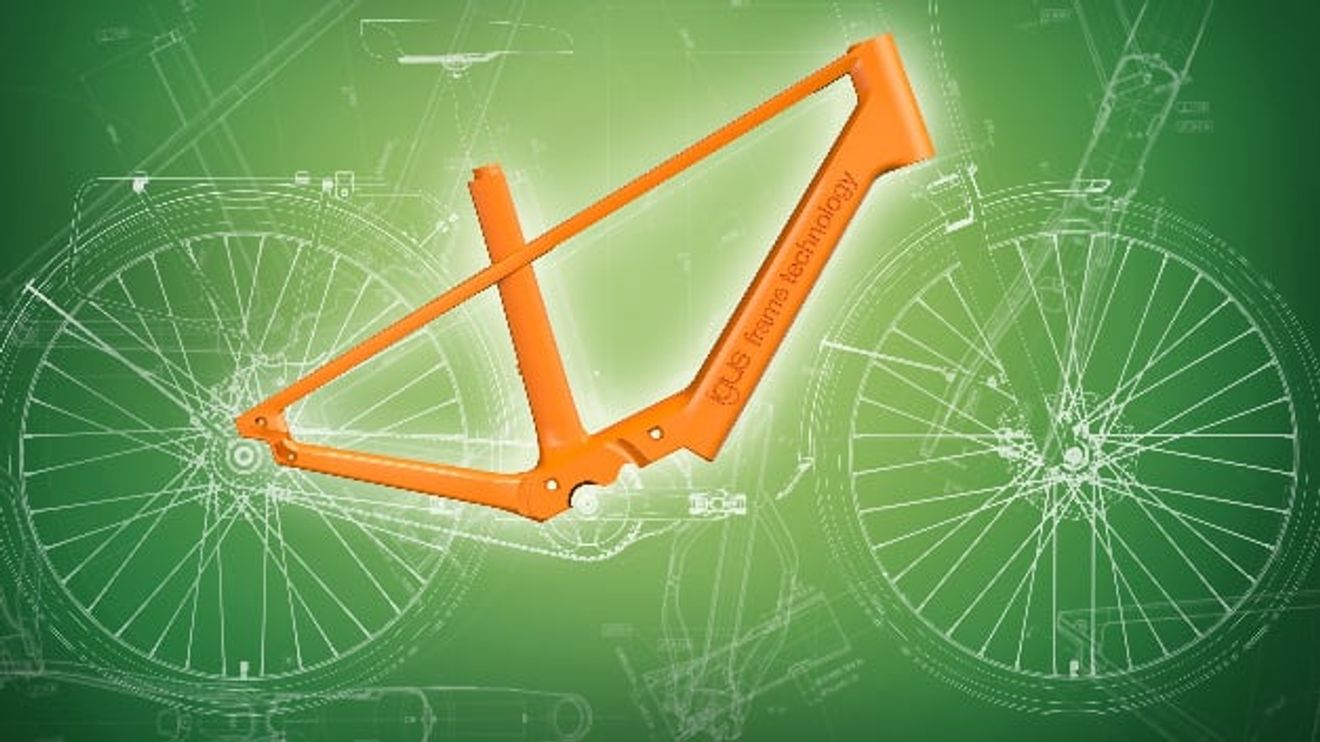
The new bicycle frame is 3.3 kg light, recyclable and injection-molded from a single piece.
© IgusAfter the 'RCYL Bike', a bicycle made from 50% recycled fishing nets, Igus is setting the next milestone for sustainable mobility: the company has developed the first bicycle frame made from recyclable composite material for the German e-bike manufacturer Advanced Bikes, which is manufactured using the injection molding process.
In 2023, more e-bikes than conventional bikes were sold in Germany for the first time. The reason for this is not least the growing awareness of environmental protection. The problem: 90% of today's bicycle frames are made of aluminum or carbon, are produced in very energy-intensive processes and end up in huge bicycle landfills at the end of their service life. In order to drive forward the transformation to a circular economy, e-bike manufacturer Advanced Bikes is relying on Igus for its future frame production. Together, the companies have developed a sustainable bicycle frame made from composite material, which is to be used in the new trekking e-bike 'Reco Urban'.

To drive forward the transformation to a circular economy, e-bike manufacturer Advanced Bikes is relying on Igus for its future frame production: Helge von Fugler (Advanced) and Jan Philipp Hollmann (Igus) (from left to right).
© Igus"Advanced's requirement was to manufacture a frame from a composite material with 100 percent recyclable plastic using the injection molding process," recalls Jan Philipp Hollmann, Head of Bike Components at Igus. "As we have been developing and producing components such as bearings, rod ends, gears and guide rails for the bicycle industry for over 30 years, we immediately accepted the challenge of supporting Advanced with the design of the bicycle frame and taking on the development, toolmaking and injection molding."
To ensure that the frame has sufficient strength, rigidity and low weight, Igus uses a composite material in granulate form, consisting of high-performance plastics and carbon fibers. The company also produced a multi-part injection mold for the complex geometry of the bicycle frame within a few weeks. The result is a 3.3 kg lightweight, one-piece injection-molded bicycle frame - without weld seams, corrosion-resistant, durable and externally tested. Production in Germany enables short delivery routes and just-in-time production in line with demand. Igus is also able to regranulate used frames via its own 'chainge' recycling program in order to return the material to the material cycle. "In the future, we also want to have other recyclable bicycle components such as luggage racks, rims, spokes and seat posts manufactured using the injection molding process," explains Helge von Fugler, founder and Managing Director of Advanced. "This is the only way to make a completely recyclable e-bike a reality."
Igus currently produces bicycle frames using two different processes at its headquarters in Cologne. Injection molding is used to produce both modular frames and frames in one piece. In addition, frames are manufactured using the rotomolding process - for example for the company's own 'RCYL Bike'.
Igus is not limited to bicycle frames either: The know-how in plastics processing and the new development experience also flow into new bicycle components - from wheels to cranks and handlebars to planetary gears.
Maximum security
Before they are used, all components are extensively tested. "We will use computer tomography to check the first injection-molded bicycle frames for potential problems such as air pockets in the composite material and carry out all relevant frame tests in our test laboratory," explains Hollmann. Customers receive a 30-year guarantee from Advanced. For maximum safety, Igus therefore relies on a large number of test procedures that are based on standard tests such as those carried out by the EFBE and TÜV. In addition, the company also carries out its own test procedures - for example in the company's own climate chamber.


You might also be interested in
Strategic acquisition of Cableforce Electronics
The Lapp Group has acquired Cableforce Electronics with effect from June 1, 2025. By merging with the Chinese specialist for circular connectors, Lapp intends to strengthen its global market presence and production capacities for industrial...
 read more...
DigiKey and Qorvo cooperate
DigiKey and Qorvo announced a global distribution agreement at the end of February.
read more...Igus takes over assembly provider
Igus has taken over the company Elko Verbindungstechnik. With this step, the company is expanding its assembly capacities in the field of drive technology.
read more...Connectors for outdoor data communication
Conec has developed a versatile connector system that ensures reliable data communication under extreme conditions.
read more...Ergonomic workstation solutions with linear technology & co
RK Rose+Krieger is presenting components and system solutions from the fields of linear technology, profile technology, connection technology and module technology at Motek. One current example is the 'RK Easymount' assembly table.
read more...Management change at connector manufacturer
On September 1, 2024, Christian Schumacher took over the position of Managing Director at Conec Elektronische Bauelemente in Lippstadt, which has been part of the Amphenol Group since 2019.
read more...Corner connector for cable trunking system
RK Rose+Krieger has developed corner connectors for the existing 'KK-40x40' and 'KK-80x40' cable duct profiles of the 'Blocan' cable duct system made of anodized aluminium.
read more...Compact design with mounted strands
Binder is expanding its M12 portfolio to include flange connectors with a continuous M12×1 mounting thread, which are now equipped with mounted stranded wires. In addition to the previously available dip soldering variants, this version is now...
read more...Housing for Raspberry Pi 5
Fischer Elektronik offers the right housing for the Raspberry Pi 5. The housing consists of an upper and lower shell made of punched and bent 1.5 mm thick aluminum sheet.
read more...