
Electromagnetic compatibility
A holistic approach is required
Increasing sensitivity of electronic components, decreasing signal levels and the increasing use of wireless communication - all this poses more and more electromagnetic risks. This makes it all the more important to consider the topic of EMC shielding holistically rather than selectively.

If the picture in the living room flat-screen TV is not clean, it is unattractive - but not a safety risk. The situation is different in an industrial environment: here, people can be put in danger due to interference resulting from electromagnetic coupling, or production rejects can drive up costs.

Better shielding effects can be achieved if the braided shield of the cable is routed all the way to the electronics in the switch cabinet and is only connected to earth there, as is possible with the 360° TRI spring contact.
© PlowAlthough control cabinets and enclosures can be shielded quite well with appropriate measures, there is often a gap where signal and power cables are routed through the enclosure wall, through which electromagnetic waves simply 'slip through'. In order to close this gap securely, cables and cable glands are required that make optimum contact with the shield at the cable entry into the enclosure and thus integrate it into the overall EMC concept. However, cable glands in which the cut-to-length - i.e. interrupted - braided shield is pushed onto a metal cone and contacted there cannot always be used - for example, if faster clock rates up to the Gbit range are required or if the focus is on signal integrity. In these cases, the user must use solutions in which the braided shield is not interrupted and is continued through the cable gland to the specified connection point on the electronics.
Safe 360° contacting
With the 'Uni Iris' cable gland from Pflitsch, for example, an internal spring washer ensures 360° contact with the exposed cable shield. When the pressure screw is tightened, it is pressed securely against the braided shield on all sides and ensures a good electrical transition. The cable shield does not need to be fanned out or cut to length during installation. The shielding effect and cable impedance (important for signal integrity) created during the manufacturing process are thus fully retained. The cable shield is only connected to the 'reference ground' directly at the terminal point specified by the customer near the electronics. This avoids unnecessary coupling of useful signals with interference signals.
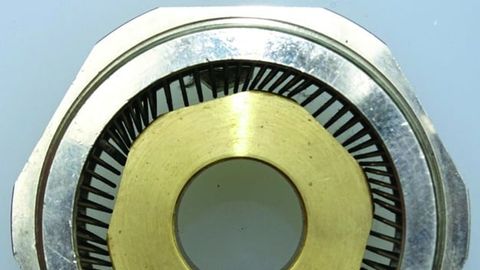
A TRI spring in the cable gland: Due to its geometry, the TRI can also reliably contact non-cylindrical round cables.
© PlowEven better values - typically around 10 to 15 dB at frequencies below 10 MHz and even 20 to 30 dB above 300 MHz - can be achieved by using a triangle contact spring. The name 'triangle' refers to the basic shape of the contact spring, which reliably contacts the cable shield when the pressure screw in the cable gland is tightened. This shape means that even cable shields that are not exactly circular can be contacted, including oval and angular cable shields, which are increasingly common in modern, multi-shielded power cables. This solution is being used for the first time in the Blueglobe series from Pflitsch, for example. This metric cable gland has a spherical sealing insert that fits securely to the cable geometry and achieves protection ratings of IP68 and IP69K as well as above-average strain relief values. Thanks to the sealing insert, this cable gland also has large clamping ranges, which means that the required cable gland sizes can be reduced.
In the corresponding version, the cable gland is approved for applications with the high Cat. 7A requirements. According to DIN IEC 61156-5, at least -60 dB attenuation is required up to 1000 MHz. The so-called 'TRI' achieves significantly higher values of -65 dB; even in the frequency range up to 2.5 GHz, this is typically at least -50 dB.
If even higher EMC attenuation values are required, there are two options: Firstly, a non-magnetic TRI toroidal spring can be used, as this version of the spring has no ferromagnetic influences on the shielding. Secondly, there is the option of equipping the cable gland with two triangle springs one behind the other, as Pflitsch has done with an extended special version of the Blueglobe TRI. This provides a good 6 to 10 dB more attenuation, as tests in the test laboratory have confirmed.
The current carrying capacity criterion
In addition to HF attenuation, the current carrying capacity - i.e. the ability of a component to carry a certain continuous current - is an important criterion for an EMC cable gland. In the event of malfunctions, incorrect installation or lightning strikes, high currents can flow through the cable shield and the cable gland. The voltage drop at the contact resistors of a cable gland also generates a certain amount of power loss due to the current flowing through the cable shield. The resulting heat leads to an increase in temperature of the cable gland, which should not exceed +60 °C for reasons of contact protection.
As there is no test standard for this case, Pflitsch has implemented a practical test setup in which an increasing current up to a maximum of 100 A is applied to the cable shield and the temperature development in the cable gland up to +60 °C is determined. The result: As a rule, the aforementioned Blueglobe TRI achieves a higher current-carrying capacity than the shielded cable and therefore offers the necessary safety. In practice, however, this should be verified in the respective installation.

The EMC multiple washer with internal TRI contact springs allows several cables to be routed through one EMC cable gland to save space. The washer is securely contacted in the gland body via a circumferential iris spring.
© PlowAnother solution is the split EMC adapter: If this is screwed in between the housing wall and an EMC gland, this also results in double contacting with correspondingly higher attenuation values and higher current transmission with minimized technical and financial effort. If the user uses this adapter as a locknut, certain RF attenuation values can even be achieved cost-effectively and retrospectively for standard and plastic cable entries, which is usually sufficient for less critical applications.

With a split EMC connection block, thick, rigid cables can be fed into the control cabinet easily and in compliance with EMC regulations.
© PlowEvery cable gland requires a certain amount of installation space. However, if a user wants to insert various EMC cables into an enclosure, the trend towards ever more compact systems can sometimes lead to bottlenecks in the enclosure environment due to a lack of installation space. To solve this problem, Pflitsch relies on a sealing insert concept in which several cables - even with different diameters - can be fed through one cable gland.
Behind the sealing insert in the EMC solution is a metal disk that is manufactured precisely for the cable diameters used by the user. The shield of each cable is securely contacted in this disk by means of a TRI spring. Contact is made with the inserted washer in the cable gland via a circumferential iris spring ring. With this sealing concept - designed up to size M120 - several EMC cables with a diameter of 5 to 20 mm, including braided shield, can be integrated.
With rigid cables in the cabinet
Power cables and lines with larger cross-sections are usually very rigid and are therefore often difficult to install. In order to be able to insert such shielded cables into an enclosure and make EMC-safe contact, a divisible EMC connection block made of nickel-plated brass has been developed to simplify installation. This means that the stable lower part of the EMC block is first fitted to the control cabinet entry, the cable is positioned and the cable sheath is removed at the level of the contact point so that the cable's shielding braid is exposed. Once the prepared cable is positioned in the EMC connection block, the upper part of the block is pressed on and fixed in place with two screws. The non-magnetic TRI spring, which is also split, presses reliably around the braided shield of the cable. The EMC connection bracket is currently available in five sizes for cable diameters from 20 to 65 mm. Further sizes in M 25 and M 32 will follow shortly.
Contact multiple screens safely
In modern electronics, the cable shield often fulfills several tasks: On the one hand, it significantly determines the cable impedance and, on the other, it is intended to prevent signals from being coupled out and/or in. Unpleasantly, unwanted potential equalization can still take place via the braided shield. This is why there are special cables with multiple shields. The challenge now is to make EMC-compliant contact between these shielded cables in the shielded housing and the electronics. This is possible with an extended cable gland such as the aforementioned Blueglobe TRI with its two triangle springs positioned one behind the other.
The first spring is used to connect the outer shield of the cable directly to the outside of the housing, while the second spring connects the inner shield to the housing with low impedance. The possible third shield can then be routed to the ground test point in the switch cabinet and connected there. This solution achieves a shielding effect of better than -80 dB at frequencies up to over 1 GHz. Furthermore, the current-carrying capacity is doubled, which is important for frequency converters and in the field of electromobility, for example, where high-frequency shield currents of more than 25 A are nothing out of the ordinary.
'Channeling' EMC correctly
Ultimately, when it comes to EMC, the focus should not only be on the cable or its cable gland; particularly in demanding applications, the cable duct must also be designed for E and H fields specific to the application. Unlike cable glands, however, each EMC cable duct assembly is unique and must be specially adapted to the application. This first requires an analysis of the installation environment. The interference fields that occur are just as important for the design: Magnetic fields in the vicinity of electric motors or frequency converters can be attenuated by increasing the wall thickness of a trunking, for example, while in the case of electric fields, care must be taken to design the trunking with as few gaps as possible. In some cases, molded parts may even have to be made "from the solid".
Pflitsch, for example, uses 2 mm thick sheet metal to protect against magnetic fields. In order to keep out electric fields, the application-specific assemblies are provided with holes at a maximum distance of 50 mm along the trunking components so that the body and cover as well as the required fittings can be screwed tightly to the trunking body without gaps. Seals made of copper-beryllium, as used in safety doors, can also be inserted. Special connecting elements are used at the seams of the trunking parts.
Equipped in this way, only a few interference waves can escape from or penetrate into the trunking. In the test, this type of cable duct design achieved a magnetic shielding attenuation of -18 dB compared to an unprotected installation of cables and lines. For comparison: a standard cable duct system achieves around -10 dB attenuation.
Authors:
Günther Quednau is an EMC expert at Pflitsch in Hückeswagen;
Walter Lutz is a specialist journalist in Haiger.
EMC measurement without expensive measurement technology

During the development of the EMC cable glands, Pflitsch realized that none of the established measurement methods for evaluating the shielding behavior of cable glands is really suitable for providing clear and reproducible measurement results on the shielding behavior of these components. The reason for this is that it is not the cable gland itself that is measured, but always the entire installation. In addition, the conventional methods require very expensive measurement technology.
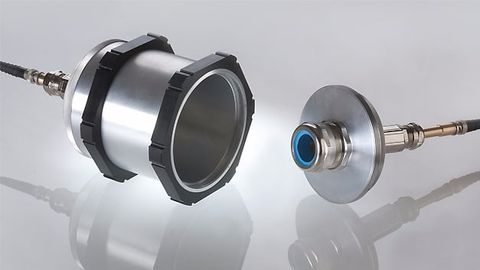
As a result, the Hückeswagen-based company further developed the internationally standardized measurement method for coaxial connectors - the triaxial method (in accordance with IEC 61 196-1, IEC 61 196-A, prEN 50 289-1-6 A +C, VG 95 214-12 and VG 95 214-13). The resulting KoKeT method (Coaxial Kelvin Tube) is able to measure the shielding effectiveness and the transfer impedance (absolute) of direct current up to over 1.5 GHz. KoKeT works according to the double-coaxial method. A partition wall is screwed into a well-shielded tube, which divides the chamber into two chambers one behind the other and at the same time contains a receptacle for shielded cable glands in sizes M8 to M85. Comparative measurements show that this method measures around 20 dB more accurately in the important frequency range of 25 to 130 MHz than the commonly used injectionline or absorber clamp methods.
KoKeT is now listed in the current IEC 62153-4-10 as a recognized measurement method.


You might also be interested in
Authorized distributors made visible online
Lapp is expanding its digital service portfolio and is the first B2B industrial company to provide its authorized distributors with a verifiable online seal from authorized.by. The company aims to create more transparency and security for buyers and...
 read more...
Axel Barnekow Widmark becomes CEO
Habia, a global supplier of customized high-performance cables, announces changes in the company's management: On April 1, Axel Barnekow Widmark took over the position of Chief Executive Officer. He succeeds Carl Modigh, who will remain with the...
read more...Avoid wear and tear
Tsubaki Kabelschlepp has added a new function to its condition monitoring system so that wear can also be monitored outside the chain without the need for additional cables in the cable carrier. The system also monitors the push/pull forces during...
read more...Cables in a modular system
The 'Heluchain' system from Helukabel is a modular system that is available in three expansion stages and combines cable drag chains, highly flexible cables, individual assemblies and matching accessories.
read more...Cables for stage technology
Igus wants to tap into the stage technology market and has developed a plainly colored series of highly flexible 'Chainflex' cables.
read more...Strengthening fiber optic cable production in Germany and Europe
The production of fiber optic cables in Germany has fallen by over 43% in the last ten years. In order to avoid long-term strategic dependencies, the ZVEI is calling for the maintenance and expansion of industrial capacities for network components...
read more...Energy chain series switched to recycled material
Igus is converting the entire catalog range of its standard energy chain series 'E2.1' to the new recycling material 'igumid CG LW'.
read more...Billion in sales maintained
Despite the challenging geopolitical and economic situation in 2024, Igus was able to increase the number of active customers by 5%. With sales of € 1.105 billion, the company recorded a comparatively moderate decline in sales of 2.5%.
read more...Igus takes over assembly provider
Igus has taken over the company Elko Verbindungstechnik. With this step, the company is expanding its assembly capacities in the field of drive technology.
read more...