

Filling of foodstuffs
Axes perfectly synchronized
The aseptic filling of food is a difficult task. The demands placed on the automation technology used in the machines are correspondingly high, especially in terms of motion control. One example.

If liquid or paste-like foods such as jams or yoghurt can be kept for many weeks without preservatives or refrigeration, this is largely due to aseptic filling. However, filling perishable products aseptically requires a high level of expertise and experience. Both are available at the family-run company VMS Maschinenbau in Obersontheim near Schwäbisch Hall in the heart of Germany's 'Packaging Valley'.
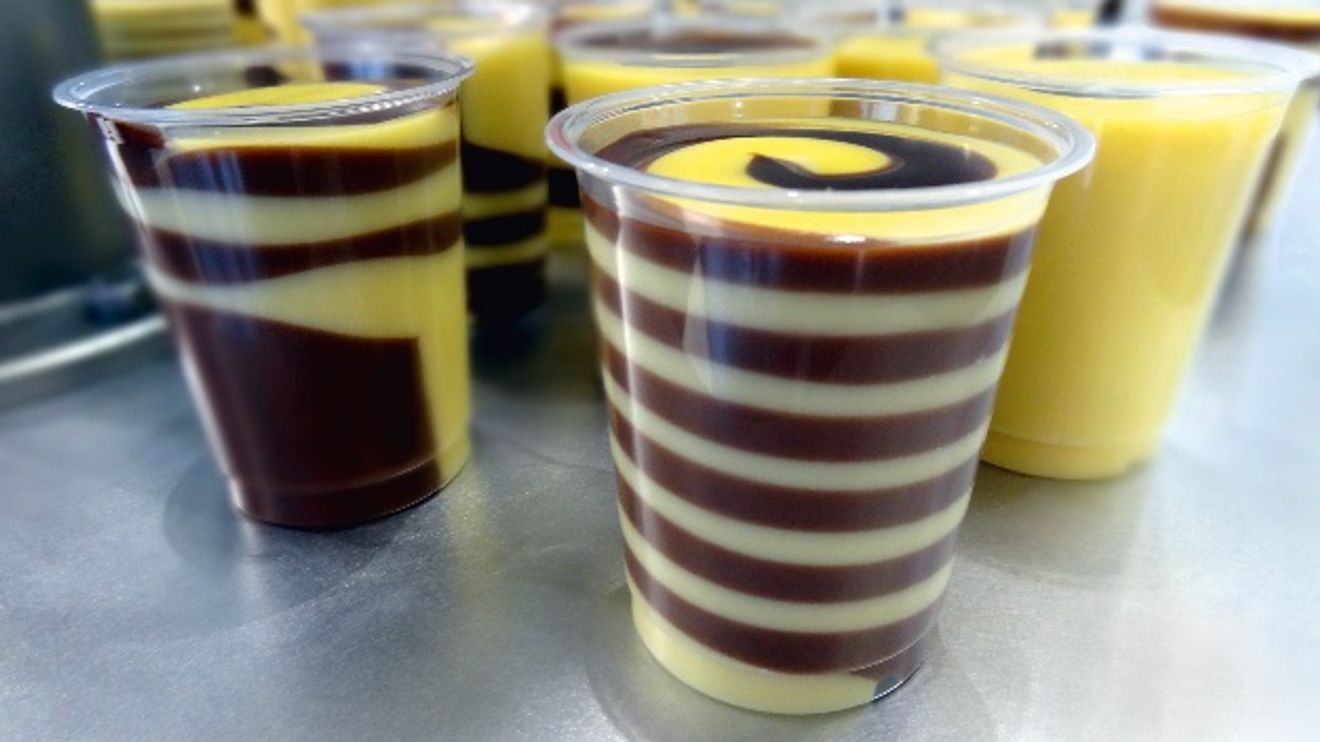
With its patented Kontifill line, VMS manufactures aseptic filling machines that can be adapted modularly and flexibly to different filling containers and variants. In an intermittent or continuous process, liquid and pasty products such as jams or dairy products are filled into cups, bottles or buckets and the containers are sealed with a welded-on aluminum lid. When passing through the machines, the patented twist filler allows several products to be filled in any sequence, creating colorful patterns and even colorful lettering.
To ensure maximum sterility, the filler and its surroundings at the end customer are supplied with sterile air via a tunnel system. In addition, the containers to be filled in the machines are first disinfected with hydrogen peroxide and then dried with sterile hot air. This ensures germ reduction and reduces the residual hydrogen peroxide content to less than 0.5 ppm. "Hygiene safety is also so important for our customers because, particularly in the food sector, product recalls not only result in supply bottlenecks and high costs for the disposal of entire batches, but can also cause lasting damage to a food brand's reputation," says VMS Marketing Manager Daniela Kraft.
Up to 38,000 cups per hour
In cup filling, which is typical for yoghurt or fruit quark, for example, the machines fill up to 38,000 cups per hour. Despite this enormous output, the filling systems comply with the highest hygiene standards up to level log6, which describes a germ reduction to below 10-6 of the initial germ count. In other words: 99.9999 % of all germs are killed. An intensive, multi-stage cleaning process is required to clean and sterilize the filling machines themselves. It takes around three hours and is carried out at intervals of one to three days, depending on the product and hygiene requirements. During this 'Cleaning In Place' (CIP) and 'Sterilizationi In Place' (SIP), all components and pipelines that come into contact with the product are sterilized with saturated steam at 143 °C and the sterile tunnel is disinfected with hydrogen peroxide.

The patented twist filler also allows several products to be filled in any sequence in a single pass.
© VMSVMS supplies many well-known food producers and large dairies worldwide with its machines - including Emmi, the leading Swiss milk processor and one of the most innovative dairies in Europe. VMS has also built its most powerful and versatile filling machine to date, the Kontifill Cupline, which is equipped with seven different filling units and can fill and seal up to 9600 cups per hour. According to VMS design manager Jürgen Lerner, there is hardly another machine on the market with more functions than this customized development for Emmi. The modular machine concept offers the option of incorporating various plug-ins to optimize the filling process, which the end customer can order on request - for example, if special toppings or trimmings are to be applied to the product to be filled.
The motion control architecture
The process steps of the aseptic filling machine are quite complex: the cup destacker, inspection and sterilization are followed by the filler and lid applicator, the sealing station and leak check, and finally the snap-on lid applicator, cup lifter and packer. To ensure that the entire product and pack flow runs with pinpoint accuracy, a wide variety of motion sequences have to be perfectly coordinated. To implement the automation technology required for this, the Swiss company brought SEW-Eurodrive from Bruchsal on board.

Specifically, 38 different axes had to be coordinated for the machine to be implemented, with various motor-gearbox technologies being used for a wide range of functions and performance requirements - from servo bevel gear motors and servo planetary motors to precision servo geared motors with cycloidal gears. The precision servo gearboxes are used, for example, on the conveyor belt in connection with chain elongation, rigidity and precise feed, as well as on the lid applicator, where freedom from play and precision when placing the lid are important. Servo planetary geared motors, on the other hand, ensure precision and dynamics in the friction drives, among other things, and the bevel gear servo geared motors meet the high requirements for power transmission in the pistons.

With the help of SEW's motion control technology, in which a high-performance multi-axis servo system in combination with prefabricated software modules enables high machine performance as well as quick and easy commissioning, Emmi was finally able to simulate cams and, based on this, ultimately execute all movements in such a way that precise coordination is guaranteed even at high speeds. A filler such as the one installed in the machine for Emmi is characterized by complex mechanical interaction. This means, for example, that there are only very narrow mechanical gaps when the cups are immersed. In other words, the axes in the machine are at high risk of collision in many places. If there was no precise coordination in the real-time cycle, such machines could not be realized electronically.
The motion control architecture from SEW-Eurodrive can be seamlessly integrated into the automation or machine architecture of VMS by making it just as easy to integrate third-party peripherals such as sensors and safety components as it is to connect to third-party controllers or HMI panels. "This allows us to program the motion controller very quickly using the convenient SEW software, while the machine is controlled by a higher-level controller," says Daniela Kraft.
One software for all engineering tasks

The cell board with the containers (beakers): The filling points are clearly visible. The seal-less piston fillers enable consistently high filling accuracy over many years.
© VMSSpeaking of programming: such powerful and highly complex filling machines as those developed and implemented by VMS previously required many different engineering tools (commissioning, programming, diagnostics, etc.). This is usually accompanied by the need to manage various interfaces, time-consuming machine programming and, last but not least, familiarization with many different software interfaces. The use of the new Movi-C automation platform from SEW with the Movisuite engineering software has made things much easier for VMS in this respect. This all-in-one tool can be used for planning, commissioning, operation and diagnostics in equal measure - regardless of whether standard or functionally safe components, individual inverters or entire machines or systems are involved.

The entire transport process is carried out continuously via servo drives. In the picture: the drives for filling technology - lifting the cup, piston (drawing in and ejecting the product) and reamer (opening the product feed into the container).
© SEW-EurodriveIn addition to classic programming, a large number of application modules significantly reduce complexity. As a result, sophisticated motion kinematics can be implemented with simple parameterization. Another advantage of the solution is its consistency: vertically from the controller to the geared motor and horizontally through all electronic components. This means one interface instead of different software tools or products, which in turn require different tools and interfaces for commissioning or servicing purposes. Furthermore, there is no need for additional data interfaces or the associated programming effort.

The lid applicator with plug-in lid sterilization. The sterile area is completely separated from the drive elements. This enables quick and easy maintenance access.
© VMSIn addition to flexibility in terms of engineering and the choice of higher-level control systems, the topic of service is of great importance to VMS - after all, the company originally developed from a service provider for the maintenance of aseptic packaging machines. VMS still offers customer-specific services today: Maintenance, repair, conversion or modernization of packaging and filling machines of various makes. Because the customers of the machines are under considerable time pressure to meet their delivery obligations, VMS is also dependent on a fast-response service from its suppliers - and has found the right partner for this in SEW-Eurodrive.
First steps towards virtual reality
The pace of technological change is unstoppable. In order to keep pace, VMS is currently working with SEW-Eurodrive to develop pioneering condition monitoring solutions for the machine using virtual reality technologies. An initial concept was implemented in a test filler using the Movi-C automation platform.

The VR solution developed together with SEW-Eurodrive will be used in the future to conduct training sessions with maintenance personnel, among other things.
© VMSAll relevant data and status information of the automation components are stored in SEW's Automation Controller as a digital twin and can then be sent wirelessly to an OPC UA client - for example to Hololens glasses - using the manufacturer-independent OPC UA communication protocol and also linked via smart remote services. This makes it possible to carry out service diagnostics on installed components very quickly, for example during servicing or maintenance intervals. This saves time and reduces unplanned downtimes.
Author:
Heiko Füller is the Head of Market Management at SEW-Eurodrive.


You might also be interested in
New board member for production and quality management
Bosch Rexroth appoints Dr. Christina Franke (49) to the Management Board with responsibility for Production and Quality Management as of April 1. She succeeds Reinhard Schäfer (60), who is retiring.
 read more...
Integrated measurement technology for condition monitoring
There are new variants of the high-precision motor feedback system 'EDS/EDM35' from Sick. Variants with additional sensors for monitoring vibration behavior and humidity supplement the standard variants.
read more...Drive controller with high-current variant
As a high-current variant, the 'SD4B' drive controller from Sieb & Meyer extends the range of possible applications: as a servo amplifier for operating rotary and linear low-voltage servo motors or as a frequency inverter for high-speed...
read more...Robust electric cylinders for indoor and outdoor use
With the 'LD' series, RK Rose+Krieger offers electric cylinders that are suitable for indoor and outdoor use.
read more...Easy to implement
Leantechnik rack and pinion gearboxes can be used to design all types of lifting and positioning systems. Integration into the application is easy thanks to the 3D product configurator from Cadenas.
read more...Increase in orders for the German electrical and digital industry
The German electrical and digital industry started the second half of 2024 with a fifth more orders (+20.8% year-on-year).
read more...Expansion of the Management Board
The Supervisory Board of Siemens has announced personnel decisions at Managing Board level in order to further expand its position as a leading technology company and to accelerate the increase in value.
read more...Relieving the load on large gearboxes with a new control strategy
The IMA at the University of Stuttgart has developed a new monitoring and control system that detects damage to large gearboxes and provides relief without affecting the overall performance of the system. Unscheduled maintenance is reduced.
read more...Precision gearboxes for the food industry
The gearboxes in the 'Neco' and 'RD-C' series from Nabtesco have a hygienic design with smooth surfaces and optimized seals, making them easy to clean
read more...