
Employee survey / Bitkom
Available on vacation?
The proportion of employees who can also be reached on business while on vacation remains high. Younger people are the most likely to be able to disconnect completely. These are the findings of a recent Bitkom survey.

As in previous years, the Berlin-based digital association Bitkom surveyed German employees before the start of the vacation season to find out whether they are also available for work during their vacation. The result: 64% are. Although this is a decrease of seven percentage points compared to the previous year, it remains to be seen whether a general trend is emerging. Since Bitkom has been conducting this survey, the figures have always fluctuated slightly. However, it is striking that the highest approval rating of 76% was achieved in the first survey in 2014 and the lowest this year. It is possible that the realization is slowly gaining ground that summer vacations are for relaxation and that digital technologies enable flexible working, but do not oblige people to be constantly available.
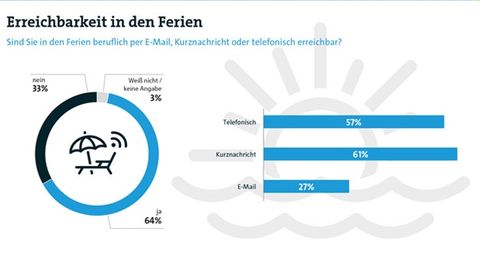
The survey was conducted by the Bitkom association among 426 working people who are on vacation in the summer. Only a third of them stated that they were not available for work while on vacation.
© Bitkom ResearchAccording to the Bitkom survey, younger employees are the most likely to take a break from work while on vacation. 39% of employees up to the age of 29 completely disconnect from work during their summer vacation. Only 30% of 30 to 49-year-olds manage this, and 34% of those over 50.
Most Germans can be reached by phone (57%) or text message (61%) by their boss, colleagues and business partners while on vacation. In contrast, the proportion of those who read work emails has fallen significantly (27%) - four years ago, this figure was twice as high at 54%. In contrast, availability by telephone or text message has hardly changed.
As a rule, employees do not need to be reachable outside of working hours - i.e. on vacation or on public holidays, explains Bitkom CEO Bernhard Rohleder. Where availability is necessary, a clear and mutually agreed arrangement should be made, for example in the form of an on-call service, he recommends and warns: "Situations in which permanent availability is tacitly assumed without this being compensated for in any other way are particularly problematic."


You might also be interested in
Industry in the crosshairs
German industry is increasingly being targeted by criminals: This is the result of a study for which the digital association Bitkom surveyed 503 managing directors and security managers:
 read more...
How employees become opportunists
According to modern management theory, managers should treat employees with respect. In practice, pressure is often released downwards. Management consultant Dr. Albrecht Müllerschön describes how a harsh climate can turn employees into opportunists.
read more...Open-plan office as a communication killer
Whether individual or open-plan offices or flexible workstations - every workplace strategy changes the company's internal communication and team structure. There is no one-size-fits-all solution, but the future is pointing towards greater...
read more...Ten good questions for the job interview
A job interview is not just about giving the smartest possible answers. It's also about asking smart questions back. The New Work consultancy Intrinsify has put together ten inspiring questions on culture and employee orientation.
read more...Does WhatsApp now have to be taken off the company cell phone?
Continental bans social media apps on 36,000 company cell phones - because of the GDPR. Lawyer and employment law specialist Thomas Faas explains the liability risks for users and companies associated with WhatsApp & Outlook.
read more...Job profile of a data scientist
Around a quarter more jobs for data experts
Growing volumes of data are generating new job profiles such as data scientist. The career platform Joblift analyzed around 14 million job advertisements from the last 24 months to find out more about the job profile and the demand for it.
read more..."Robots create jobs"
The rapid expansion of industrial robots is leading to a positive job balance in companies: In addition to tasks that are now performed by machines, new activities have been created for employees. This is the conclusion of a ZEW study.
read more...Avoid burn-out
Due to the increased work pressure in many companies, more and more employees are struggling with mental health problems. In most cases, however, the causes of this are also personal. But how can burnout be avoided?
read more...Hubertus Heil on a summer trip
Battle for future jobs - digital, clean and safe?
Robots are on the rise - but Labor Minister Heil does not want to leave the jobs in Germany to them. Will the digital world of work become cleaner and less stressful or risky and precarious?
read more...