

Six facts about the birthday
The barcode turns 50
In June 1974, a barcode was scanned on a product at a supermarket checkout for the first time. Experts expect the code to be replaced in a few years' time.
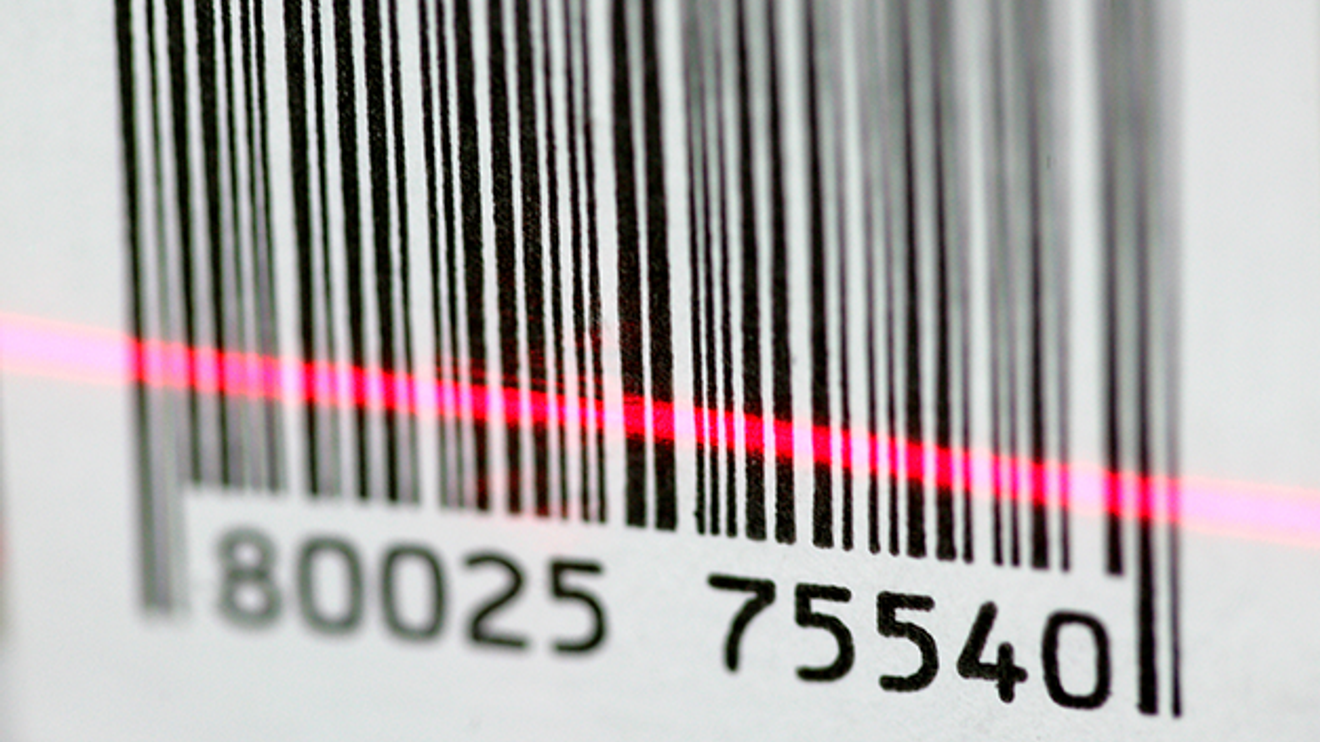
Cologne(dpa) - Thick lines and thin lines, with white in between. Everyone knows them. Barcodes can be found on food, but also on the packaging of electronic goods and labels on new items of clothing. They are an integral part of consumers' everyday lives. On June 26, 2024, the barcode celebrates its 50th birthday. The most important facts about the famous codes.
How they work
Today, more than one billion products carry a barcode, which is scanned ten billion times a day worldwide. The basis for the code is the GTIN below it, a 13-digit article number. The Cologne-based company GS1 assigns the numbers to retailers so that they can label their products and make them identifiable and sellable worldwide. The barcode is then generated using special software. The content of the code and number is the same, only the presentation differs. Companies pay a license fee, the amount of which depends on the annual turnover and the number of article numbers required. There are 116 country organizations worldwide that also offer this service.
Each product has its own barcode. All Milka Alpine Milk chocolate bars have the same article number, while the hazelnut variety has its own. With the encrypted code, each item can be identified worldwide. When a cashier swipes it over the scanner, the system recognizes which product it is. Information on the brand, variety, weight, size, ingredients and nutritional values is stored. Why does it beep when scanning? The beep signals to the cashier that an item has been scanned. If not, it can be scanned again or entered by hand.
The inventors
The codes were invented by the Americans Joseph Woodland and Bernard Silver. In 1948 and 1949, the two students developed a concept and applied for a patent to enable product information to be read automatically even without numbers. However, it was still years before the first product was pulled over a cash register. In 1962, Silver and Woodland sold their now patented invention to the company Philco for 15,000 US dollars. Several manufacturers then set about further developing barcodes and scanners with laser technology.
The premiere
In 1971, retailers and manufacturers in the USA agreed on the introduction of the "Universal Product Code" (UPC) standard. The barcode celebrated its premiere on June 26, 1974, when the first item, a pack of Wrigley's Juicy Fruit brand chewing gum, was scanned with a special device in a Marsh supermarket in Ohio, USA. It is the year in which Germany wins the soccer World Cup final.
In 1976, retail organizations and countries in Europe agreed on the 13-digit EAN code - the so-called "European Article Number". In Germany, the Wuppertal-based company Wichartz was the first to label one of its spice blends with a barcode on July 1, 1977. The first scanner checkout was put into operation in October 1977 in a "Südmarkt" supermarket in Augsburg. According to GS1, almost all packaged food for end consumers in Germany bore a code from 1984. The EAN was renamed GTIN in 2009.
Experts like Stephan Rüschen are convinced of the merits of the technology. "The barcode has not only simplified checkout over the last few decades, but has also significantly improved the entire process chain in retail," says the Professor of Food Retailing at the Baden-Württemberg Cooperative State University in Heilbronn.
What comes after the barcode?
Until the 1970s, every item in stores worldwide had to be labeled individually and every price had to be typed in - even at the major food retailers in Germany. Gradually, companies introduced scanner tills. Edeka installed the first one in Zwingenberg in Baden-Württemberg in 1981. The discounter Lidl switched in 1996. Aldi Süd only later, in 2002, all stores were equipped with modern scanner checkouts, and Aldi Nord even a year later. Looking back on those days, when cashiers knew all the article numbers by heart and typed them in at breakneck speed, they still like to talk about a myth at Aldi today.
Consumers can now decode barcodes using special smartphone apps such as Barcoo. Scanning a product in the supermarket gives access to further product information such as nutritional information.
Pop culture and advertising
The barcode also appears outside its actual area of use. The artist Scott Blake creates images of famous personalities such as Marilyn Monroe that consist solely of barcodes. The street artist Banksy has also repeatedly used the code in his works. Cologne-based private brewery Gaffel also plays with the design. For years, it has been printing a barcode in the shape of Cologne Cathedral on its party kegs and the six-pack of Kölsch beer.
Barcode forever and ever?
"Thank you dear Barcode for your services in the past. The future belongs to others," says retail expert Rüschen. What comes next is already becoming apparent. GS1 expects a gradual switch to two-dimensional codes such as the QR code. The process is already underway and retailers are being prepared for the changeover, they say. According to GS1, the camera-based scanners required for this are already installed in more than 80 percent of checkouts in the retail sector.
Why is a change necessary? "Consumers today are more critical, they want more information about a product, about allergens, data on sustainability and packaging," says expert Sandra Hohenecker from GS1. The article number would not be able to display this large amount of data, but with QR codes this is easily possible and can be tracked transparently for customers. Another advantage is that the best-before date can also be stored. One thing does not change with the QR code: items are scanned individually at the checkout.
This is different with the RFID tag. Expert Rüschen sees good opportunities for this technology. The process for automatically identifying objects via radio is already being used by clothing retailers such as Zara, Uniqlo and Decathlon. The items do not have to be scanned individually, but can be recorded simultaneously - when the shopping cart is pushed through a gate or the products are placed in a tray. The tag can uniquely identify each individual item. This means that 1000 Nutella jars do not have a common number, but 1000 different ones.
The disadvantage: individual identification is time-consuming and RFID tags are more expensive. This is why they are more suitable for higher-priced products in the clothing sector than for a 60-cent yoghurt pot, says Rüschen. He can imagine that RFID will finally become established in the food sector in the next 5 to 10 years. Sandra Hohenecker expects several codes to become established, depending on where they are used. She is unable to predict when the barcode will finally be superseded.


You might also be interested in
Revolutionary for medicine and technology
What Professor Röntgen discovered by chance in the evening during experiments in the laboratory in Würzburg revolutionized science. 100 years after his death, researchers are using the rays named after him to illuminate more than just people.
 read more...
Franco-German test
60 years ago, the former wartime enemies Germany and France signed the Elysée Treaty, a friendship for Europe. Recently, however, there has been quite a bit of friction between the neighbors. The anniversary now offers the opportunity for a new...
read more...Curious standards from tea to clay
Tea is quickly made in everyday life. But not when it comes to ISO standard 3103. Here, the process is explained in great detail over six pages. You can read these and other strange guidelines here.
read more...Saxony and Bavaria conduct joint research
Over the next three years, three universities from Munich and Dresden want to work on making the use of artificial intelligence even better. This also involves energy consumption.
read more...German industry records more orders for the first time in 2024
German industry surprisingly received significantly more orders in June. However, experts do not believe the downward trend has been broken yet.
read more...Data leaks more expensive - German companies fix them quickly
Data leaks can cost companies dearly. In Germany, the costs have recently risen significantly - but local companies are among the fastest when it comes to fixing them.
read more...Authority wants to regulate industrial discounts on grid fees anew
In view of the changing electricity mix in Germany, the Federal Network Agency is planning to revise the discounts that industrial companies receive for their electricity consumption. The regulatory authority presented a key issues paper on the...
read more...Bridge between research and application
DFKI AI Center launches
A new facility for AI is to be a point of contact for small and medium-sized enterprises and start-ups in particular. The Digital Minister speaks of AI "Made in Germany".
read more...Worldwide computer malfunctions - What we know and what we don't know
Computer problems are disrupting air traffic in many places around the world. Here is an overview of what is known so far and the aspects that are still unclear.
read more...