
Wireless
Sparking sensor networks
Point-to-point connections for wireless sensors are the status quo on moving or inaccessible machine and system parts. New are wireless networks that connect hundreds of sensors to higher-level IT systems via access points.
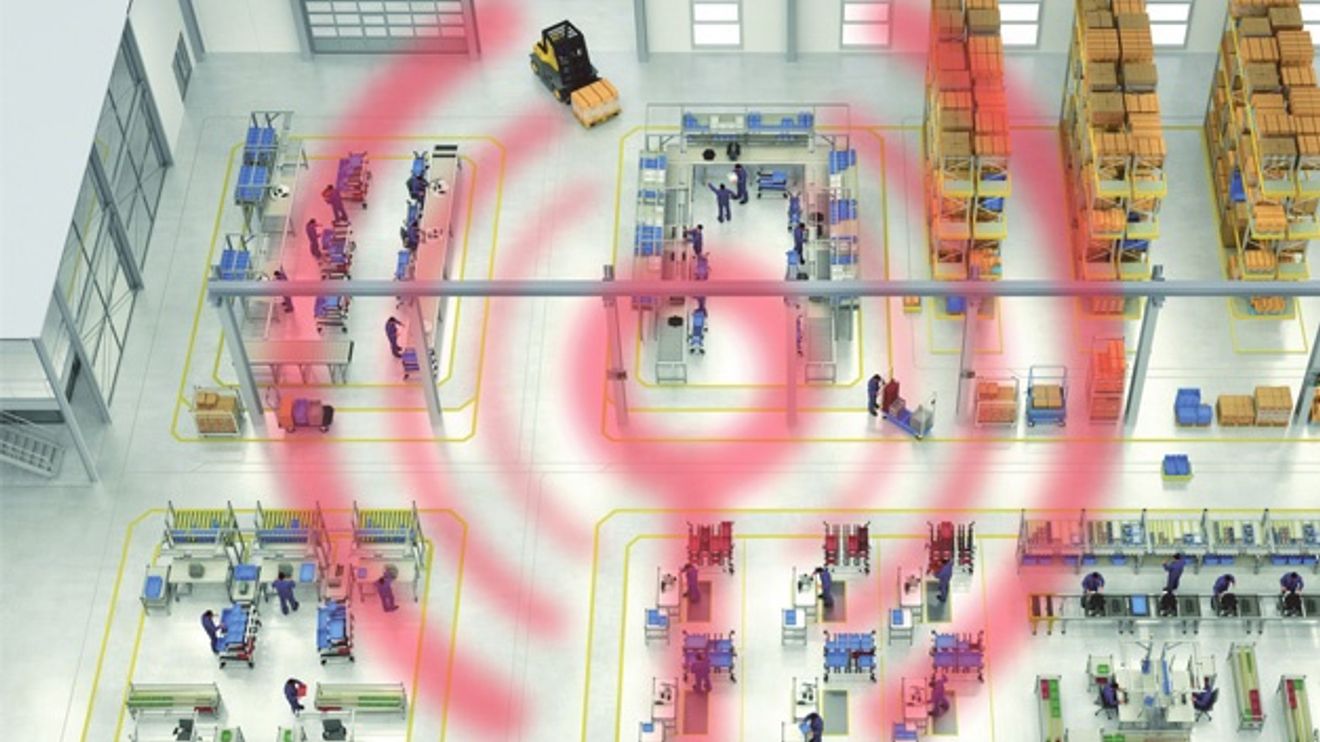
There is a wide range of wireless technologies available for industrial applications. Standards such as IEEE 802.15.4 (Zigbee), Wireless HART and Bluetooth each fulfill different requirements, their participants transmit in short-range traffic and are considered 'Short Range Devices' (SRD).

For sensor-actuator communication, however, the 868 MHz frequency range has become established (or 915 MHz in other regions of the world). This radio standard enables bidirectional operation with a maximum range of 60 m indoors and 700 m outdoors, does not interfere with DECT, WLAN, PMR and other radio systems and can be easily integrated into automation systems. As it works with short telegrams, the duty cycles are short and the collision probabilities are correspondingly low.
Many applications require confirmed communication or a query of the status of a sensor; bidirectional communication is absolutely essential here. For these applications, Steute has developed its own wireless technology called sWave 868/915, which can be operated with energy harvesting systems or battery-powered.
Uni- or bidirectional
In order to achieve a favorable propagation behavior, frequencies in the sub-GHz range were selected, whose low energy consumption enables battery operation of the wireless sensors with battery life of several years and makes battery management superfluous.
The transmission reliability of sWave 868/915 is being continuously enhanced - for example by adding the 'Listen before talk' function to the radio protocol. This enables the switching device to check the assignment of the selected frequency before the signal is sent. Figuratively speaking, the wireless switching device 'listens' to the radio network before communicating. This prevents the transmission from being impaired by transmitters that are transmitting at higher power at the same time, for example.
Sensor principles such as magnetic, inductive and optical sensors (light scanners) can be made fit for this wireless technology. Radio inductive sensors are used in combination with a universal transmitter. Wireless magnetic sensors are used, for example, to detect the position of machine components, tools or workpieces, and security tasks in industrial building technology are also part of the range of applications. Wireless inductive sensors are used, for example, to monitor the position of valves in process engineering applications and in energy technology. And last but not least, wireless diffuse sensors can be found in intralogistics, for example, where they check the occupancy of conveyor lines or rack bays with containers or cartons.
Most wireless technologies today operate in the 2.4 GHz frequency band. Although Steute does not use this band for the communication of wireless sensors, it does use it for wireless switching devices.
The 2.4 GHz technology
The 868/915 MHz band is less susceptible to interference and offers medium availability of the single-channel radio link. Other features are the short 'wake-up time' of 4 ms on activation and the possibility of connecting many transmitters to one receiver. The 2.4 GHz band, on the other hand, is multi-channel and the availability of the radio link is significantly higher. The FHSS method (Frequency Hopping Spread Spectrum) with eight channels in four frequency groups contributes to this. A special procedure also ensures good coexistence with the 2.4 GHz technologies often used in parallel, such as WLAN and IEEE 802.15.4 (ZigBee).
In the 'sWave' radio system, the 2.4 GHz technology has fourfold redundancy, while the redundancy of sWave 868/915 is simple. A special 'pairing' procedure enables interference-free parallel operation of several transmitter and receiver units. However, the range of 2.4 GHz radio switching devices is significantly shorter at 20 m.
In terms of market positioning, this results in a dichotomy: the 868/915 MHz band is the 'basic technology' for irregular sensor-actuator communication, while the 2.4 GHz band is more suitable for more demanding applications with high reliability but a short range. In the 2.4 GHz band, there are also dedicated radio protocols for safety-related applications and hazardous areas.
Wireless networks for sensors

Gateway nodes connect the sensor network to a backend system, such as an IP network. The transmission of messages via the sensor network is controlled by the 'sWave.Net' communication protocol. The middleware provides basic services.
© Steute switchgearAnother trend is making a name for itself, particularly in material flow technology systems: Wireless networks in which several hundred electromechanical switching devices and/or sensors communicate wirelessly with higher-level IT systems via access points. These systems complement the radio standards, which are all based on a point-to-point connection between sensor and receiver unit.
Under the name 'sWave.Net', Steute also offers such a wireless system for complex installations and networks. It is limited to the irregular transmission of small data packets with extremely low energy consumption and has a range of up to 700 m in the open field or a maximum of 50 m in mobile machine applications.
At sWave.Net, the interface between the customer-specific application and the radio system is provided by driver software, which also manages the entire radio system. In the current version of the wireless network, this software handles communication with the higher-level IT infrastructure, for example with the warehouse management system or production planning and control. As easy-to-install standard software solutions are available in these areas, there is no need for customer-specific interfaces.
The advantage of such wireless networks is the possibility of exchanging information and data across the individual levels - from the store floor to management, which is particularly important for production designed according to the principles of Industry 4.0.
Wireless position sensor for intralogistics

Wireless sensor for E-Kanban systems: When the container is removed, the sensor that detects the position of the rocker sends a radio signal to the material flow control system via the access point.
© Steute switchgearA special wireless sensor was developed for E-Kanban systems. In this type of automated replenishment in material flow technology, a position switch or sensor detects whether a container is on the roller conveyor of a Kanban rack and sends a corresponding signal to the controller of the E-Kanban system. A large rocker serves as the actuating element and an integrated position sensor detects the position of the rocker without contact. Both the angle of inclination and the switching hysteresis at which a signal is triggered can be set via the 'sWave.Net' software. In practice, these wireless position sensors, which are available for the frequencies 868, 915 and 922 MHz, are mainly used to detect the filling of roller conveyors in shelving systems: If the penultimate container is removed, the sensor sends a signal to the radio receiver and requests replenishment. Alternatively, staggered signals can be issued - several wireless sensors in a row of racks then also report the removal of the third or penultimate container. As such sensors are often used in large numbers, it makes sense to integrate them into a wireless network.
The possibility of operating wireless sensors in production-wide networks will open up further areas of application for wireless technology - particularly in material flow technology. In addition to E-Kanban racks, this could include, for example, the monitoring of gates and ramp locations in goods distribution centers or occupancy detection on mobile systems such as AGV fleets (AGV: automated guided vehicle systems).
Author:
Andreas Schenk is Wireless Product Manager at Steute Schaltgeräte in Löhne.


You might also be interested in
New test laboratory in Neu-Isenburg
UL Solutions builds EMC and radio laboratory
UL Solutions has started construction of a new laboratory for electromagnetic compatibility and wireless communication in Neu-Isenburg. The facility is set to expand testing capacities for industrial systems, medical technology, consumer goods and...
 read more...
Safe Wireless HMI for Profinet/Profisafe
The 'KeTop T150/T155 Safe Wireless' mobile handheld control units from Keba are suitable for mobile machine and robot operation.
read more...5G module production entirely in Europe
Kontron has announced that it will manufacture its 5G modules entirely in Europe in future. In doing so, the company wants to underline its commitment to shorter supply chains, Europe's technological sovereignty and the reduction of CO2 emissions.
read more...5G and Industrial Wireless Arena continues to grow
Next year, the three partners VDMA, ZVEI and Deutsche Messe will continue their collaboration at Hannover Messe 2025 as part of the special show "5G and Wireless Arena".
read more...Four tips for successful automation
Some SMEs are reluctant to introduce automation solutions because they perceive them as complicated, expensive and time-consuming. Peter Lange from Omron gives four tips to help simplify automation.
read more...9th TSN/A Conference 2024 - Registration is open now!
"Application of TSN" - this is the motto of the international TSN/A Conference, which will take place in Stuttgart from October 1st to 2nd this year. Join the community and discuss the application of the real-time Ethernet standard with experts and...
read more...The Cloud RAN extension
The 5G-Industry Campus Europe in Aachen has now been expanded with a Cloud RAN infrastructure. "Cloud RAN" creates a basis for the use of 5G functionalities and industrial applications on shared server hardware.
read more...Radio-based communication
Steute Technologies' Controltec division will be presenting its wireless industrial switching devices in a suitable environment - at the Industrial Wireless Arena + 5G Networks & Applications at the VDMA joint stand.
read more...Wireless IoT retrofit via vSoM
With eDNP/8331, SSV offers a concept for virtual System-on-Module (vSoM) solutions including various wireless IoT modules.
read more...