
Saarland University / Hannover Messe 2017
Sensor cable detects the smallest magnetic field changes
Where exactly is the subway or the train in the tunnel? Where is someone trying to get onto a property where they have no business being? Or: Who has a cell phone with them when they shouldn't? Answers can be found in a thin sensor cable that scientists at Saarland University are working on.
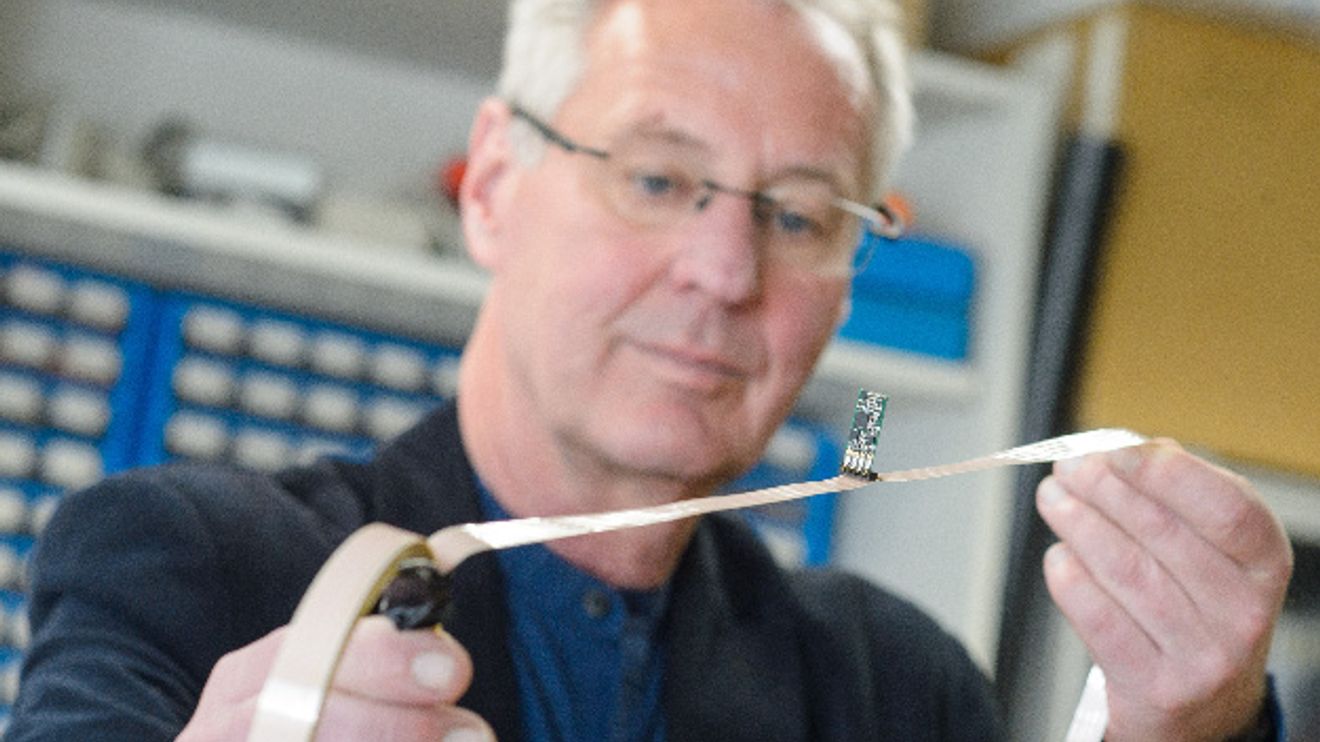
The innovative sensor cable detects everything that changes the earth's magnetic field in any way a few meters around it. It recognizes the smallest changes in the magnetic field, assigns them and reports them. Without collecting data.
Attached to fences...
...it can distinguish, for example, whether it is just the wind shaking the mesh or a bolt cutter.
Installed in the ground...
...it recognizes cars, detects which direction they are driving in and distinguishes them from trucks. It even detects drones flying over the cable at a height of a few meters - as well as the zipper or cell phone of the person walking over it.
At airports, subways or train stations...
...it makes new control systems possible, as well as new monitoring technology on private property, nuclear power plants and industrial facilities.
Various sensor systems developed by his working group...
...are already being used as traffic guidance systems, for example at airports or in parking garages. "We have continuously developed the magnetic field sensors over the past few years and made them increasingly sensitive and selective," explains Professor Uwe Hartmann, project manager at Saarland University. "We can very precisely assign the measured values and signal patterns that arise when our sensors detect changes to the causes of a disturbance."
The small sensors, which the physicists string together like beads on a string...
...in a thin cable, are networked with each other and report their measured values to a microcontroller. This processes the data further.
"The signal patterns differ depending on the type of interference," explains Hartmann. "We have simulated several types of changes in the magnetic field and vibrations in numerous series of tests and assigned them to the respective causes. We used this information to teach the system. It recognizes typical patterns, assigns them to faults independently and sorts out false alarms."
To do this, the physicists have...
...mathematically modeled and programmed and refined the evaluation unit and sensors in ever greater detail. The system shows the exact location of the fault, which is particularly interesting for large monitored areas.
"We can adapt it very flexibly to a wide range of requirements," explains Haibin Gao, who holds a doctorate in physics and is researching the new sensor technology in Hartmann's team. "At the Hannover Messe at the end of April, we will be looking for partners with whom we can develop the system to series production readiness as required," says Gao. The sensor cable does not require a lot of power, and could be powered by solar generators, for example. The sensors are virtually wear-free and their measurements are independent of the weather - they work without any problems even in rain, fog or snow. And the system does not store any data or other information. Hackers also have no target. Messages can be sent to a smartphone or tablet via Bluetooth, for example."
The Federal Ministry of Education and Research funded the research...
...with a total of over one million euros, more than 250,000 euros of which went to Saarland University. The partners involved were Sensitec, based in Mainz and Lahnau, Listec, based in Isen, and GBA-Panek, based in Kahla.


You might also be interested in
The 'incredible machine'
100 years ago, in a workshop in Esslingen am Neckar, Festo founder Gottlieb Stoll asked himself how technology could make work easier. To mark the company's 100th anniversary, Festo has now designed and built a machine that shows the fascinating...
 read more...
SmartFactory-KL at the Hannover Messe
The production island_Phuket
AI applications increase the performance, efficiency and productivity of robots, machines and production systems and also help to save a lot of money because they significantly reduce material usage, energy requirements, CO2 emissions and set-up and...
read more...ZVEI at the Hannover Messe 2025
ZVEI criticizes high regulatory hurdles
At the start of Hannover Messe 2025, the German Electrical and Electronic Manufacturers' Association (ZVEI) described the economic situation in the German electrical and digital industry as challenging.
read more...BDI at the Hannover Messe 2025
Industry in crisis
At the start of Hannover Messe 2025, leading industry associations BDI, VDMA and ZVEI described the economic situation in Germany as worrying. According to BDI President Peter Leibinger, the mood in many companies is worse than ever before.
read more...VDMA at the Hannover Messe 2025
Mechanical engineering calls for far-reaching reforms
At Hannover Messe 2025, the mechanical and plant engineering industry emphasized the need for comprehensive reforms in order to strengthen industrial competitiveness in Germany and Europe. The VDMA believes that the German government and the...
read more...Industry 4.0 - outgrowing its infancy
At Hannover Messe 2019, it became clear that Industry 4.0 has long since left the theoretical stage. Smart factories and future-proof manufacturing concepts characterized the image of the trade fair in many places.
read more...Robotics - safe and cost-effective
Robotics doesn't have to be expensive, complicated and dangerous for workers - this was the message sent by numerous exhibitors at Hannover Messe 2019 to visitors to 'Robot Hall 17'.
read more...AI as the dominant topic
True to the leitmotif of this year's Hannover Messe - Industrial Intelligence - the topic of artificial intelligence was omnipresent at the exhibitors' stands; not only in theory, but also in practice using the example of numerous use cases.
read more...The video review
"Integrated Industry - Industrial Intelligence" was the guiding theme of this year's world's largest industrial trade fair. Which topics were particularly in focus this year? Computer&AUTOMATION was on site with a camera.
read more...