
KIT
Printed circuits protect sensors
Electronic sensors can benefit many applications in industry, for example in automotive engineering. However, they must be protected against attacks and falsification. This is where the 'sensIC' joint project comes in.
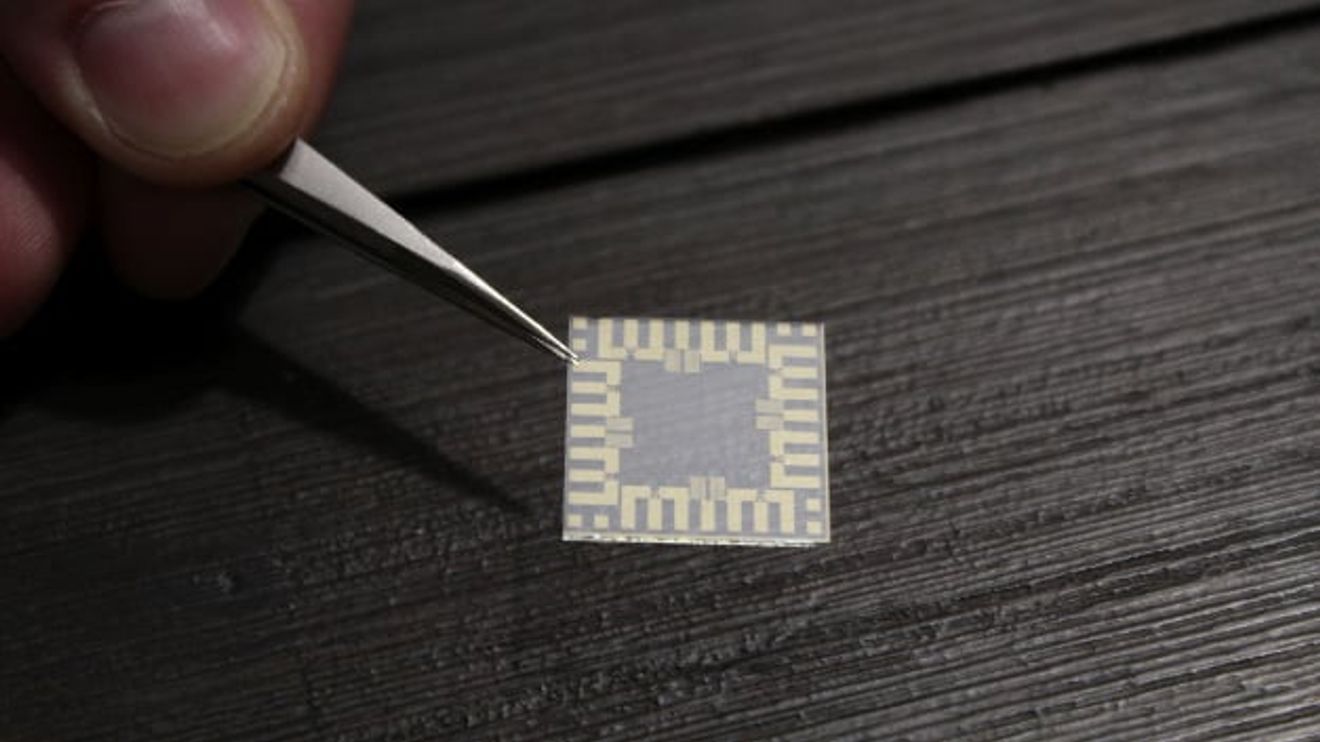
The joint project 'sensIC' aims to integrate printed electronics and silicon components directly into products in order to safeguard sensors. To this end, researchers at the Karlsruhe Institute of Technology (KIT) are developing a central component: printed safety circuits with special hardware-based functions, so-called Physical Unclonable Functions (PUFs).
Electronic sensors can reduce costs, improve reliability and enable new functions in many applications. For example, they monitor the temperature of batteries in electrically powered vehicles in order to optimize their service life and performance, and in chemical and pharmaceutical plants they monitor the operating status of passive components in order to detect faults immediately. Their use is particularly important when substances such as drinking water or food, oil or gas are transported through pipelines and a reliable supply and distribution chain must be guaranteed. Sensors can help to detect tampering immediately. However, sensors that convert physical states into data streams are themselves exposed targets for attacks and falsification. "Currently, information security in these applications is mainly based on software algorithms. But no software is perfect. That's why we also have to ensure security via the hardware," explains Professor Jasmin Aghassi-Hagmann, head of the 'Low Power Electronics with Advanced Materials' research group at the Institute of Nanotechnology (INT) at KIT. "Additive processes that create two- and three-dimensional components layer by layer are particularly suitable for this. With the help of such components, we can retrofit safety functions without having to hand over the design to the manufacturer."
The joint project 'Unique identifiability for trustworthy hybrid sensor electronics using additive manufacturing - senslC' combines additively manufactured, i.e. printed, electronics with silicon components and securely integrates them directly into products. As a concrete application of the project, hybrid integrated sensor circuits are built into hoses, as required for various automotive and industrial applications. The project, coordinated by Benecke-Kaliko, a subsidiary of Continental, combines materials science and cybersecurity. At INT, researchers led by Professor Jasmin Aghassi-Hagmann are developing and manufacturing a central component for this: printed security circuits with so-called Physical Unclonable Functions (PUFs).
PUFs are hardware-based functions that arise due to minute fluctuations in the production process. For example, variations occur in printed electronics due to the coarse print resolution and the materials and inks used. A PUF evaluates these fluctuations and generates an individual signal that acts as a digital fingerprint, so to speak, and enables the unique identification of the component or the secure encryption of information. In a paper recently published in the journal Nature Communications, the research groups led by Professor Mehdi Tahoori, Professor Horst Hahn and Professor Jasmin Aghassi at KIT, together with Professor Axel Sikora's group at Offenburg University of Applied Sciences, have presented a hybrid PUF based on metal oxide thin-film devices that combines printed electronics and silicon technology. This PUF is suitable for securing devices and protecting data in the Internet of Things, in which people communicate with machines and machines communicate with each other.
For industrial and automotive applications, the sensIC project supplements PUFs as electronic identification features with optical identification features developed by Polysecure: embedded fluorescent particles form random and therefore non-copyable patterns as a result of the process. These particle patterns are registered during the production process and allow the component to be uniquely identified as well as providing additional pad protection against hardware manipulation.
The Federal Ministry of Education and Research (BMBF) is funding the three-year sensIC project, which was launched on 1 May 2021, with 2.9 million euros and a total project volume of 4.25 million euros as part of the 'Microelectronics from Germany - Innovation Drivers of Digitalization' framework programme. Benecke-Kaliko, a subsidiary of Continental, is acting as coordinator. In addition to the Institute of Nanotechnology at KIT, other partners involved in the project are Cyient, Polysecure, the Leibniz Institute for New Materials, Offenburg University of Applied Sciences, ContiTech MGW and, as an associated partner, Elmos Semiconductor.


You might also be interested in
Electronic nose sniffs out mint scents
If you want to distinguish plants in nature, you need a lot of experience, an identification book or a good nose: in this respect, technical support could soon be available in the literal sense.
 read more...
Karlsruhe Institute of Technology
New AI methods for picking robots
Researchers at the Karlsruhe Institute of Technology (KIT) are working with partners from Germany and Canada to make order picking robots more intelligent using distributed AI methods.
read more...The e-paper of issue 4/2021
In the e-paper of our issue 4, you can find out why the focus of IoT application development is shifting away from the cloud and towards the edge. You can also read more about TSN in conjunction with Linux and RTOS and how to close security gaps in...
read more...Security for embedded systems
In the 'Xandar' project coordinated at the Karlsruhe Institute of Technology (KIT), partners from science and industry are developing a complete tool chain for software development and hardware-software integration for complex applications.
read more...Robotic artificial intelligence you can touch
Making artificial intelligence tangible through humanoid robots - this is the aim of the 'Robotic Artificial Intelligence' real-world laboratory at the Karlsruhe Institute of Technology (KIT).
read more...Value stream kinematics research project
Revolution in production?
Together with industrial partners, KIT scientists are developing a production planning system that combines the precision of specialized machines with the flexibility of industrial robots.
read more...The top articles in July 2024
Innovative spirit and entrepreneurial thinking characterize the most-read articles from July. Find out more about competitive advantages through AI, click through award-winning developments and read more about model-based design and quantum sensor...
read more...Robotics Institute Germany founded
Together, the leading locations for robotics in Germany will establish the Robotics Institute Germany (RIG), which is to become the central contact point for robotics in Germany in the future.
read more...Karlsruhe Institute of Technology
The EDAI project
In the EDAI project, researchers at the Karlsruhe Institute of Technology (KIT) are combining the design of AI algorithms and AI chips. EDAI is based on open source software to facilitate access to AI-based solutions, particularly for small and...
read more...