
Gas sensors
No chance of leaks
The main area of application for sulphur hexafluoride is the insulation of high-voltage electrical switchgear. As the non-toxic gas is the strongest of all greenhouse gases, its use is subject to the strictest environmental regulations - and special requirements for measurement technology.
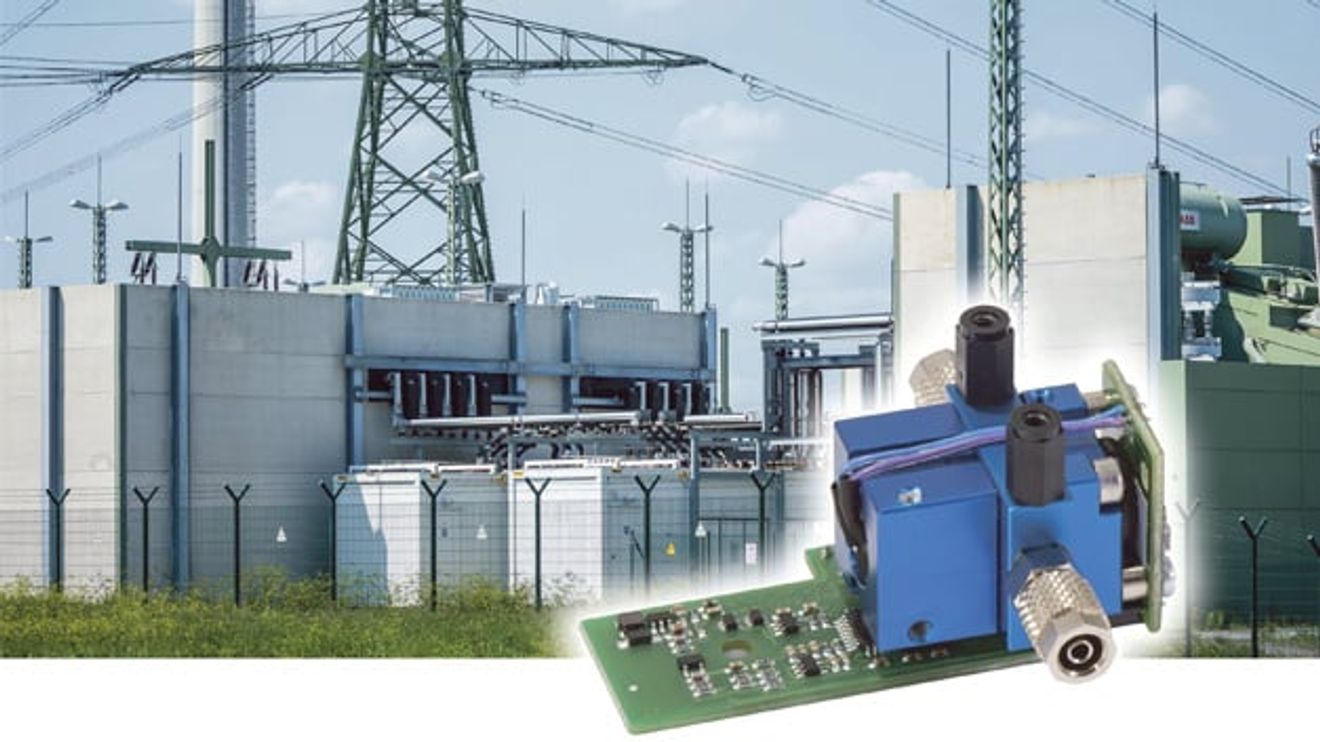
Gas-insulated switchgear with high-voltage switches are used all over the world. Their advantage over air-insulated systems is their compactness: as the protective gas SF6 has a dielectric strength three to four times higher than air and therefore effectively prevents sparks or the formation of an arc, air-insulated systems with SF6 insulation that would otherwise be the size of a soccer pitch can now theoretically fit into the basement of a detached house. In addition, spark gaps extinguish much faster in an SF6 atmosphere than in the air. This makes the inert gas indispensable, especially in densely populated areas with a high level of electrification in confined spaces, in order to guarantee the safe operation of electrical high and medium-voltage systems and a stable supply to the urban infrastructure.

The compact NDIR gas sensor SF6 sensor (1000 ppm) of the 'Flow Evo' series is typically used in portable gas detectors or stationary SF6 detection devices to measure SF6 MAC values.
© Smart gasHowever, during operation, the purity and thus the protective function of the gas in the switch decreases. This is due to the arcs that occur in the switch as a result of the switching processes, which chemically convert parts of the SF6. It is therefore necessary to recycle the gas at regular intervals. In order to measure the purity, the smallest possible volume of gas is extracted from the switch, which must then be analyzed quickly and reliably - incorrect measurements can lead to unnecessary replacement of the gas filling and thus to costs that can in principle be avoided. As part of the purity measurement (100 percent by volume), a clear measurement with the smallest gas volumes is therefore required.
Gas-insulated switchgear is also never absolutely leak-proof. Leaks at seals, flanges and the like cause SF6 to escape and air to enter at the same time. In practice, the loss rate due to such leaks is around 0.5 percent by volume per year. These leaks must be eliminated immediately because SF6, although non-toxic and non-flammable, is the most climate-damaging of all greenhouse gases with a GWP (global warming potential) of almost 24,000. For this reason, it is advisable to equip gas-insulated switchgear with stationary gas warning systems that sound the alarm as soon as a critical SF6 concentration is exceeded in the room air. The measuring ranges of such gas warning systems are usually 1000 ppm. Mobile SF6 leak detectors are also used for regular maintenance work.
Harmless background gases

Thanks to SF6 insulation, high and medium-voltage systems can be operated safely in the smallest of spaces.
© Smart gasThere are various measurement methods for both cleanliness measurement and leak detection, whereby optical measurement methods are considered superior to others in terms of service life, selectivity and low maintenance. Optical methods include detection with sensors based on the NDIR principle (non-dispersive infrared). The sensors are based on a purely physical process and measure the concentration of the gas to be detected via the degree of absorption of its specific wavelength in the infrared spectrum. Background gases such as cleaning agents or solvents do not influence the measurement.
Unlike sensor technologies based on chemical reactions, NDIR gas sensors are not consumed and therefore require less maintenance and have a longer service life. The lower maintenance requirements and reliable measurements go hand in hand with low system downtimes and high system availability. They are also characterized by low detection limits, a high temperature range, short response times and low drift.
An example of such NDIR gas sensors are the SF6 sensors in the 'Flow Evo' series from Smartgas. With measuring ranges of 100 vol%, 1500 ppm, 1000 ppm and 50 ppm, the company offers technologies for quality monitoring, indoor air monitoring and leak detection.
Principle of the dual wavelength
The SF6 sensor (100 % by volume) for precise measurement of the purity or quality of the SF6 gas filling in gas-insulated switchgear and transformers or cables uses dual wavelength technology, as do all of the manufacturer's sensors. The measurement in accordance with IEC 60480 for testing SF6 after removal from electrical equipment is used to decide whether the SF6 must be recycled or can remain in the switch. The measuring range from 0 to 100 % by volume and the special adjustment to the 'working range' between 80 and 100 % by volume qualify the SF6 sensor (100 % by volume) for continuous and discontinuous monitoring measures in high-quality SF6-insulated medium and high-voltage switchgear. Due to its internal volume of less than 1 ccm, the amount of SF6 to be extracted for measurement is reduced to a minimum.
The SF6 sensors with a measuring range of 1000 or 1500 ppm are ideal for monitoring compliance with the maximum SF6 concentration in the ambient air (MAK value = 1000 ppm) in switchgear, gas storage facilities, power stations and substations as well as in semiconductor manufacturing plants. They are typically used in portable gas detectors or stationary SF6 detection devices. As SF6 has a much higher density than air and collects at the lowest point of a room, the sensor protects maintenance personnel from the risk of suffocation, especially when used in low-lying rooms.
The SF6 sensor with a measuring range of 50 ppm is also installed in portable gas detectors or stationary SF6 detection devices for discontinuous or continuous measurement of the smallest SF6 leaks. Due to its high sensitivity and low lower detection limit, this sensor reliably detects even minimal SF6 leaks. It performs its function if, for example, the quality measurement has produced a negative result and/or the gas warning system has tripped due to increased SF6 concentrations in the room air. The leak is detected with a portable gas detector and repaired immediately.
Another typical application of the SF6 sensor (50 ppm) is the detection of SF6 in the context of environmental simulations. SF6 is often used as a tracer gas for investigations into the spread of fire gases or hazardous substances in tunnels, subway railroads, buildings or ships. The gas is released in very low concentrations and can then be measured in real time using highly sensitive sensors. These low concentrations and background gases pose problems for conventional measurement methods or have previously been associated with high costs when using optical methods, for example. In addition, the devices are often too large for portable use at the measurement site.
The sensors, which are also suitable for laboratory applications with high demands on performance, selectivity and reliability, can be easily integrated into OEM systems. They have either Modbus ASCII or RTU interfaces for connection to the system controller. As the NDIR gas sensors are based on a single platform, application-specific adaptations can be easily made. And as all of the supplier's sensors have the same data interface, they can be operated in parallel. This allows users to interchange the sensors without having to make changes to the software or the data interface.
Author:
Volker Huelsekopf is Managing Director International Sales at Smartgas Mikrosensorik in Heilbronn.


You might also be interested in
From sensor to intelligent system
Sensors, measurement technology and artificial intelligence are merging to form intelligent systems. From June 9 to 11, 2026, Sensor+Test in Nuremberg will showcase the most important trends in a changing industry.
 read more...
Changes to the Endress+Hauser Executive Board
Three new people will strengthen the top management level of Endress+Hauser in the future: The Board of Directors has appointed Dr. Mirko Lehmann, Prof. Dr. Katja Windt and Helena Svensson to the Group's Executive Board.
read more...Sensors and measurement technology
Application start for AMA Innovation Award 2026
The AMA Association for Sensors and Measurement (AMA) is inviting scientists and developers from industry and research to apply for the AMA Innovation Award 2026. We are looking for research and development results in sensor and measurement...
read more...Industrial AI at SPS | Endress+Hauser
"AI will become a natural functional component"
Industrial AI is also becoming increasingly relevant in process automation: although field devices themselves still make little use of it, it is already proving helpful in evaluation and peripheral devices as well as control systems. Christian...
read more...Slight decline in incoming orders
The sensor and measurement technology sector recorded no change in turnover in the third quarter of 2024 compared to the previous quarter. However, turnover fell by 10% compared to the third quarter of 2023. Incoming orders were 2% below the level...
read more...Chip start-up founded
The start-up milli IC from Karlsruhe specializes in the development of ASICs - and Vega Grieshaber is 'on board' to ultimately develop radar measuring devices with radar frequencies of more than 100 GHz.
read more...Indian flowmeter producer acquired
The Baumer Group has acquired Manas Microsystems, a supplier of flow meters in India.
read more...Largest construction project in the company's history launched
The Endress+Hauser Group's oldest and largest production site in Maulburg is being extensively modernized and expanded. To this end, the provider of measurement technology and automation solutions is investing more than 100 million euros in the...
read more...Endress+Hauser Liquid Analysis
New managing director from October 2024
Dr. Thomas Buer will become Managing Director of Endress+Hauser Liquid Analysis on October 1, 2024. He succeeds Dr. Manfred Jagiella, who is retiring at the end of September after 17 years at the helm of the competence center for liquid analysis.
read more...