
TU Kaiserslautern
Automatically detect wear phases
In order to develop material combinations such as plastic-metal systems with better friction behavior, Kaiserslautern researchers have developed a system that automatically detects wear phases and analyzes data directly.
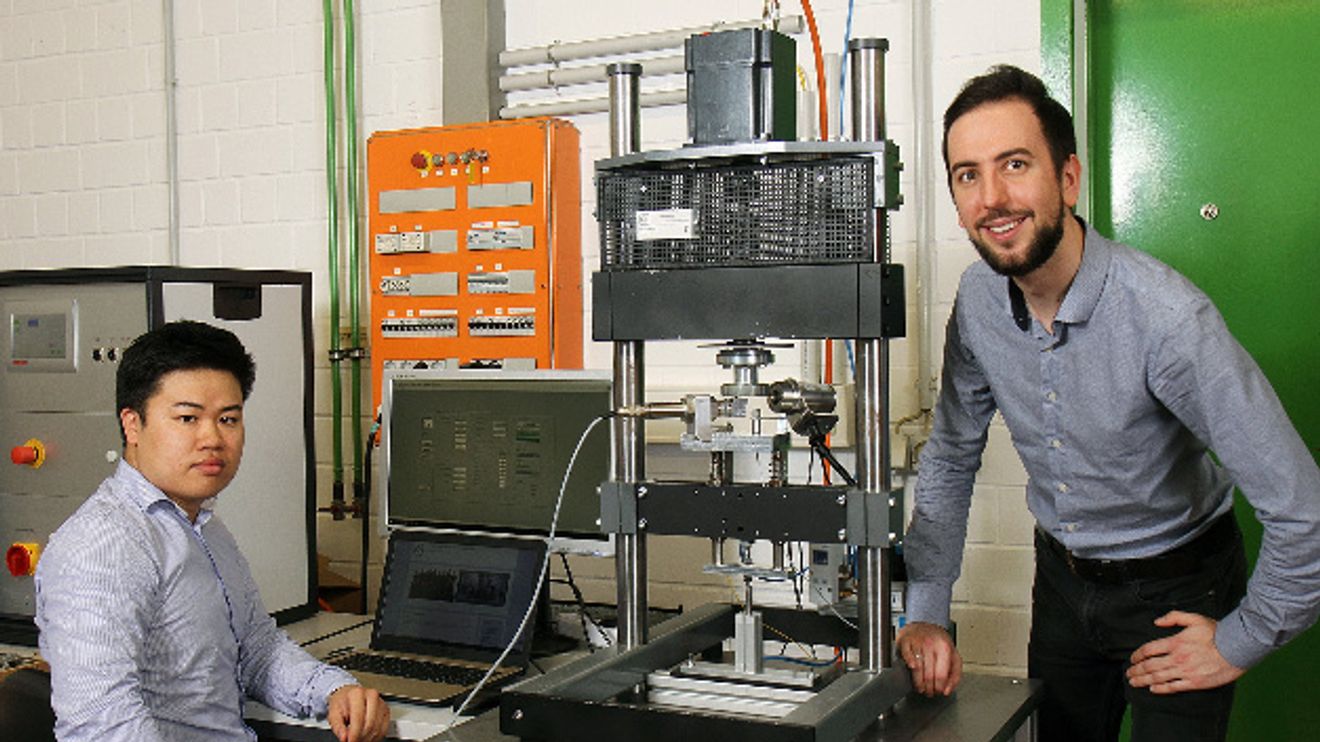
At the Chair of Composite Materials under Professor Dr. Alois K. Schlarb at the Technical University of Kaiserslautern (TUK), researchers are developing new types of materials. Among other things, they are investigating how the service life can be increased under the influence of friction and wear. In this context, experts speak of tribology, the science of friction, wear and lubrication.
Various testing machines are used for this purpose, such as the pin-on-disc tribometer. A small rectangular sample (pin) is clamped in a holder. A metal disk is placed over it, which rests directly on the sample. The disk can rotate for several hours in this test stand. There are sensors on the device that measure the contact pressure and frictional force, and an infrared sensor also records the temperature. "We set the speed using a motor and the contact pressure of the disk using air pressure, and the temperature can also be regulated," says PhD student Sebastian Kamerling. "We use this technology to simulate different conditions that components are exposed to during operation," continues the engineer. "The measured values help us to see how the material pairing behaves. By this we mean the combination of a plastic base body with a metal counter body; simply put, a plastic-metal system."
The Kaiserslautern engineers have now developed a globally unique system for this test. "On the one hand, it controls the machine," continues Kamerling. "It recognizes when a constant phase is reached, i.e. when the wear phase that is relevant in practice begins and the actual measurement can start." Previously, this required manual control. The technology is also able to automatically set a new load level. What's more, the system evaluates the resulting data directly. "With our method, we can measure and analyze significantly more data in less time," the researcher continues. "This also helps us, for example, to characterize the properties of the material sample much more precisely."
The method is not only interesting for research, but also for industry, as such testing techniques play a role in many companies to determine material wear. The technology can help to make this work faster and more efficient. The testing effort is significantly reduced with the new method. Material and cost expenditure can also be reduced in this way.


You might also be interested in
Monitor critical machine states
TE Connectivity is developing the 830M1 triaxial broadband accelerometer in response to the increasing demand for solutions for monitoring the condition of critical machine states using sensors.
 read more...
Cable easily replaceable
The triaxial ICP sensor model 356A06 from Synotech offers a measuring range of 1000 g with a sensitivity of 5 mV/g and, according to the supplier, a wide frequency range for many types of vibration tests.
read more...Quantum sensor technology for commercial applications
E²MS service provider Turck duotec has become a strategic investor in the start-up Quantum Technologies from Leipzig. The necessary contracts were signed at the beginning of March 2021.
read more...Draw-wire displacement sensors for industrial applications
Draw-wire sensors in the Wiresensor WPS-K100 series from Micro-Epsilon measure paths and distances in industrial environments. Two new models have measuring ranges of 1500 and 2500 mm.
read more...Programming is welcome!
Researchers at the Technical University of Kaiserslautern have put a programmable 'Farmbot' into operation, which interested parties can help program via the Internet. The aim is to create a robot that gardens independently.
read more...Data transmission / architecture
5G transmission masts of the future made of wood?
The new 5G wireless standard aims to make communication and data transmission faster and more efficient. One prerequisite for this is sufficient transmission masts. The TU Kaiserslautern has investigated how these can be integrated inconspicuously...
read more...Technologies for precise data and analytics
From June 9 to 11, 2026, Sensor+Test once again brought together trade visitors from the fields of sensor technology, measurement, and testing in Nuremberg. With its focus on these core technologies and the wide range of application areas, the trade...
read more...Increased revenue and expanded production capacity
The Fraba Group, a manufacturer of sensors for industrial motion control, looks back on a successful 2025, during which both revenue and the number of employees increased.
read more...From sensor to intelligent system
Sensors, measurement technology and artificial intelligence are merging to form intelligent systems. From June 9 to 11, 2026, Sensor+Test in Nuremberg will showcase the most important trends in a changing industry.
read more...