
TÜV South
The cybersecurity trends of 2022
Cybercrime-as-a-Service, growing awareness and securing the entire supply chain are among the most important trends in cyber security in 2022.
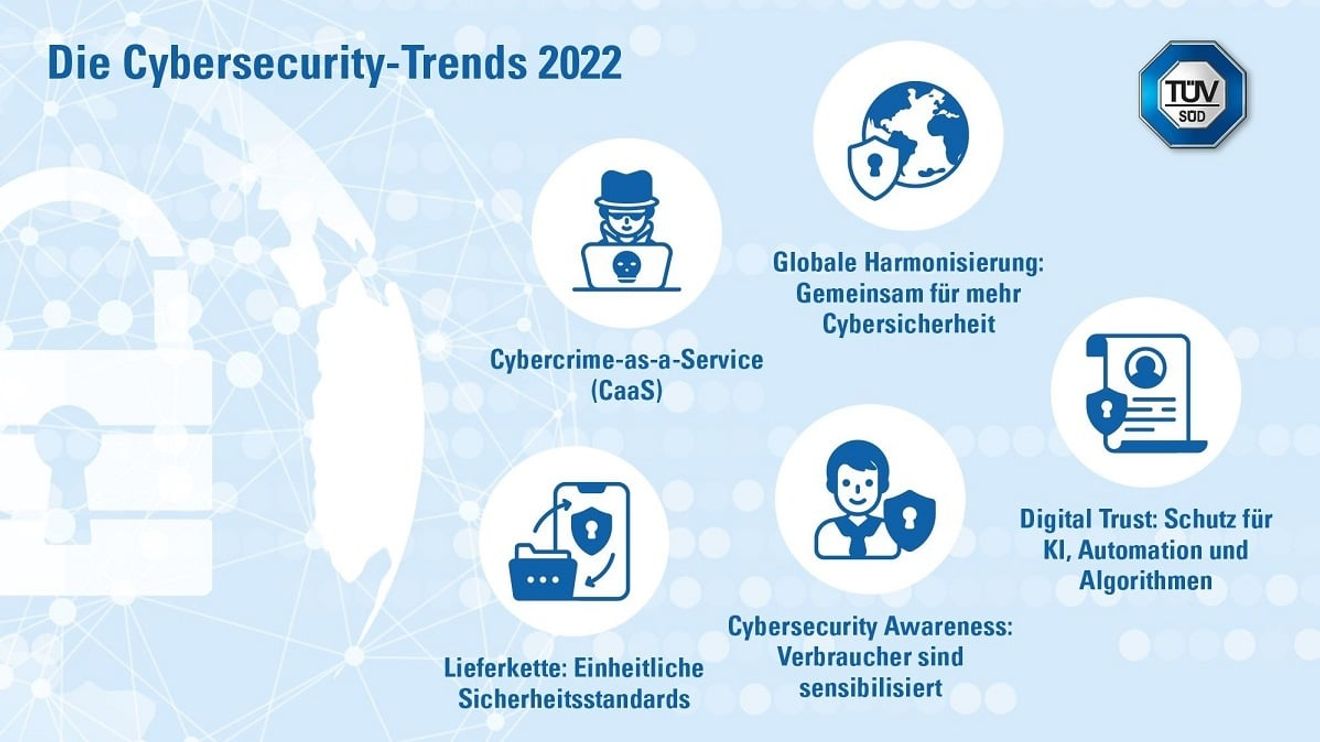
"Kaseya, SolarWinds, the Colonial Pipeline: The attacks in 2021 have shown once again how important it is to establish cybersecurity as part of the corporate culture and implement it across the entire supply chain," explains Sudhir Ethiraj, Global Head of Cybersecurity Office (CSO) at TÜV SÜD. "In addition, ransomware is now accessible to everyone as cybercrime-as-a-service, including technical support. Cybercriminals have used 2021 to reposition themselves, professionalize and expand their field of activity. It is therefore now important for SMEs, industry and authorities to react." In line with these developments, the security experts at TÜV SÜD see the following trends for 2022
Cybercrime-as-a-Service (CaaS)
Malware (ransomware) is now marketed by cyber criminals in a similar way to regular software and has thus created a business model. Malware can be purchased for license fees, even including technical support. This market will continue to grow. Companies need to respond proactively and invest more in training and awareness for their employees and in securing their technical infrastructure.
Cybersecurity awareness: consumers are sensitized
Attacks on large companies and infrastructure have shown that the industry's cybersecurity measures, for example for IIoT, are well behind the attackers' methods. It is in the interest of the industry itself to raise its own awareness of risks and threats and to jointly develop requirements that help it become more resilient to attackers. End consumers are also paying increasing attention to cyber security when deciding to buy connected products, for example IoT devices such as smartwatches or other wearables.
Supply chain: uniform safety standards
Past incidents show that the supply chain in software development in particular needs even greater awareness of cyber threats. In addition, there must be common standards for secure software, such as those required by the Charter of Trust, a global cybersecurity alliance of which TÜV SÜD is an active member. Manufacturers should support their partners and suppliers in complying with new regulations in order to motivate them.
Global harmonization: Working together for more cyber security
"Standards are the backbone of cyber security." This motto must be practiced internationally and requires cross-border cooperation. Industry and legislators must respond: There must be joint work on harmonized minimum requirements that ensure that products and services are cyber-secure "ex works" across industries and technologies. Uniform and universally applicable standards for cybersecurity make it possible to strengthen the level of security.
Digital trust: protection for AI, automation and algorithms
AI and automation help companies, for example, to optimize processes and analyse their own data traffic in order to detect attacks, data leaks and theft at an early stage. However, these technologies are only as reliable as the algorithms behind them are secured. Companies and organizations need to be careful how they protect these technologies. After all, cyber criminals are also increasingly using AI for their own purposes. Basic standards for the cyber security of AI can support the protection of infrastructure and data integrity.


You might also be interested in
Why cyber criminals still have an easy time of it
What do Media Markt and Saturn, the medical service provider Medatixx and the US broker Robinhood have in common? They have all fallen victim to hackers who want to extort ransom money. There is no end in sight to the wave - although there have been...
 read more...
Solarwinds hackers target tech companies
The hackers behind the serious cyberattack on IT service provider Solarwinds are now targeting dozens of companies in the tech industry, according to Microsoft's findings.
read more...Holistic approach required
In recent months, ransomware attacks have repeatedly made the headlines. And they show: Attacks on corporate IT can also cause problems in the OT environment.
read more...New Vice President of Global Partner Ecosystem appointed
Effective immediately, John Ryan is the new Vice President of Global Partner Ecosystem at Claroty, a specialist in the security of cyber-physical systems (CPS).
read more...Increasing cyberattacks on the manufacturing sector
A report from Check Point Exposure Management on the threat landscape in the manufacturing industry shows a dramatic increase in ransomware, supply chain attacks and OT-related cyber incidents. As smart factories and connected supply chains become...
read more...Cybersecurity is a top priority for car manufacturers
The latest "Automotive Manufacturing Outlook Survey" from ABB Robotics shows that cyber security has become the most important focus for automotive manufacturers around the world. This indicates a clear change in the perception of digital risks.
read more...Dragos expands collaboration with Microsoft
Dragos, a global provider of cyber security for OT environments, is expanding its collaboration with Microsoft. The aim is to support companies in modernizing and securing their cyber-physical operating processes.
read more...All for One acquires stake in BrightFlare
All for One acquires a minority stake of 25.1% in the Austrian company BrightFlare. BrightFlare is a cybersecurity services provider for the protection of industrial plants and critical infrastructures.
read more...Claroty appoints new Chief Revenue Officer
James Love is the new Chief Revenue Officer (CRO) of Claroty, a specialist in the security of cyber-physical systems (CPS).
read more...