
Bihl+Wiedemann
Retrofit with ASi-5
The SPAX screw is available in countless variants and sizes. But how and with which machines are they produced? And what is the concept for the (future) security behind it?
The name SPAX has stood for 'chipboard screws with X-slot' and quality 'Made in Germany' for over 50 years. Manufacturer SPAX International, based in Ennepetal, North Rhine-Westphalia, employs around 500 people and produces up to 50 million screws every day.
The manufacturing process of a SPAX screw begins with cutting the original material to length from a rolled wire coil. The head of the screw is then formed by upsetting and pressing in a press, whereby the so-called force application (e.g. the cross recess) is also determined. The thread and the tip are then rolled onto the so-called press nail in a roller. Finally, the screw is hardened and finished.
Production with proven machines
SPAX uses a large number of identical or similar machines for screw production - presses and rollers that often date back to the 1970s and 1980s. However, as their machine bodies are so robust and solid, they are regularly overhauled mechanically and electronically in order to keep them up to date with the latest technology. The company has its own mechanical engineering department for this purpose, which carries out the retrofit with its own personnel and overhauls between eight and twelve machines every year.
As the presses and rollers are machines that can pose a risk to the employees working on them, the issue of machine safety is immensely important. However, while two-hand relays were still used in the 1970s and 1980s, for example, safety requirements have changed considerably in the meantime. For this reason, SPAX was already looking for a solution over ten years ago to solve the safety technology in such a way that it meets modern requirements, is future-proof and expandable and takes up as little space as possible. With around 70 to 80 presses and the associated control cabinets, space alone is a decisive criterion. SPAX found what it was looking for at Bihl+Wiedemann, a provider of automation solutions with AS-Interface and ASi Safety at Work.
Safety first - a solution for many machines

Process and diagnostic data from IO-Link sensors for pressure, temperature and flow can be used for predictive maintenance via ASi-5.
© Bihl+WiedemannSafety technology plays a decisive role at various points on SPAX machines: directly on the machine, it is important that the operating personnel can only open safety doors and covers when there is no more dangerous movement. This is ensured on the one hand by the active distributor ASi Safety (BWU3565) in IP67 from Bihl+Wiedemann, which is mounted directly on the machine and with which the safe door switch can be integrated into the ASi network via the profile cable. On the other hand, safe monitoring of standstills takes place. This is implemented either via a Safety Basis Monitor installed in the control cabinet or a Safety Gateway from the company. Other safety-related tasks that are also solved via the ASi Safety Gateway are the two-hand operation of the presses and rollers and the connection of emergency stop buttons.
For SPAX, safety technology via ASi Safety at Work has several advantages - apart from the simple and flexible wiring technology. As the majority of the presses and rollers are almost identical and only differ in terms of special equipment, which can be activated separately, the solution can be transferred from one machine to another. As a rule, the same products with the same functionality can be used in the same place for all machines. In addition, control cabinets can be fully assembled and tested in advance and therefore stored in a functional condition. Once a machine has been mechanically and electronically overhauled, the control cabinet can be connected directly, which saves a lot of time. And the safety program for a machine, once created in the 'Asimon360' software suite from Bihl+Wiedemann, can also be easily copied for other machines without the need for major changes. All of this makes the maintenance and modernization of the machines much easier for SPAX employees.
In addition to the safety technology, the monitoring of pressure, temperature and flow was a second issue that was solved via AS-Interface. These parameters need to be constantly monitored to ensure that the presses and rollers are always sufficiently lubricated to function efficiently and prevent damage. For this purpose, ASi digital modules from Bihl+Wiedemann were initially used, which could be used in parallel with the safety technology on the same ASi line and monitored via the same ASi gateway.
Predictive maintenance and Industry 4.0

IO-Link sensors are integrated via the ASi-5 modules with integrated IO-Link master with four master ports from Bihl+Wiedemann.
© Bihl+WiedemannThe foresight behind the decision to solve the safety technology and the monitoring of pressure, temperature and flow with AS-Interface was demonstrated in 2019, when SPAX decided to make production Industry 4.0-capable. In this context, SPAX's maintenance department was also commissioned to develop a concept for the presses and rollers that would enable predictive maintenance. The aim was to obtain more information from the machines about their condition and to feed this data to an IT solution via a standardized protocol in order to be able to derive the current condition of the machine and, if necessary, appropriate recommendations for action - ideally with as few changes to the existing equipment as possible.
Together with Bihl+Wiedemann, a solution was then developed with which almost all of the formulated requirements could be realized. One contributing factor was that the latest AS-Interface generation, ASi-5, was launched at the end of 2018, which is backwards compatible with all previous ASi generations and has the necessary high data bandwidth and short cycle times to transfer data from IO-Link sensors. On the other hand, Bihl+Wiedemann has now equipped all new ASi gateways with an OPC UA interface, which can be used to make data available to IT directly - bypassing the control system.

The author: Thomas Rönitzsch is responsible for corporate communications at Bihl+Wiedemann in Mannheim.
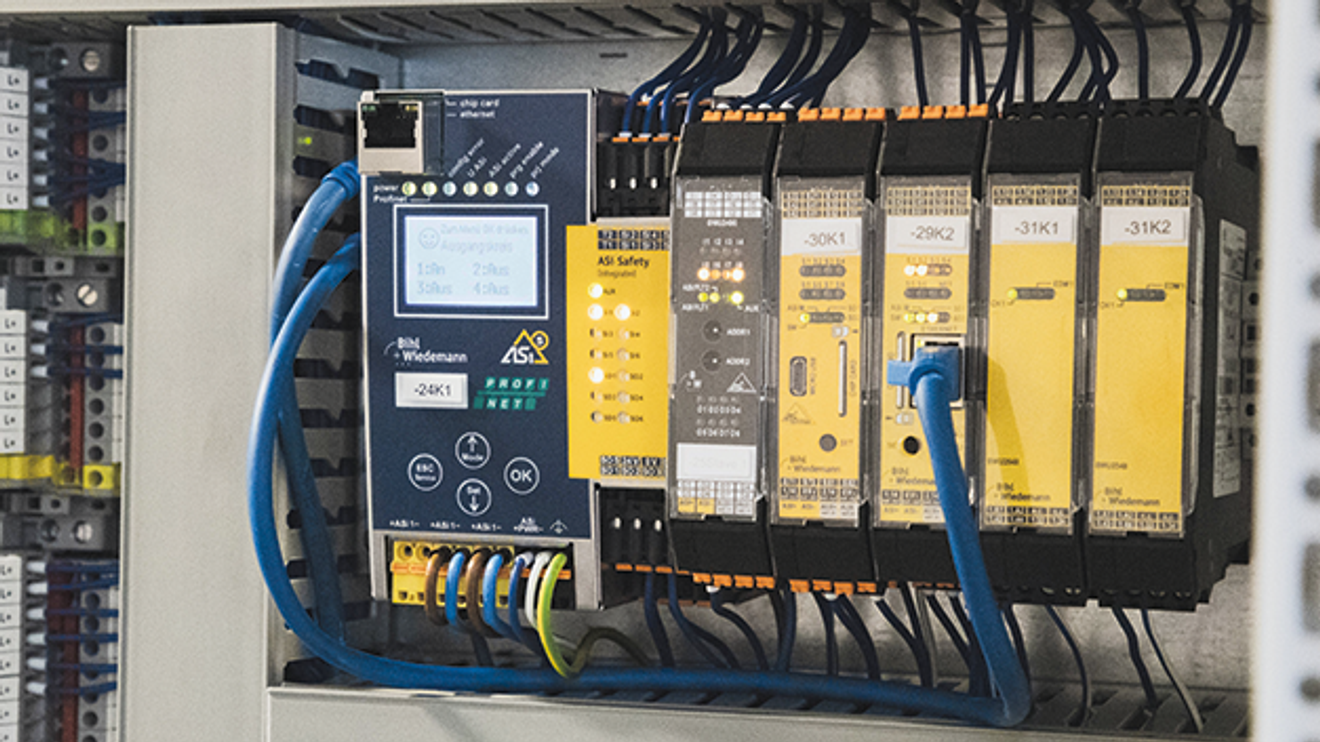
© Bihl+WiedemannFor the SPAX presses and rollers, this means in detail that the entire safety technology was left as it was before. Only the previous ASi safety gateway had to be replaced by an ASi-5/ASi-3 Profinet gateway BWU3863 with an integrated safety monitor and OPC UA server - with minimal configuration effort. The ASi digital modules were replaced by ASi-5 modules with an integrated IO-Link master with four master ports (BWU4067), to which the IO-Link-capable sensors for pressure, temperature and flow already installed in the machine are connected and also parameterized via the Asimon360 software. These few and simple changes now make predictive maintenance possible, as the connected IO-Link devices no longer only provide digital values, but also process and diagnostic data. They are transmitted to IT via the OPC UA server in the ASi-5/ASi-3 gateway. For example, SPAX can detect at an early stage whether and how pressure, temperature and flow rate are changing and react quickly if necessary.
SPAX began making the first machines 'ready for predictive maintenance' in accordance with the jointly developed solution back in 2020, and the conversion of the presses and rollers has been progressing step by step ever since.


You might also be interested in
AS-Interface for drive and conveyor technology
ASi-3 for collecting individual binary signals, ASi-5 for complex tasks where high transmission speeds and large data bandwidths as well as efficient addressing of participants are important - a 'dream team' especially for intralogistics systems.
 read more...
CC-Link certification for modular I/O system
Weidmüller has received the CC-Link Partner Association (CLPA) certificate for its modular I/O system 'u-remote'. This makes u-remote the first modular I/O system with official CC-Link IE safety certification for CC-Link IE TSN.
read more...Dynamic alarm display and secure input processes
Hima, provider of safety-related automation solutions, and Deuta, provider of certified display and safety technology, are jointly launching a solution that includes Hima safety systems and function block libraries as well as a safety-related...
read more...CEO appointed for Sella Controls
The Hima Group has appointed Carl Ramsden as CEO of Sella Controls with effect from October 1, 2025. According to Hima, this newly created position represents an important milestone in the further integration of the British company into the Group.
read more...Innovation partner for automation
Bihl+Wiedemann is a medium-sized, owner-managed company - founded in 1992 by Jochen Bihl and Bernhard Wiedemann in Mannheim. It develops and manufactures complete solutions for functional safety and data communication in machines and systems.
read more...Growth course continued
The Hima Group, a provider of safety-related automation solutions, grew significantly in the 2024 financial year, driven in part by international expansion and an increasing focus on digital solutions.
read more...Single-axle drive module for high performance
The modular, dynamic multi-axis servo system 'DIAS-Drive 2000' from Sigmatek has been reinforced: The 'MDP 2200-L-01' single-axis module for controlling synchronous servo motors provides up to 20 A rated current.
read more...Rockwell Automation at the SPS 2024
Security portfolio expanded
Rockwell Automation is expanding its portfolio of safety technologies with the introduction of 'Logix SIS', a Safety Instrumented System (SIS).
read more...Flexibility with macro technology
With the Sigmatek 'SCP 211' safety CPU, it is possible on the software side to create customized macro libraries and parameter lists for safety applications.
read more...