
SSV Software Systems
Optimize OT/IT cybersecurity holistically
In many organizations, networked IT and OT infrastructures are two completely different worlds. Functionally, this will remain acceptable in the future. However, the new legal requirements for cyber security require a common working level.

IT networks in companies are usually first planned and then implemented based on the context. Security aspects are usually also taken into account during planning. This includes, for example, segmentation with the help of subnetworks for servers and workstations as well as central access to the Internet. In many cases, a special WLAN is even provided for users only. Extensive thought is certainly also given to possible access rights within the entire network infrastructure; after all, legal data protection regulations must be complied with here - which is why access to the personnel or customer database from the visitor WLAN must also be prevented. Furthermore, there is a basic distribution of roles with at least two groups of people: a very specific one whose members are allowed to both carry out installations and change the configuration settings on systems and equipment - i.e. the administrators - and all others who are only allowed to use these components as intended. Due to the complexity of corporate IT and its importance for day-to-day operations, practically every IT landscape also includes internal or external experts who ensure the smoothest possible 24/7 availability. In larger companies, there is even a manager responsible for the IT systems. Through this IT manager or Chief Information Officer (CIO), the overall responsibility for cyber-secure IT operations is also anchored in the management team.
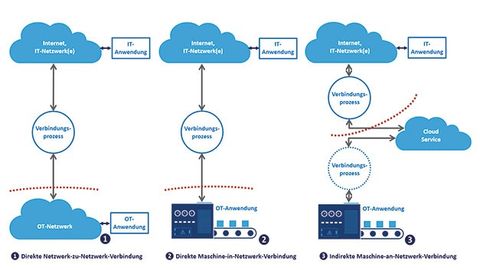
Figure 1: Various scenarios are possible for the connection between OT and IT applications. From a cyber security perspective, each individual application should preferably have a suitable connection process that is integrated into the company's internal IT management by the respective operator and for which monitoring, patch and update management as well as event detection also exist.
© SSVIt can be assumed that all experts follow a state-of-the-art IT operating process that regulates other elementary tasks such as data backup, monitoring, patch and incident management in addition to administrative activities. As a result, vulnerabilities and potential risks in relation to cyber security are generally known and monitored by experts.
Create structures
Regardless of the size of the company, networked automation applications - and in many cases also the existing IoT applications - are not seen as a direct component of the company's IT as a whole or in part and are therefore not included in the security considerations and management processes of IT experts. However, in view of the requirements of the EU NIS 2 directive on network and information security, it seems sensible to assign operational technology (OT) to IT, at least in terms of security, and to integrate it into the network segmentation concepts. One technical challenge here is the diversity of OT networking. Here are three examples:
- Direct network-to-network connection: An OT application runs together with other software functions within a separate OT network. The IT application can access the OT application via a dedicated connection interface between the two networks. In exceptional cases, the OT application can even establish a connection to the Internet via the IT network, for example to carry out remote maintenance for certain OT assemblies - although this would be a security-critical process that would be very difficult to control.
- Direct machine-to-network connection: An individual machine and therefore the OT application of a machine are directly integrated into the IT network via the respective connection process and can therefore be used like any other service within the IT network for an IT application. Depending on the settings of the responsible IT administrator, the machine can also be granted Internet access - which is critical in terms of security - so that the desired remote access option is available for a predictive maintenance or condition monitoring application from an external service partner, for example.
- Indirect machine-to-network connection. The machine has already been supplied with an integrated mobile radio modem or similar and connects to a cloud or cloud service via a wireless wide area network (WWAN) at its own discretion. The IT application of the machine or IT network operator also has access to this cloud via the Internet in order to communicate (indirectly) with the machine OT application, for example. In this case, the operator can only control the connection between the IT application and a cloud. The OT connection interface or the connection process to the cloud is usually managed by the OT application provider. This is usually the machine manufacturer or the IoT service partner.
Objective: Defense in Depth
A suitable approach for cyber-secure OT/IT integration is one that first analyzes and documents the data flow of each individual application connection in Figure 1 - if necessary with the help of special tools such as network sniffers that also detect OT protocols such as Modbus, OPC UA or Profinet in order to create the prerequisites for the next steps. The aim here is to design a connection process for each individual OT/IT connection that takes the individual security risks into account. The table provides an overview of the security risks for OT and IT applications based on the STRIDE model. This makes it possible to carry out effective condition analyses for OT/IT integrations, determine the individual risks with the help of a metric and develop suitable countermeasures.
| Threat | Description/example |
|---|---|
| Spoofing (identity concealment) | Various types of authenticity problems, e.g. the unauthorized use of another person's authentication information (user name, password) to log on to and use an IT system. |
| Tampering (manipulation) | Integrity aspects for stored or transmitted data, etc. For example, malicious modification of a dataset (the contents of a database) or a data transmission (targeted attack on a transmission channel in order to change the data sent and thus provide the recipient with manipulated information). |
| Repudiation (denial) | Non-repudiation of an action. All user actions in an IT system or IT process should be clearly attributable. If, for example, a certain file is deleted on a server and there are no legally secure logging methods with regard to user activities, practically any user with the corresponding access rights could have carried out the action, but could still deny it. |
| Information disclosure (data breach) | Loss of confidentiality because, for example, a user without the appropriate access rights can read the content of a file or read the data of a transmission channel due to a lack of or weak encryption. The loss of confidentiality of authentication information in particular can have serious consequences. |
| Denial of service | Availability problems of a certain service due to sabotage measures. If, for example, a web server with a large number of "pointless" website requests is put into a state where "normal" requests relating to a website can no longer be processed due to overload, this is referred to as a denial of service (DoS) attack. |
| Elevation of privilege (extension of rights) | Authorization challenges, e.g. through unauthorized expansion of user rights. Each user of an IT system should only have the absolutely necessary rights to perform the respective tasks. If a normal user is granted additional rights, e.g. administrator rights to run certain programs, this can lead to considerable damage. |
With detailed knowledge of the data flow between OT and IT applications and the protocols used for this, plus a threat analysis that is as comprehensive as possible, a context-related connection process can then be developed. It should be noted that there are significant differences between IT and OT applications in terms of threats and risks. In the case of attacks in IT environments, spoofing and privilege escalation are very often possible methods of gaining unauthorized access to certain data sets. This can lead to considerable damage for the affected company. In the OT environment, on the other hand, unauthorized data access is less risky: the confidentiality of a machine's condition monitoring status data has a manageable value for attackers; ensuring data integrity is often the bigger problem. On the other hand, OT systems offer numerous possibilities for denial of service attacks, which can also cause a great deal of damage, for example by manipulating the real-time behavior of a controller or manipulating sensors. In this respect, an effective threat analysis in practice definitely requires cooperation between IT and OT experts.
In the subsequent implementation of a secure connection process, the segmentation concepts commonly used in the IT world with virtual LANs (VLANs), special firewall systems - such as NG, layer 4 or layer 7 firewalls - and universally applicable gateway systems can be used. However, very special assemblies, such as unidirectional gateways, may be required to securely isolate OT and IT networks. It should be borne in mind that there is not always a patch for many modules within the OT network to eliminate identified vulnerabilities as part of a software update.

Together with the connection process, system modules for logging OT/IT data traffic and measures for detecting security-relevant events should also be implemented where possible - see the IEC 62443 minimum requirements for logging and cyber attack detection as well as "SzA" from the BSI. Such an OT/IT connection process forms a solid starting point for continuously developing the entire OT/IT cyber security into a multi-layered defense in depth concept. More on this in the next part of this series.


You might also be interested in
Germany Among the Top Three Countries for Ransomware
TrendAI's 2026 Cyber Risk Report shows that Germany is among the three countries most severely affected by ransomware attacks worldwide. At the same time, the average cyber risk for companies is declining slightly.
 read more...
Mitchell Plonski Assumes Global Responsibility
NinjaOne has appointed Mitchell Plonski as Senior Vice President of Global Public Sector. He will be responsible for the global strategy for government agencies and public institutions.
read more...Why AI Agents in the SOC Don't Learn Over Time
AI agents support security operations centers, but so far they lack a permanent memory. A technical article explains the challenges facing autonomous security automation.
read more...New Vice President of Global Partner Ecosystem appointed
Effective immediately, John Ryan is the new Vice President of Global Partner Ecosystem at Claroty, a specialist in the security of cyber-physical systems (CPS).
read more...Increasing cyberattacks on the manufacturing sector
A report from Check Point Exposure Management on the threat landscape in the manufacturing industry shows a dramatic increase in ransomware, supply chain attacks and OT-related cyber incidents. As smart factories and connected supply chains become...
read more...Cybersecurity is a top priority for car manufacturers
The latest "Automotive Manufacturing Outlook Survey" from ABB Robotics shows that cyber security has become the most important focus for automotive manufacturers around the world. This indicates a clear change in the perception of digital risks.
read more...Cloud security often inadequate
According to Red Hat's "State of Cloud-native Security" Report 2026, 97% of the companies surveyed with hybrid cloud environments reported security incidents within a year. This is based on data from around 600 IT specialists.
read more...CRA guide for Powerlink checked
TÜV Rheinland has audited the "CRA Guide for Powerlink" from B&R. The guide is one of the first independently audited technical documentations for the implementation of the EU Cyber Resilience Act in automation.
read more...Dragos expands collaboration with Microsoft
Dragos, a global provider of cyber security for OT environments, is expanding its collaboration with Microsoft. The aim is to support companies in modernizing and securing their cyber-physical operating processes.
read more...