

Cisco Systems
On the trail of threats
Cisco presents an application designed to close the gap between IT and OT. AI technology helps to identify threats when monitoring networks.
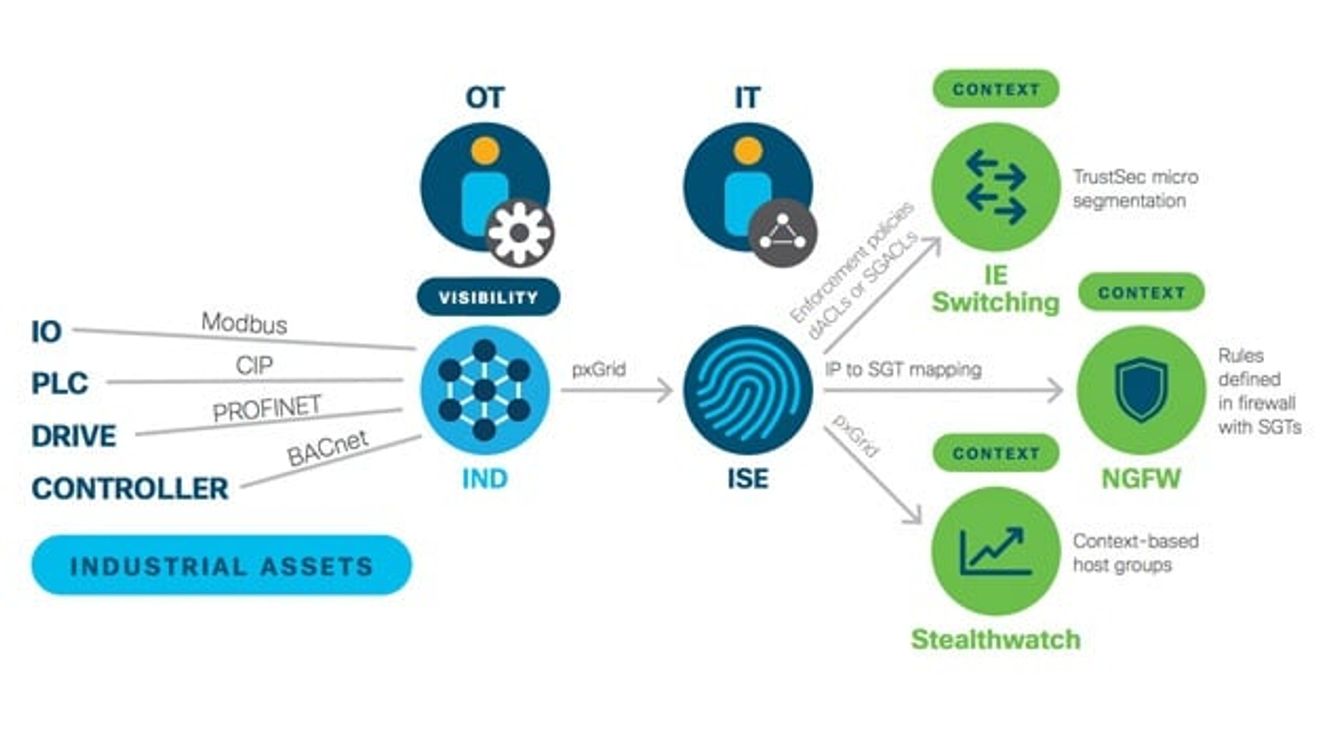
In the course of Industry 4.0, manufacturing companies have to manage more and more networked devices. To do this, they often use solutions from the IT world, which not only have to be adapted to the specific needs of the OT level, but also have to be protected against threats. To get to grips with this problem, Cisco is presenting an application based on a software-defined network structure.
It is implemented with the help of three Cisco solutions: 'Industrial Network Director' (IND) provides operational engineers with a solution for monitoring the network and retrieving security policies based on entered targets. With the 'Cisco Identity Services Engine' (ISE), the IT department can fully control access to critical systems and dynamically apply security policies to plant components based on OT requirements. At the same time, Cisco Stealthwatch monitors and analyzes network traffic to support policy creation and accelerate threat detection and mitigation.
Use of AI increases safety
Stealthwatch' uses machine learning (ML) to identify advanced threats and malicious communications. This is based on a multi-stage cloud-based process chain of ML-based analyses that correlate potential threats to companies with known threats observed worldwide. The system analyzes user and device behavior to detect malware infections, data theft and potentially unwanted applications. It uses a combination of techniques with AI, ML and mathematical statistics. In the medium term, it helps the network to better detect malicious attacks itself.
This process chain collects information from every part of the extended network, including encrypted traffic, classifies it and finally recognizes whether a device or user is actually at risk or not. By very carefully analyzing and correlating the collected evidence, it can also reliably detect new types of attacks without triggering false alarms. According to Cisco, this capability in particular is very important today. Companies now receive so many alerts that their own IT teams are often no longer able to evaluate them. The machine learning engine, on the other hand, processes huge amounts of data in almost real time in order to detect critical incidents with a high degree of certainty and also provide clear recommendations for action for rapid remediation - and to prevent any gaps in the operational process in the first place.


You might also be interested in
Significantly more processors affected by attacks
Not only high-end processors are susceptible to side-channel attacks. Researchers from Kaiserslautern and Stanford have shown that common embedded processors also have similar security vulnerabilities.
 read more...
BSI warns of contaminated devices
The German Federal Office for Information Security (BSI) has discovered pre-installed malware in the firmware of some smartphones and tablets that are sold online.
read more...Spark Assistant' voice assistant
Artificial intelligence for meetings
IT provider Cisco has introduced the 'Spark Assistant', an adaptive voice assistant for companies. Unlike 'Siri', 'Alexa' and the like, it is specifically designed to make meetings easier and more productive.
read more...Together against cybercrime
Two major players in the IT security market - Cisco and IBM - intend to improve the efficiency of IT security for their customers through technology integration, combined services and collaboration on threat intelligence.
read more...Safety in sensor technology
What do sensor manufacturers currently offer in terms of safety? At SPS IPC Drives, there were a number of clever concepts on show - including from Sick, Pepperl+Fuchs and Leuze electronic.
read more...Video flashback of the three days of the fair
New hall, new topics and a new name in 2019 - the SPS IPC Drives 2018 in seven minutes.
read more...The review in the movie
New hall, new topics and a new name - that was SPS IPC Drives 2018 in seven minutes.
read more...OPC UA and TSN - a major trade fair topic
The OPC UA and TSN communication standards are major topics of discussion in the industry. This could not be overlooked at SPS IPC Drives 2018.
read more...Smart transport - three approaches in the video
How can material and product transport in machines and systems be reorganized in the age of Industry 4.0? Beckhoff, B&R and Bosch Rexroth presented interesting approaches in this regard at SPS IPC Drives 2018.
read more...