

IT Security
Attackers use Google Classroom for global Phishing Campaign
Security researchers from Check Point have uncovered a coordinated phishing campaign in which criminals abused the trust in Google's learning platform. Within a week, they sent more than 115,000 emails to 13,500 organizations in several regions of the world.

A recent investigation by Check Point Research shows how attackers are increasingly relying on legitimate cloud services to circumvent existing security barriers. The criminals' target this time was Google Classroom - a service that is actually used for digital collaboration between teachers and students and is used by millions of people worldwide.
Between August 6 and 12, 2025, a total of around 115,000 phishing emails were sent in five coordinated waves of attacks. More than 13,500 organizations from Europe, North America, the Middle East and Asia were affected. The emails imitated invitations to digital classrooms, but contained content that had nothing to do with education. Instead, recipients were lured with offers such as product reselling or SEO services. All messages led to a WhatsApp contact number - a common means of diverting communication away from companies' secure email systems.
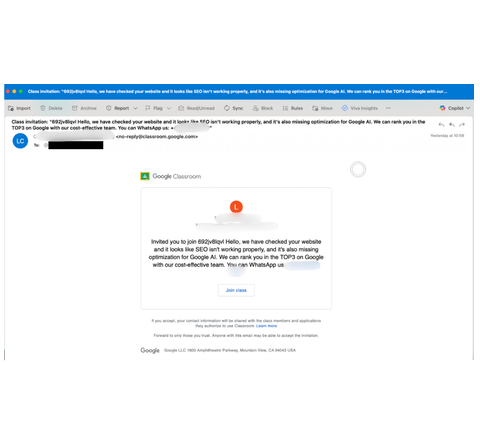
According to the security researchers, the attackers specifically exploited the fact that many email security solutions classify messages from Google services as trustworthy by default. This allowed the fraudulent invitations to bypass numerous defense mechanisms. "Attackers continue to find creative ways to exploit legitimate services like Google Classroom to gain trust, bypass defenses and reach targets on a large scale. With over 115,000 emails in just one week, this campaign shows how easily cybercriminals can abuse digital platforms to commit fraud," said Check Point experts.
Although a significant proportion of the messages successfully bypassed firewalls and gateways, most attempts were blocked by additional security layers, according to Check Point. Among other things, the company's own SmartPhish detection technology was used, which not only analyzes sender addresses, but also the context and intentions of the message.
The researchers emphasize that traditional email gateways are increasingly reaching their limits. As attackers use services such as Google, Microsoft 365 or Dropbox, they can create the appearance of legitimate communication and thus gain access to protected mailboxes. In addition to technical protection mechanisms, employee training is therefore also crucial.
Several measures are recommended:
- Raising awareness: Employees should always check unexpected invitations and links critically, even if they come from known platforms.
- Enhanced protection: AI-supported security solutions that analyze context and content increase the chances of detecting attacks at an early stage.
- Cross-platform monitoring: Companies should include not only email traffic, but also collaboration and messaging tools in their defense strategies.
- Awareness of social engineering: Criminals are increasingly turning to channels such as WhatsApp to circumvent company guidelines.
The scale of the campaign shows just how quickly cyber criminals are able to repurpose legitimate platforms and exploit trust in digital services. According to the researchers, organizations from various sectors were affected, from educational institutions to industrial companies and service providers.


You might also be interested in
Authorities, industry and IT targeted by cyber criminals
Authorities, industry and IT were most frequently targeted by cyber criminals in 2025. Authorities remained the main target of cyber attacks, as the latest report and situation report "Anatomy of a Cyber World: Global Report by Kaspersky Security...
 read more...
Post-quantum cryptography: time window is running out
Companies are facing a strategic dilemma: quantum computers will soon be able to crack today's encryption, while many organizations will need years to switch to new security standards. A recent survey shows: The window of opportunity is narrowing,...
read more...Shutdown after only 20 Hours
German companies believe they are inadequately prepared for hybrid threats. According to a Bitkom survey, they would only be able to continue working for an average of 20 hours in the event of an internet outage. 83% of respondents expect a serious...
read more...Global Incident Response Report 2026
AI accelerates Cyber Attacks
The "Global Incident Response Report 2026" by the Unit 42 team at Palo Alto Networks analyzes over 750 serious security incidents in more than 50 countries. The evaluation shows faster, more complex attacks, increasing use of AI and growing risks in...
read more...Three new OT Attacker Groups identified
The new OT/ICS report from Dragos documents a growing number of specialized attacker groups and a significant increase in ransomware activity in industrial environments. Three new OT groups have been identified.
read more...16 % more Cyber Attacks in Germany in January
As Check Point's Monthly Cyber Threat Report shows, there were 16 percent more cyber attacks in Germany in January. In Europe, the volume of attacks rose by 18 percent to 1755 weekly attacks per company. In Austria, they rose by 14 percent to 1676,...
read more...Edge Security for Industrial Plants
Advantech uses AI EdgeLabs for Runtime Security
Advantech integrates the AI EdgeLabs platform to implement security and governance functions directly into edge and industrial platforms. The aim is to comply with European cybersecurity regulations such as CRA and NIS2.
read more...Criminals use AI Systematically
Trend Micro warns in a new study of the increasing professionalization of AI-supported cybercrime. Deepfakes, fraud and malware are gaining in importance.
read more...Trend Micro warns of Darknet AI 'Xanthorox'
AI writes Malware at the Touch of a Button
The AI tool 'Xanthorox' is supposed to generate malicious code automatically and is advertised in criminal forums. According to Trend Micro, it is less powerful than claimed, but shows how easily attackers can use generative AI for cyberattacks.
read more...