
Omron
The flexible fleet
An extremely ambitious project with mobile industrial robots in Scandinavia is currently underway at the Vola factories, manufacturers of bathroom and kitchen fittings. Here, a fleet of robots from Omron works side by side with human colleagues.
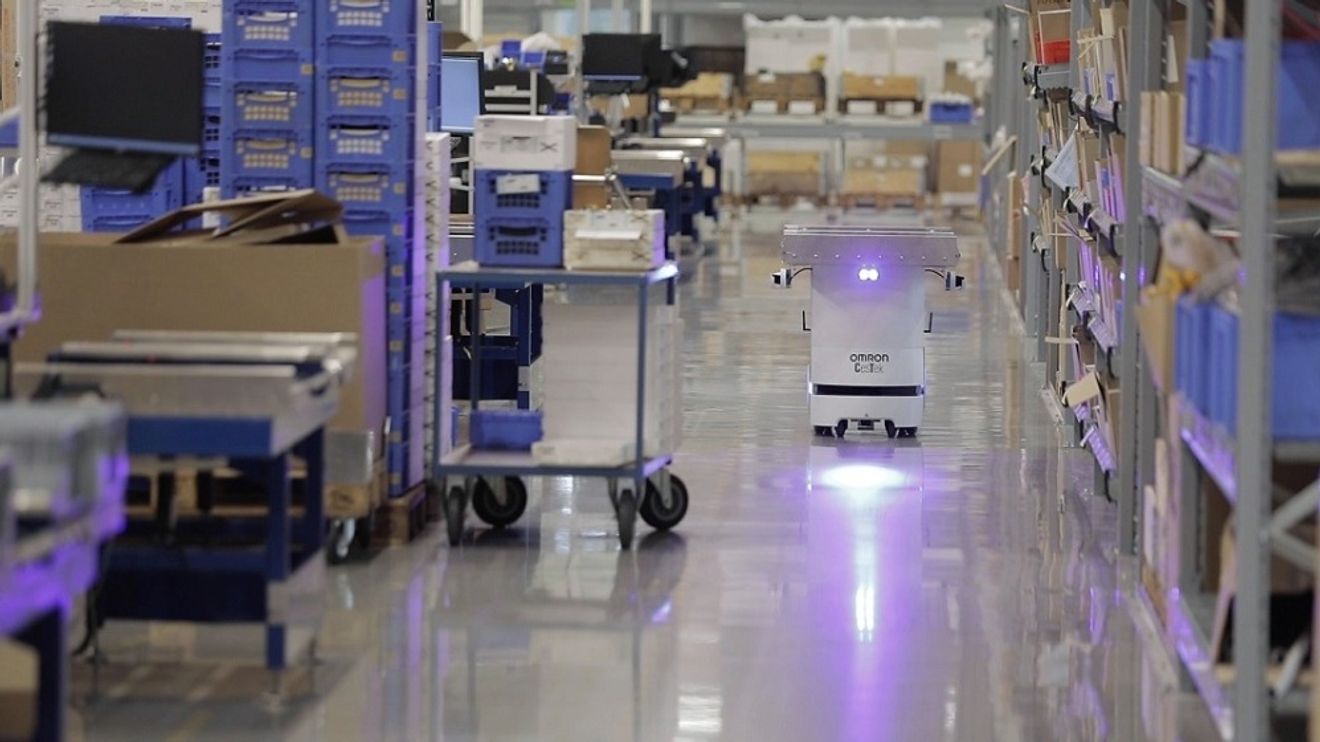
Due to increased market demand for a wide range of product variants, Vola decided a few years ago to expand the factory in Horsens, Denmark, by 5500 m2 . As part of these plans, a new high-bay warehouse, an assembly hall and various facilities for goods deliveries were also added. Vola also ordered nine LD robots from Omron for one of the most ambitious projects involving mobile industrial robots in Northern Europe. They replaced the previously used roller conveyors to create a more flexible production and logistics facility. This approach is in line with the company's one-off production process, in which all fittings are made to order.
Customizable robotics
Mobile robots are fully autonomous intelligent vehicles that help to increase throughput, reduce machine downtime, eliminate errors and improve material traceability. At the same time, they allow employees to focus on tasks that require complex human skills. In addition, unlike conventional automated guided vehicles (AGVs), mobile robots navigate based on the spatial conditions of the plant and do not require expensive conversions.
The autonomous mobile robots in Omron's LD series are available in four different models. They move at speeds of around 3 to 6 km/h and can lift between 60 and 250 kg. Each robot also offers wireless connectivity and sensors to help it move and navigate in a dynamic and ever-changing environment. The robots are controlled by Omron 's 'Enterprise Manager', a fleet management system that can control up to 100 robots and optimizes autonomous material handling.
The robots in the series are also particularly customizable, as they can be individually equipped with conveyor belts, courier systems and adaptive material transport mechanisms. Accessories such as positioning systems (HAPS), lateral lasers or the image-guided localization system 'Acuity' can be used to adapt mobile fleets. This technology provides an additional localization method that allows the mobile robot to be integrated into frequently changing environments. The combination of the LD with collaborative robots (cobots) also creates a new market for 'mobile manipulators' that can handle both manipulation tasks and material handling.
Robotics for current and future requirements
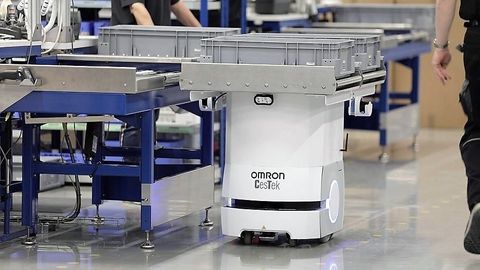
The mobile robots at Vola are controlled by an innovative fleet management system. The project was awarded the automation prize by the Danish Industrial Robot Association (DIRA) in September 2020.
© OmronPeder Nygaard, Factory Director at Vola, explains: "Roller conveyors are really efficient, but I don't know what the structure of our production will look like in ten years' time. If we add more conveyors to the production line, it could quickly affect the flexibility we are so proud of. We opted for the autonomous robots from Omron because they are much more flexible."
Vola is always looking for ways to further improve efficiency and lead time. For example, boxes have to be transported very quickly from one location to the next. Mobile robots support this goal, as permanently installed assembly or conveyor belts are much more rigid and cannot be easily adapted to new conditions.
At the Vola plant, the mobile robots first transport the empty containers to the assembly area. The employees then scan the containers to see what needs to be produced. The mobile robots then pick up the finished goods in the containers and take them to the warehouse.
Assembly is carried out manually, while transportation is now automated. This means that employees can concentrate more on their tasks and no longer have to lift or move heavy materials.
Seamlessly control up to 100 robots
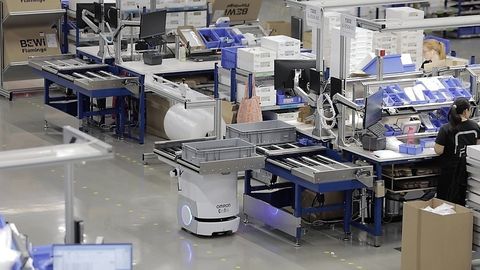
Vola has designed the new factory in such a way that it is optimally equipped for collaboration between humans and robots.
© OmronThe robots have the task of transporting components and finished parts back and forth between the high-bay warehouse and the assembly hall. They are controlled in their tasks by the 'Enterprise Manager', a fleet management system that ensures a smooth flow of traffic like the tower of an airport. With the help of the Fleet Manager, a maximum of 100 mobile robots with different payloads and functions can be controlled. The Fleet Manager takes on the tasks of traffic and battery management as well as order management. Different robot models can be controlled via the same system without users having to worry about compatibility or performance. The system tells each individual robot where it should move and when. This also includes the times when it needs to take a break to recharge its batteries.
The human-robot interaction
To take full advantage of the investment, Vola has designed the new factory in such a way that it is optimized for collaboration between humans and robots. For example, particular attention was paid to aspects such as safety, convenience and unimpeded movement of people and robots in the locations of the assembly tables and the routes used by the employees. The work processes were also designed in such a way that the individual workflows are precisely coordinated. Whereas the assembly team previously called up a job list on the screen, this is now managed by a central team. Today, the job list appears on the employee's screen as soon as they have scanned an item that the robot is transporting.
"There has never been an implementation like this before. We are therefore also aware that there will be an adjustment phase in which we have to ensure that our employees get used to working with the robots," comments Nygaard.
The current nine mobile robots are to be supplemented by eight more robots in the next phase of the project. In the coming years, the company also wants to make internal processes more and more fluid in order to further increase efficiency and gradually improve the collaboration between human employees and machines.
Purist bathroom and kitchen fittings - About Vola
With more than 50 years of experience, Vola is one of the leading Danish manufacturers of high-quality sanitary fittings with product lines such as bathroom and kitchen fittings. Arne Jacobsen designed the first Vola fittings for the Danish National Bank, which was completed in 1968. To this day, all of the company's products are manufactured in the Vola A/S factory, a traditional Danish company.
Founded in 1873, the company is still owned and managed by the founding Overgaard family. In 1961, Verner Overgaard developed the concept of a wall-mounted mixer tap. The design was intended to conceal all the technical parts in the wall; only the handles and the spout were to remain visible - a revolutionary, completely new concept in the early 1960s.


You might also be interested in
Robots for light Scara applications
With the i4L Scara series, Omron is launching a compact robot designed for light scara applications.
 read more...
Artificial intelligence on board
How can human error analysis be minimized and automated when inspecting assemblies or entire system units? One possibility is a robot system with AI.
read more...Reliably detect iron and aluminum
Manufacturers in the automotive industry are striving to meet the demand for electric vehicles and reduce fuel consumption through lighter vehicles by favoring aluminum over iron.
read more...Chocolates from the chocolate robot
The world's first chocolate and praline robot from Kuka is at Zotter in Riegersburg, Austria. Visitors can watch it live at work.
read more...Gripper series with three additional sizes
The Zimmer Group has added three sizes to its GPP5000IL and GPD5000IL series of pneumatic-electric hybrid grippers.
read more...Parallel gripper for the clean room
With the 2FG7, OnRobot presents a gripper that users can also use in cleanrooms without any problems: The electric parallel gripper is IP67-certified and is particularly suitable for the automation of small series or a large number of variants.
read more..."Three questions for..." - the July edition
The paths of drive technology
Comprehensive networking opens up new possibilities for automation technology. In our online series "Three questions for..." we asked automation industry experts about the potential of the Industrial IoT for drive technology.
read more...Four tips for successful automation
Some SMEs are reluctant to introduce automation solutions because they perceive them as complicated, expensive and time-consuming. Peter Lange from Omron gives four tips to help simplify automation.
read more...Dassault Systèmes at the Hannover Messe
Virtual twins simplify manufacturing processes
Dassault Systèmes, together with Omron, will demonstrate how Virtual Twin technology simplifies the process from factory planning to operation, increases efficiency and enhances flexibility.
read more...