

University of Bremen
Key role in robotics network of excellence
The University of Bremen becomes a member of the European Robotics Network of Excellence 'euRobin': Within the network, it coordinates one of four scientific focal points.
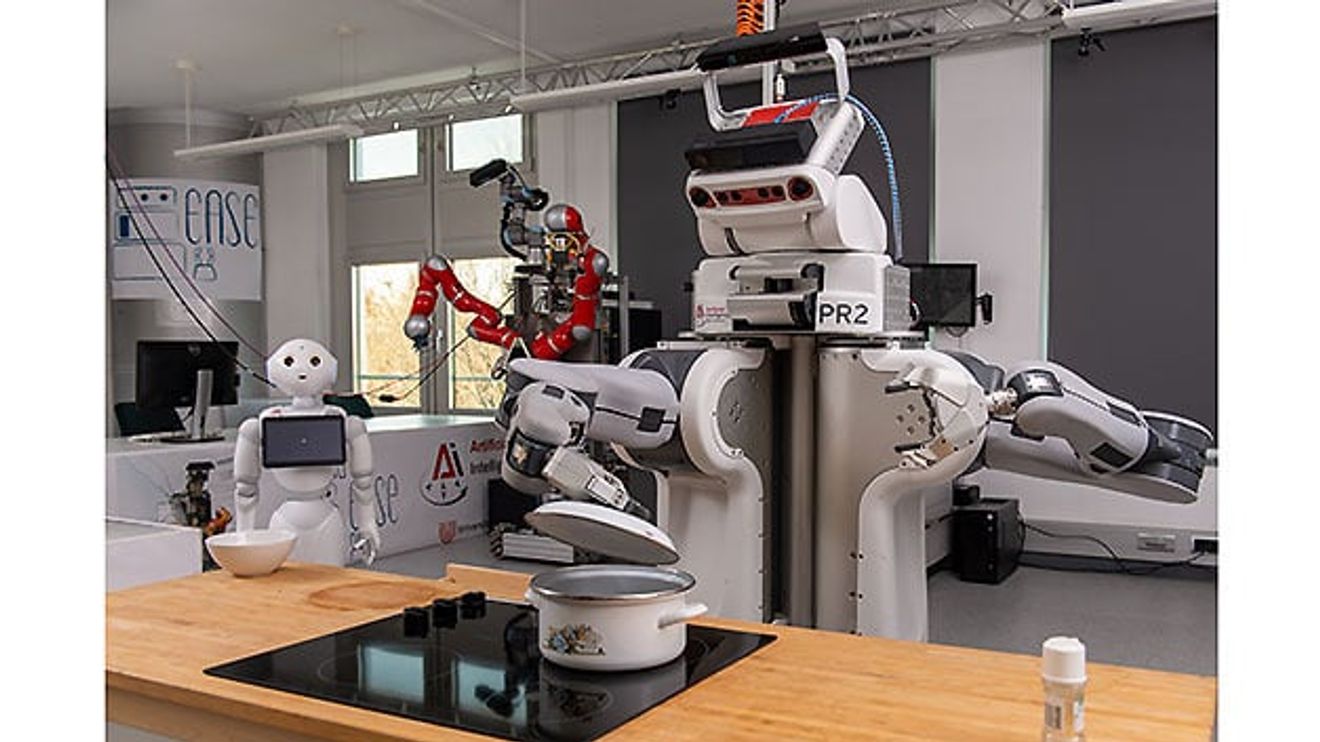
The most important European centers in the field of robotics and artificial intelligence (AI) will cooperate closely within a network of excellence in the future. This will establish a cooperation infrastructure for European robotics with the aim of achieving a leading international position in this disruptive field of research. The coordinators of the network will include the University of Bremen, which has built up extensive expertise in the field of AI-based robotics in recent years. Other participants include the University of Naples (Italy), ETH Zurich (Switzerland) and the Royal Institute of Technology (Sweden) as well as several international industrial companies.
The 'euRobin' network is funded by the European Union as part of Horizon Europe, the EU's central funding program for research and innovation. In this network, the University of Bremen coordinates the activities in the research area 'Knowledge Representation and Reasoning'. In addition, the team led by Professor Michael Beetz contributes key elements for the development of an infrastructure for European cooperation.
"Bremen may be one of the smallest locations in the network, but we have been given one of the key roles," says the Rector of the University of Bremen, Professor Bernd Scholz-Reiter. "This is a great success for our focus on artificial intelligence and AI-based robotics in particular."
Professor Beetz and his team not only coordinate one of the four scientific areas of the network with the research area 'Knowledge Representation and Reasoning', but also lead one of the nine work packages with specific research topics. In addition, the University of Bremen is helping to develop the infrastructure for intensive European cooperation. Specifically, the plan is to set up a knowledge base under the name 'EuroCore' (European Robotics Collaborative Repository). The university is providing an important building block for this with openEASE, a comprehensive web-based knowledge service for robots.


You might also be interested in
AMR in focus
In addition to collaborative lightweight robotics, Bosch Rexroth is also increasingly involved in the AMR market: through a collaboration with the Austrian manufacturer Agilox and the further development of the 'Rokit' mobile robotics construction...
 read more...
With a focus on artificial intelligence
The e-paper of issue 05/06-22
Three trade fairs and the special issue Sensor&Vision await you in issue 5/6 of Computer&Automation. Find out in our special Robotics&Automation section why high plant efficiency does not depend on full automation and how SMEs can use...
read more...The interactive e-paper of the winners
The interactive e-paper Computer&Automation "Products of the Year 2022" offers twelve categories, 36 winners and video interviews with the award winners at a glance! Click right in and experience the industry's pacesetters up close.
read more...Computer&Automation Interactive
The new e-paper experience
Where print reaches its limits, our e-paper unfolds its full potential - true to the motto: pictures say more than 1000 words. Our e-papers now contain more information in the form of videos, GIFs, web links and picture galleries! See for yourself!
read more...B-Human wins the RoboCup World Cup 2024
At this year's RoboCup World Championship in Eindhoven, Team B-Human from the University of Bremen and the German Research Center for Artificial Intelligence (DFKI) won the world championship title for the eleventh time.
read more...Ubica wins European robotics award
Together with the University of Bremen and dmTech, the start-up Ubica Robotics in Rotterdam has received the euRobotics Technology Transfer Award 2022. The award recognizes the transfer of research results from European robotics research to...
read more...Digital Material Selection reduces CO₂ Emissions
Using an industrial gripper as an example, Schunk and CADFEM demonstrate that simulation-based material selection can reduce CO₂ emissions from secondary materials and additive manufacturing by up to 40%.
read more..."AKIMI" Research Project develops AI for Flexible Robotics
The AKIMI research project is launching at the WZL at RWTH Aachen University. The goal is to develop agent-based AI that simplifies the programming and reconfiguration of robotic systems for small and medium-sized enterprises.
read more...Barcelona Declaration on Robotics and...
Robotics Associations Adopt Global Automation Strategy
The global robotics industry is stepping up its collaboration. The associations AER Automation, A3, IFR, and VDMA Robotics + Automation have formed a long-term alliance by signing the “Barcelona Declaration on Robotics and Automation 2026.” The...
read more...