

VDMA Robotics and Automation
Growth forecast for 2024 halved
The VDMA Robotics and Automation Association has reduced the industry's original sales forecast for 2024 from 4% to 2% growth to EUR 16.5 billion. In the previous year, companies achieved record sales growth of 13% to reach 16.2 billion euros.

"The robotics and automation industry is treading water in a weak domestic economy," says Frank Konrad, Chairman of VDMA Robotics + Automation.
© VDMA"The robotics and automation industry is treading water in a weak domestic economy," says Frank Konrad, Chairman of VDMA Robotics + Automation. "In 2024, the industry expects impetus solely from abroad: here, incoming orders rose by 21% in the first four months of 2024."
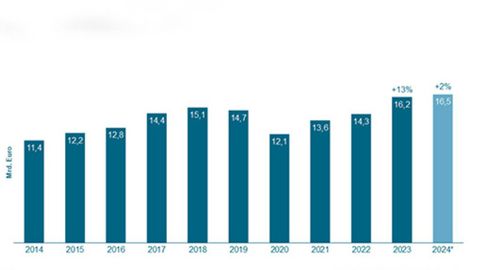
Robotics and automation in Germany will be driven in particular by international business in a subdued domestic economy: the industry is forecasting an overall increase in sales of 2% to EUR 16.5 billion in 2024.
© VDMAInternational competition for the German robotics and automation industry is likely to intensify in future due to the increased involvement of Chinese competitors in Europe. China is one of the most advanced economies in the world when it comes to industrial automation: according to the International Federation of Robotics (IFR), robot density in the manufacturing industry recently rose to 392 units per 10,000 employees, almost on a par with Japan (397 units) and Germany (415 units). Beijing is also specifically promoting its own high-quality Chinese robotics industry as part of its five-year plans. The trade disputes with the USA mean that Chinese companies will increasingly set up local service and sales structures in Germany and the EU.
"Politicians have recognized robotics and automation as a key technology for Germany's competitiveness," says Frank Konrad. "But now the pace of implementation needs to pick up: Germany needs a reliable framework for investment and new impetus in order to strengthen its competitiveness." The VDMA strategy paper 'Robotics and Automation 2028', which defines specific fields of action, provides important guidance for this. The recommendations include industrial policy measures, accelerated innovation, the promotion of talent and practical regulation.


You might also be interested in
Subsidiary for the European robot market
At the beginning of August 2024, the Chinese robot manufacturer Estun Automation will start its expansion in Europe with its own subsidiary, Estun Robot Europe. The company's President & CEO is Gerald Mies, previously CEO of Kuka Systems.
 read more...
Disappointing order situation
The German mechanical and plant engineering sector closed the first half of 2024 with a double-digit decline. In June, orders were again down by nine percentage points in real terms.
read more...Robotics Institute Germany co-founded
Fraunhofer IPA is a co-founder of the Robotics Institute Germany, which aims to bundle Germany's cutting-edge research into AI-based robotics.
read more...OEP acquires majority stake in Comau
The private equity company One Equity Partners, OEP for short, will become the majority shareholder of Comau, while Stellantis will remain an active minority shareholder. An agreement to this effect has been signed.
read more...B-Human wins the RoboCup World Cup 2024
At this year's RoboCup World Championship in Eindhoven, Team B-Human from the University of Bremen and the German Research Center for Artificial Intelligence (DFKI) won the world championship title for the eleventh time.
read more...Fewer orders in May
The high order intake in April proved to be a flash in the pan for the German mechanical engineering industry. Disillusionment set in the following month.
read more...Fewer orders in May
Germany's mechanical engineering companies have suffered a significant setback in incoming orders. Growth in April was followed by a significant slump in May.
read more...Uncertain times for machine vision
Based on the latest VDMA surveys, the European machine vision industry recorded a 7% decline in sales in 2023. The VDMA Machine Vision department expects a further decline in sales of 3% for the current year.
read more...Screen Edition 2024
Welcome to the first issue of the 'Screen Edition', which opens up a completely new way of reading and informing yourself: With the Screen Edition, we offer you a dynamic and always up-to-date source of information with its finger on the pulse.
read more...