
Robotics award
Gecko gripper wins 'Robotics Award 2019'
First place in the Robotics Award 2019 went to OnRobot from Odense, Denmark. It entered the competition with a new type of gripping technology for lightweight robots. Computer&AUTOMATION lists the three finalists for the Robotics Award.
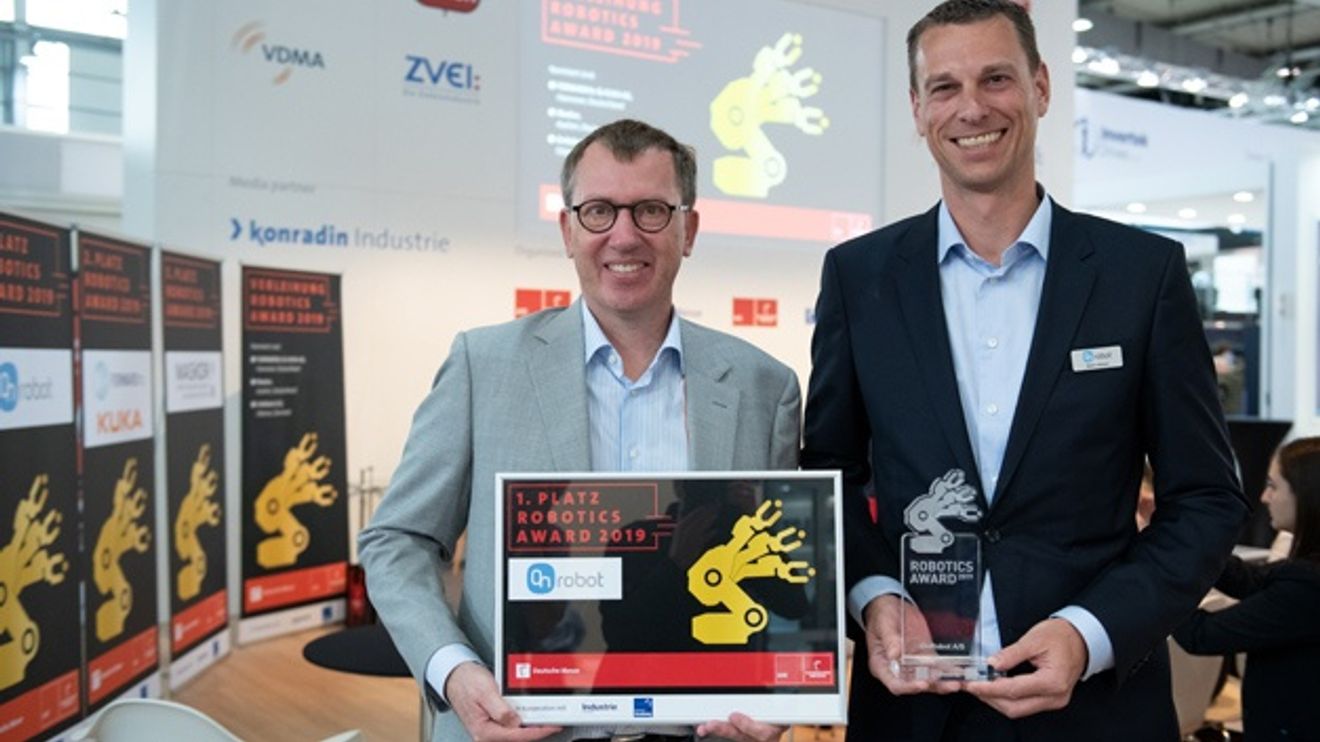
Enrico Krog Iversen (left) and Björn Milsch (right) from the company OnRobot accepted the 'Robotics Award 2019', which is endowed with 10,000 euros. They received the prize for ...
© German Trade FairEvery year, Deutsche Messe, organizer of the Hannover Messe, presents the 'Robotics Award' to products, projects and technological innovations that contribute to robot-based solutions in the field of industrial automation / mobile robots or autonomous systems. The condition for participation is that the submission is presented to the public for the first time at the 'Robotics Award' or that it is a significant further development. The jury will also make sure that the solution is at least market-ready, or even better, industrially tested and is considered particularly advanced.

2nd place in the 'Robotics Award 2019': The charging assistant for electric cars - the result of a joint project between the companies FORWARDttc and Kuka.
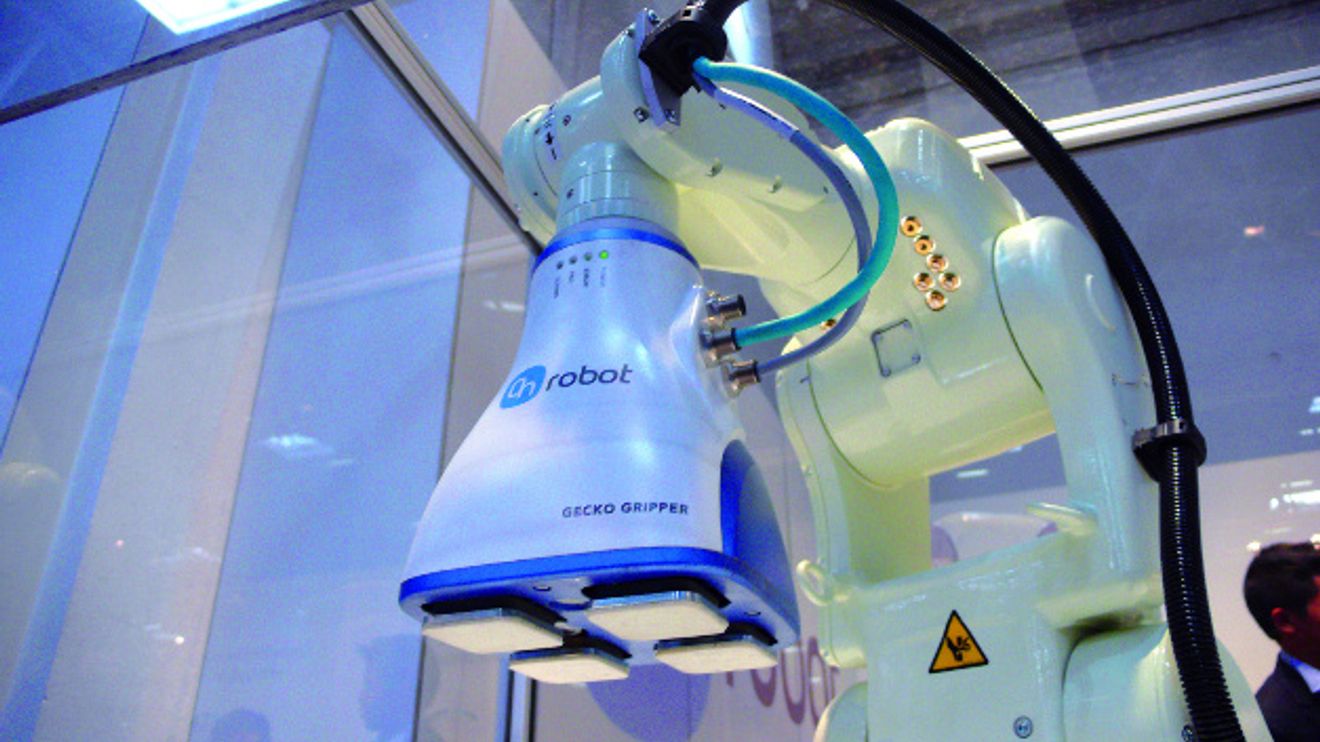
© FORWARDttc, KukaThe 'Gecko Gripper' gripping technology, which won the 'Robotics Award 2019', uses an adhesive technology that comes from nature: the gecko. Millions of tiny hairs develop van der Waals forces on contact with an object, which in turn create adhesion and shear adhesion. The effect: the gripper holds objects without requiring any further force or energy. The gripping process can be released by slightly tilting the holding surfaces.

3rd place in the 'Robotics Award 2019': The 'ETAROB' field robot from the 'MASKOR' team at Aachen University of Applied Sciences.
© Aachen University of Applied Sciences, Arnd GottschalkA joint project by the companies FORWARDttc and Kuka took second place in the Robotics Award 2019. This is a cost-effective charging assistant for electric cars in private and commercial use. The fully automatic charging process can be controlled by remote control or app and, thanks to its compatibility with various charging capacities and charging systems, is suitable for all electric vehicles in the passenger car sector. The charging process can also be transferred to new fuels such as hydrogen.
Third place this year went to 'MASKOR': The 'Institute for Mobile Autonomous Systems and Cognitive Robotics' at Aachen University of Applied Sciences competed with the autonomous field robot 'ETAROB'. This robot specializes in efficient weed control in various vegetable crops. Unlike other solutions on the market, the robot can navigate freely in an unstructured environment, avoid obstacles and remove weeds and their roots from the ground.


You might also be interested in
Another year of growth - but only just!
At the 'Automate 2019' trade fair in Chicago, the International Federation of Robotics (IFR) announced the preliminary figures for 2018 - another record year for the industry!
 read more...
Robot factory officially opened in Slovenia
After around two years of construction, the Japanese technology group Yaskawa officially opened its new robot production facility and a new European robotics development center at its site in Kočevje, Slovenia, on 8 April in front of around 300...
read more...Yamaha FA opens branch office in Düsseldorf
Yamaha Factory Automation, a subdivision of the Yamaha Motor Robotics Business Unit, has opened a European office to strengthen support for distributors and customers of Yamaha's robotic systems and products.
read more...The Hannover Messe 2019 in pictures
At Hannover Messe 2019, exhibitors demonstrated what the networked production processes of the future will look like. In addition to AI, digitalization, 5G and I4.0, the Computer&AUTOMATION team has put together a selection of other things to...
read more...The 'incredible machine'
100 years ago, in a workshop in Esslingen am Neckar, Festo founder Gottlieb Stoll asked himself how technology could make work easier. To mark the company's 100th anniversary, Festo has now designed and built a machine that shows the fascinating...
read more...SmartFactory-KL at the Hannover Messe
The production island_Phuket
AI applications increase the performance, efficiency and productivity of robots, machines and production systems and also help to save a lot of money because they significantly reduce material usage, energy requirements, CO2 emissions and set-up and...
read more...ZVEI at the Hannover Messe 2025
ZVEI criticizes high regulatory hurdles
At the start of Hannover Messe 2025, the German Electrical and Electronic Manufacturers' Association (ZVEI) described the economic situation in the German electrical and digital industry as challenging.
read more...BDI at the Hannover Messe 2025
Industry in crisis
At the start of Hannover Messe 2025, leading industry associations BDI, VDMA and ZVEI described the economic situation in Germany as worrying. According to BDI President Peter Leibinger, the mood in many companies is worse than ever before.
read more...VDMA at the Hannover Messe 2025
Mechanical engineering calls for far-reaching reforms
At Hannover Messe 2025, the mechanical and plant engineering industry emphasized the need for comprehensive reforms in order to strengthen industrial competitiveness in Germany and Europe. The VDMA believes that the German government and the...
read more...