

Omron
Four tips for successful automation
Some SMEs are reluctant to introduce automation solutions because they perceive them as complicated, expensive and time-consuming. Peter Lange from Omron gives four tips to help simplify automation.
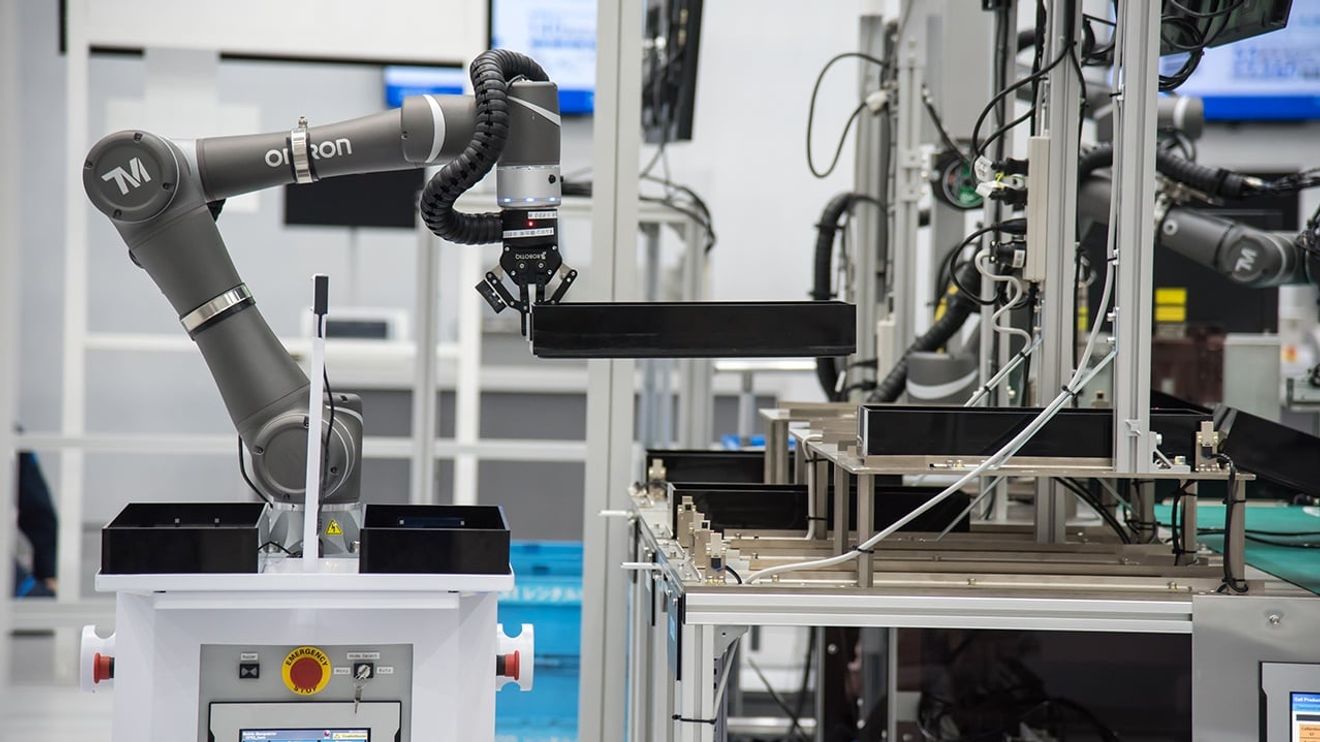
A McKinsey study predicts that the market for industrial automation will grow by almost four percent annually to over 115 billion US dollars by 2025. Cloud and IIoT solutions are particularly in demand. However, many German companies are lagging behind the international competition. According to the Industry 4.0 Barometer 2024, a study conducted by management and IT consultancy MHP together with Ludwig-Maximilians-Universität München (LMU), 41% of the companies surveyed in the DACH region stated that they do not use autonomous machines or robots. This figure was 28% in the USA and only 2% in China. Companies cite the shortage of skilled workers and difficult framework conditions as major hurdles on the road to automation. The solution? Automation must become simpler and more efficient.
Four tips for successful automation
Many SMEs are reluctant to introduce automation solutions because they perceive them as complicated, expensive and time-consuming. However, this way of thinking overlooks the enormous potential of modern technologies in terms of innovation, efficiency and sustainability. The following four tips will help to simplify automation:
1. start small and then scale up
Automation is often difficult for small and medium-sized companies because it is only really useful and beneficial if it meets the requirements of a smaller company and works. This means that the automation tool in question, such as a cobot, should be adaptable and flexible and offer a high level of availability. At the very beginning, the question is: Which challenge in your own company should be tackled, which process should be automated or which improvement should be achieved? It is advisable to start with a very specific problem. The introduction of new solutions and robotics requires careful planning. By starting with small pilot projects, companies can test the effectiveness and acceptance in their specific operation. If the implementation is successful, it can be scaled up to accelerate growth. It is important to get employees and all stakeholders on board from the start, address their concerns and show them the benefits of automation.
2. optimize flexibility and speed
The path to collaborative and autonomous production is a journey that requires good planning. The transition from proof-of-concept to the point at which a system can be utilized takes time. Companies should think carefully about which technology they want to use and how they want to scale it from a cost and risk perspective. For example, a cobot can be used for various application scenarios and machines. At the same time, companies should consider how they can ensure the acceptance of their employees. To reduce changeover times for production lines, a platform that combines machine control and robotics is recommended. The integrated technology synchronizes automation technology and robotics so that companies can improve the speed and accuracy of their production, simulate the entire production line, simplify maintenance and accelerate time to market.
3. link IT and OT with each other
Companies should harness the power of integrated solutions that combine the expertise of experienced partners and information technology (IT) with operational technology (OT). This approach ensures a seamless implementation of automation technologies. The focus is on innovative technologies such as artificial intelligence (AI), machine learning (ML) and 5G. Omron is working together with Nokia and Dassault Systèmes: The synergetic approach combines Nokia's 5G private wireless mobile technology, Dassault Systèmes' virtual twin expertise and Omron's intelligent automation, demonstrating the potential of digital transformation and IoT-based automation solutions for various industries. Omron also offers specialized software solutions for specific applications, such as welding or palletizing, to simplify implementation and deployment - especially when in-house expertise is lacking. No programming know-how is required to use this type of functional software. Users benefit from a ready-made, easy-to-learn interface. No training is required for welders, for example.
4. rely on experienced partners
Technologies such as robotics, big data and cloud computing, augmented reality (AR) and the Internet of Things (IoT) can help to automate work processes and make them more flexible. However, many companies lack the necessary expertise within their own ranks to implement such technologies and adapt them to individual requirements. Collaboration with technology providers and partner companies that are well versed in tools such as 5G, edge AI or data analysis can significantly simplify the implementation and use of new technologies and robots. Cobots have already made the use of robotics in companies easier per se, as they can be used much more flexibly and quickly in other and new areas than stationary industrial robotics, for example. In order to make full use of the flexible application possibilities, it is advisable to rely on experienced consultants who can help with this.
The author: Peter Lange is Business Development Manager Robotics at Omron


You might also be interested in
Dassault Systèmes at the Hannover Messe
Virtual twins simplify manufacturing processes
Dassault Systèmes, together with Omron, will demonstrate how Virtual Twin technology simplifies the process from factory planning to operation, increases efficiency and enhances flexibility.
 read more...
Strategic partnership for cognitive robots
Neura Robotics, a pioneer in the field of cognitive robotics, and Omron Robotics and Safety Technologies, a provider of industrial robotics and automation, have entered into a strategic partnership. The aim is to introduce cognitive robots in...
read more...AMR for loads up to 900 kg
For more efficient material handling in production, Omron offers the autonomous mobile robots (AMR) 'MD-650' and 'MD-900' with an average payload of 650 and 900 kg. The AMRs operate at a maximum speed of 2.2 m/s (MD-650) and 1.8 m/s (MD-900).
read more...The e-paper special: looking for products of the year 2024
They've earned it: all 96 nominated products from 12 categories in their own e-paper. Browse through the individual areas and make your personal selection. You can also find out more about the companies and their solutions in the accompanying video...
read more...Focus on mobile robotics
Omron Robotics and Safety Technologies and Lowpad BV have entered into a strategic partnership to complement Omron's mobile robots with Lowpad's flat solutions.
read more...AI - hype or savior for the industry?
Just because AI is currently in vogue doesn't mean that investments in machine learning and the like should be made headlong and rashly. Instead, it is important to plan precisely and proceed step by step.
read more..."There is a clear customer demand for automation solutions"
Omron celebrates its 90th anniversary in 2023. Dr. Klaus Kluger, Sales Director Central and Eastern Europe at Omron, tells us more in an interview.
read more...Optimized control and safety functions
Omron is launching the 'NX502' CPU automation controllers of the NX series at the same time as the 'NX-EIP201' Ethernet/IP devices.
read more...Accelerated AMR fleet management
Omron has announced the release of 'Fleet Operations Workspace (Flow) Core 3.0' software. The platform extends the operational capabilities of LD and HD series autonomous mobile robots (AMR) and facilitates AMR deployment and fleet management.
read more...