
International Federation of Robotics
EU industry invests heavily in robotics
Almost 72,000 industrial robots were installed in the 27 member states of the European Union in 2022 - an increase of 6% compared to the previous year. These are the preliminary results presented by the International Federation of Robotics.
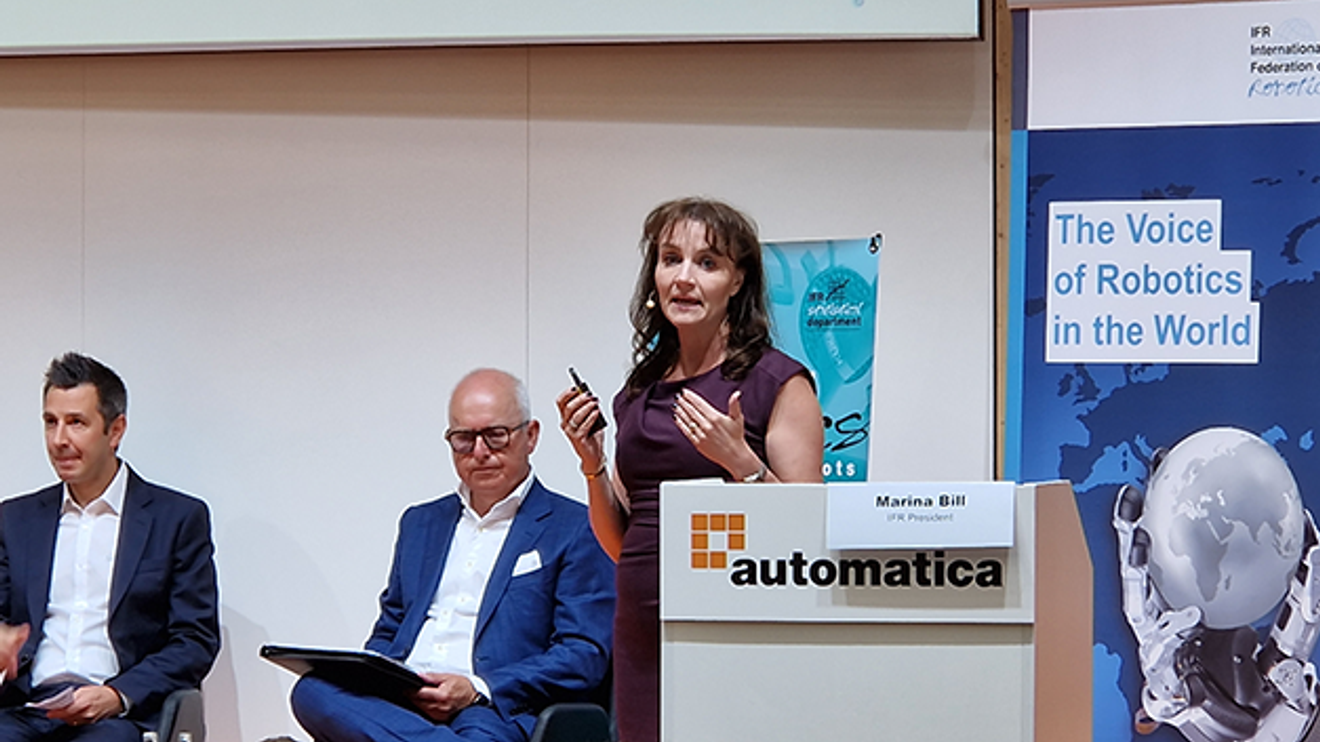
"The five leading countries within the EU are Germany, Italy, France, Spain and Poland," says Marina Bill, President of the IFR. "They account for around 70% of all industrial robots installed in the EU in 2022."
Germany is by far the largest robot market in Europe: around 26,000 units (+3%) were installed in 2022. This corresponds to a 37% share of total installations in the EU. The country has the fourth-highest robot density in the world, after Japan, Singapore and the Republic of Korea.
The automotive industry is traditionally the main customer for industrial robots in Germany. In 2022, 27% of newly deployed robots were installed in this sector. This was 7,100 units, 22% fewer than in the previous year - a familiar cyclical investment pattern in this segment. In general industry, the main customer was the metal industry, which installed 4,200 units (+20%) in 2022. This is above the pre-pandemic level, which hovered around 3,500 units per year, with a peak of 3,700 units in 2019. Installations in the plastics and chemicals industry returned to pre-pandemic levels - an increase of 7% to 2,200 units in 2022.
Italy is the second-largest robot market in Europe after Germany. An all-time high of almost 12,000 units (+10%) were installed in 2022. This corresponds to a 16% share of total installations in the EU. The country has a strong metal and machinery industry: sales reached 3,700 units - an increase of 18% in 2022 compared to the previous year. Sales of robots in the plastics and chemicals industry increased by 42% with 1,400 units installed. And the country also has a strong food and beverage industry. Installations rose by 9% to 1,400 units in 2022. Demand from the automotive industry fell by 22% to 900 units. This segment is dominated by the Stellantis Group, which emerged from the merger of FIAT-Chrysler and PSA France.
The robotics market in France ranked third in Europe in 2022. Annual installations increased by 15% with a total of 7,400 units. The main customer is the metal industry with a market share of 22%. In this segment, 1,600 systems were installed - an increase of 23%. The automotive industry grew by 19% and reached 1,600 units. This corresponds to a market share of 21%.
Annual installations in Spain increased by 12% to a total of 3,800 units. Robot installations are traditionally dominated by the automotive industry. According to the International Organization of Motor Vehicle Manufacturers (OICA), Spain is the second largest automotive producer in Europe after Germany. The Spanish automotive industry installed 900 units - an increase of 5%. Sales in the metal industry rose by 20% and reached 900 units. The automotive and metal industries accounted for almost 50% of robot installations in 2022.
Robot installations in Poland have been rising sharply for nine years. Annual installations reached a total of 3,100 units in 2022 - the second best result after the new high of 3,500 units in 2021. Demand from the metal and machinery industry increased by 17% to 600 units in 2022. The automotive industry showed cyclical demand with 500 units installed - a decrease of 37%. The war in neighboring Ukraine dampened the manufacturing industry. However, investments in digitalization and automation technologies will benefit from a total of €160 billion in EU investment funding between 2021 and 2027.
Robot installations in European countries, including non-EU member states, reached a total of 84,000 units - an increase of 3% in 2022.


You might also be interested in
International Federation of Robotics
Top 5 robot trends 2024
The global inventory of industrial robots has reached a new record of around 3.9 million units. The International Federation of Robotics (IFR) defines the key trends that will shape robotics and automation in 2024.
 read more...
International Federation of Robotics
Top 5 robot trends 2024
The number of industrial robots worldwide has reached a new record of around 3.9 million units. The International Federation of Robotics (IFR) defines the most important trends that will shape robotics and automation in 2024.
read more...Experiments with robots in the fashion industry
Instead of using automation to make existing processes more efficient, a group of researchers in Linz is trying to rethink these processes in a free and new way. Keyword: creative robotics.
read more...Skin-like sensors almost always fit
The Robotics and AI Institute MIRMI at the Technical University of Munich has developed an automated process to produce soft sensors. The measuring cells are to be used in robotics and prosthetics in particular.
read more...EU seals free trade agreement with New Zealand
Representatives of the EU and New Zealand have signed a joint free trade agreement. In addition, New Zealand will be part of the multi-billion euro research and exchange program Horizon Europe, as the EU Commission announced on Sunday.
read more...The optimal workplace
Cobots, or collaborative robots, are gaining more and more ground in production and automation scenarios. But what requirements does such a cobot actually place on its frame? What needs to be considered when planning a cobot workstation?
read more...Interview with S. Brandstetter, B&R
"Completely new type of machines"
In 2020, B&R acquired Codian-Robotics and offers machine automation and robotics from a single source. But what advantage does a machine manufacturer have when they integrate a robot into their machine? Sebastian Brandstetter from B&R...
read more...Cobots - lightweight robots with great potential
In recent years, so-called lightweight robots have been developed. They are also known as collaborative robots or cobots. A group of scientists at RWTH Aachen University has researched how these mechanical helpers can be integrated into a system.
read more...IFR World Robotics Report 2024
Record number of robots in use worldwide
Over four million robots are in use in factories worldwide, reports the IFR in the current "World Robotics Report 2024" - a record number. However, sales of industrial robots have fallen.
read more...