
Igus
AI meets plastics
Smart maintenance, low-cost robotics and AI-based online tools - these were Igus' topics at Hannover Messe. The Cologne-based company shows groundbreaking solutions for the lubricant-free and CO2-neutral industry and automation of tomorrow.
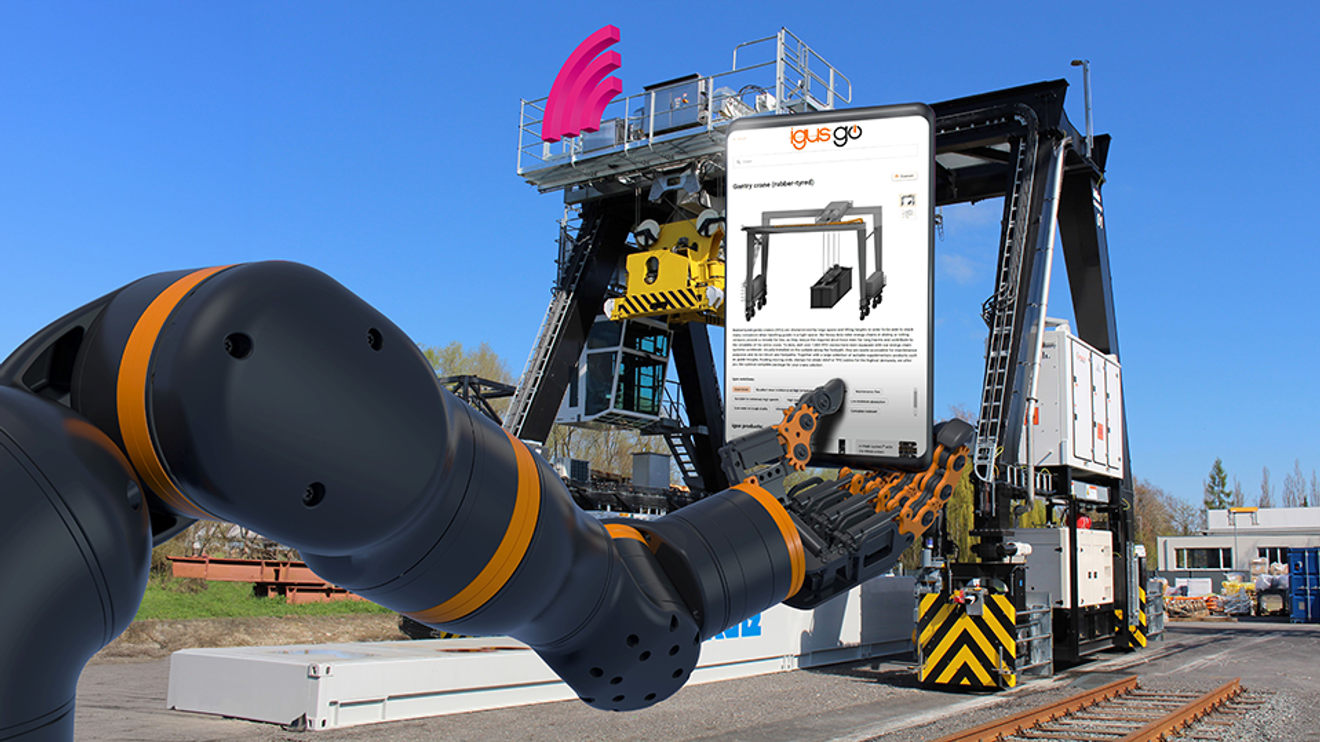
In order to support industrial companies during the challenges of our time, such as the transformation to Industry 4.0 andCO2-neutral production, the Cologne-based motion plastics specialist Igus is relying on Triple Intelligence at the Hannover Messe: artificial intelligence, plastics intelligence and Cologne intelligence. The exhibits include smart sensors for tomorrow's maintenance and AI-supported low-cost robotics that are easy to use. In addition, Igus is introducing an AI-based app that shows designers the optimization potential of their application with lubricant-free motion plastics in a matter of seconds.
AI-based app shows optimizations
Artificial intelligence (AI), machine learning, digital twins: Innovative technologies are revolutionizing the way industrial companies manufacture their products and optimize processes. Artificial intelligence simplifies the work of designers when it comes to selecting suitable components. Igus proves this at Hannover Messe with igusGO. The AI-based app reveals in a matter of seconds how an application can be technically optimized with lubricant-free components from Igus. To do this, designers don't have to pore over catalogs, make phone calls or write emails, but simply take a photo of their application. The app uses AI algorithms to recognize the object and makes suggestions for Igus products that increase reliability and reduce costs. For a bucket wheel excavator, for example, these could be heavy-duty bearings made of high-performance plastic.
A new study by scientists from RWTH Aachen and Igus has now quantified the economic and ecological benefits of lubrication-free polymer bearings for the first time: Depending on the application, this saves between 7,000 and 14 million euros per year that would otherwise be spent on lubricants. At the same time, doing without lubricants offers potential forCO2 savings. By this means, study participant Heineken Brasil, for example, saves 180 kilograms ofCO2 equivalents per year. If all Heineken stores switched to polymer bearings, the company could save 28,814 kilograms ofCO2 equivalents. A small modification with a big impact.
"The optimization potential through the use of our motion plastics can be discovered much more easily and quickly with the help of igusGO. We bring numerous innovations onto the market every year - in 2023 alone there were 227. Our AI app now makes it possible to navigate through our constantly growing product cosmos with maximum efficiency and transparency," says Tobias Vogel, CEO of plain bearings and linear technology at Igus. There are already more than 580 different applications in the app's brain, and more are being added every day - from coffee machines to crane systems to airplanes.
Predictive maintenance thanks to plastic intelligence
Plastics from Igus are also intelligent. At Hannover Messe 2024, Igus is presenting Smart Plastics, i.e. energy chain systems, cables, linear guides as well as sliding, spherical and rotary table bearings that are equipped with intelligent sensors. Not only do they enable real-time condition monitoring, but they can also be connected to various networks and IoT systems. They can be integrated into a predictive maintenance concept to avoid expensive production downtimes due to unplanned system downtimes. Sensors, evaluation modules and software enable a dynamic service life calculation and help to define optimal maintenance times for the products - which also offers an advantage in terms of sustainability. The reason for this is that products are not replaced unnecessarily or too early, but only when they have reached the end of their product life cycle.
Igus is continually developing its smart plastics services in order to respond to current challenges such as the shortage of skilled workers. Thanks to the digital service called superwise, for example, it is now possible to constantly keep an eye on your own applications via a central dashboard with fewer staff than ever before. The intelligent linking of application, product and sensor data as well as the optional use of the Internet of Things creates comprehensive "plastic intelligence". The customer automatically receives timely maintenance recommendations, offers, warnings or suggestions for improvement. If companies don't have time to keep an eye on their applications themselves, Igus takes on this responsibility. Employees proactively report when something needs to be done.
Michael Blass, Managing Director of E-Chain Systems at Igus: "The superwise service combines the modern sensor technology of Smart Plastics with an all-round digital service. In times of multiple crises, it is digital innovations like these that are more crucial than ever to the competitiveness of companies. It is important to us that small and medium-sized companies without in-depth know-how and with low budgets can also benefit from trends such as predictive maintenance."
Easy-to-operate low-cost robots
Igus also presented new products in the area of low-cost automation. This is where the Cologne intelligence comes into play. All robots at Igus are "Made in Cologne" - from injection molding to circuit board assembly to programming. This also includes the Cobot RebeL, which is available in the fully equipped plug-and-play version for just 4,970 euros. For users looking for an even more compact solution, Igus has developed the RebeL KID. Visitors can see an Education AGV, an open source solution and autonomous learning platform that consists of a driverless transport system (AGV) that can be combined with cobots such as the RebeL or RebeL KID. Via the RBTX online marketplace, customers can combine compatible low-cost accessories from more than 100 manufacturers via plug and play, for example grippers or vision systems, supported by online tools and 3D models.
RBTX is designed to help companies of all sizes get started with automation cost-effectively. Here too, artificial intelligence is playing an increasingly important role. AI can help develop an automation solution faster and easier, for example with AI-based simulations. Customers do not have to buy a robot and worry about its integration, but they can test their application in advance.
Robotics on the way to the mass market
Igus also offers products with AI-based voice and gesture control. You can connect Amazon Alexa directly to the Igus robots or integrate gesture control via ROS 2. This will make it easy to define the movements of robots in the future. This AI-supported, intuitive usability combined with a low price is paving the way for low-cost robotics to enter the mass market.
Igus currently uses AI primarily to monitor robots and to quickly and easily integrate vision sensors. The robotics team is also researching resilient programming using speech or gestures.


You might also be interested in
AI Platform Aims to Enable Energy Sharing in Industry
As part of the EU project FlexBit, Fraunhofer IFF is developing an AI-powered platform to optimize energy storage systems and manage industrial energy-sharing systems. The concept is being tested in an Industrial Energy Community in Magdeburg and is...
 read more...
Rittal wins Electrifying Ideas Award 2026
The ZVEI has chosen Rittal as the winner of the Electrifying Ideas Award 2026. With this award, the German electrical and digital industry honors innovations and solutions that use energy efficiently, conserve resources and have an economic and...
read more...Nominations for Electrifying Ideas Award have been announced
An independent jury of top-class experts from business, research and society has nominated three companies for the Electrifying Ideas Award 2026: Ideas from Philips, Rittal and ZeMA - Center for Mechatronics and Automation Technology convinced the...
read more...Circular economy for flexible materials
With a budget of 7.5 million euros and twelve partners from six countries, the European research project 'FlexCycle' is pursuing the goal of making recycling processes for the reuse of flexible materials suitable for industrial use. To this end, it...
read more...Siemens Nanjing plant becomes Lighthouse Factory
The World Economic Forum has recognized the Siemens plant in Nanjing as a Lighthouse Factory. The factory was recognized for its AI-supported, fully digitalized production and significant improvements in productivity, quality and sustainability.
read more...Analysis: These websites are the most harmful to the climate
According to a recent analysis by the University of Europe for Applied Sciences (UE), Amazon's website causes the most emissions of the 200 most visited websites in Germany, at around 1,753 tons of CO₂ per year.
read more...Franco-German research project
GreenBotAI: AI makes robotics efficient and sustainable
The Franco-German lighthouse project GreenBotAI has succeeded in making robotics more sustainable and efficient. The project shows how trustworthy AI "made in Europe" can not only speed up production processes, but also significantly reduce the...
read more...Nomination for sustainability award
Endress+Hauser is one of the three finalists for the German Sustainability Award (DNP) in the measurement and control technology sector.
read more...Green building as EMEA headquarters in Hoofddorp
Delta, a provider of energy management and intelligent green solutions, is expanding its presence in the EMEA region (Europe, Middle East and Africa). A state-of-the-art regional headquarters will be built in Hoofddorp near Amsterdam by the end of...
read more...