
Interview with Stefan Niermann, Inosoft
The advantages of Docker technology
How do you make the same software available for different operating systems and in different app stores and marketplaces? Stefan Niermann from Inosoft explains the procedure.
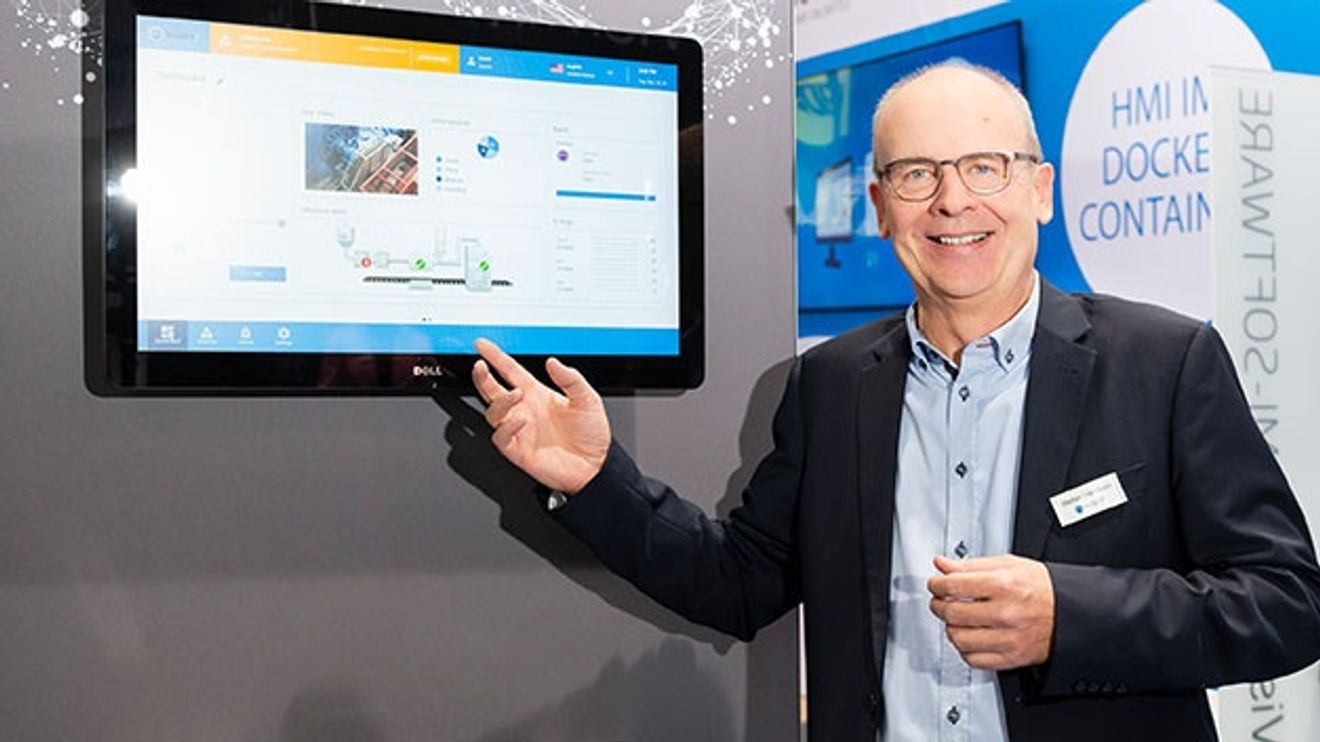
Mr. Niermann, you focused on the cross-platform capability of your software at the SPS. What does this mean?
Stefan Niermann: The term means that software can run on several platforms and only needs to be developed once. This means that we can no longer only be used under Windows, but also under Linux as an operating system.
Why are you taking this approach?
Until now, many manufacturers and users have focused on the Windows platform. Not only on industrial PCs, but also in the embedded sector with or without real-time requirements, Windows - here of course as an embedded compact version - was very widespread. This has been discontinued and manufacturers have been looking for alternatives. Many have long had their eye on Linux and are now actively switching over. Linux allows real-time applications and, as an open-source system, can be easily adapted to embedded devices. With our focus on cross-platform applications, we are represented in both areas.
Which platforms do you see in automation now and in the future?
There are currently two different areas: Where a 'real PC' is required, Windows will continue to be used - this may change in the medium or long term, but it is currently the case. We also support Windows and there are very good reasons for this. In the embedded sector, on the other hand, Linux is becoming increasingly important - here, for example, PLCs run as real-time applications or edge devices for data processing. The operating system is already set up and the applications are often set up too.
Do you also support mobile platforms?
We divide our software into the backend, which processes the data from the process in the background, and the frontend, which is the user interface. Our backend runs on either Linux or Windows, so a mobile platform makes little sense, but it does for the frontend! We have therefore built a user interface as an application for a web browser, which is available on almost every device. This allows us to run the back-end and front-end very flexibly on a wide range of device classes.
How do the applications get onto the various devices?
The front end in the browser is very simple. It loads the pages from a server and renders the content. That's it.
If you want to install the backend, there are classic installers under Windows. Everyone knows them, but they don't exist under Linux. A modern approach is to provide the software as a container and the most prominent example of this is Docker. The software is widely used under Linux and is also available for Windows. A Docker container comes with everything that the software it contains needs to run. This makes things much easier again - so easy that marketplaces for automation have been created on this basis. The application is downloaded from these like an app onto hardware. There are things like the PLC, motion and also an HMI.
Are you already represented?
Yes, we are currently represented by several manufacturers via the start-up Flecs and, most recently, on the 'Nupano' platform of our long-standing partner Lenze. VisiWin is also available on Docker Hub.


You might also be interested in
Modular HMI based on the NXP i.MX 95 SoC
The 'Modular Vision MX95' is part of a new generation of industrial HMI platforms from Seco, designed for easy integration with scalability across performance levels, form factors and application areas.
 read more...
New Managing Director at Bachmann electronic
Bachmann electronic has appointed Daniel Pfeifer as its new Managing Director with effect from January 1, 2026. He succeeds Bernhard Zangerl, who will be leaving the company.
read more...Increase added value, ensure security
The 'zenon' software platform from Copa-Data supports companies in making their production safe, efficient and future-proof, regardless of machine age, manufacturer or industry boundaries.
read more...Application Hub supplemented by validated AI applications
Electronics provider Seco has introduced new AI modules for its Application Hub. The solutions run directly on edge hardware, cover areas from speech processing to image analysis and are designed to simplify the development of industrial...
read more...Bosch pushes ahead with software offensive
Bosch is intensifying its software strategy in the Industrial Technology business sector with the aim of generating around one billion euros in sales through software and software-related services by the beginning of the next decade. "Bosch is one...
read more...Secure data management in the cloud
Bachmann presents new functions of the platform-independent visualization solution 'atvise': Thanks to container operation and a consistent client concept, the solution can now also be used securely as a higher-level IoT (Internet of Things) service.
read more...Administer and update devices with one tool
Increasing customer expectations and cyber security requirements make continuous software updates essential in automation technology. Grossenbacher Systeme offers a cloud portal application for this with the 'Grossenbacher Update Tool (GUT)'.
read more...Monitor and manage energy data
With the 'zenon' software platform, Copa-Data is helping companies to achieve their sustainability goals in accordance with ISO 50001: the integration of data from different disciplines into a networked 'single source of truth', which can be viewed...
read more..."Web-based technologies are platform-independent"
Julien Rausch and Martin Flöer talk about the challenges associated with open ecosystems and the benefits of web-based technologies in this interview.
read more...