
Flow measurement
Balluff expands process technology division
Balluff has had thermal flow monitors in its range since November 2018 and is thus expanding its process technology division. Product Manager Julia Wick talks about the portfolio expansion.
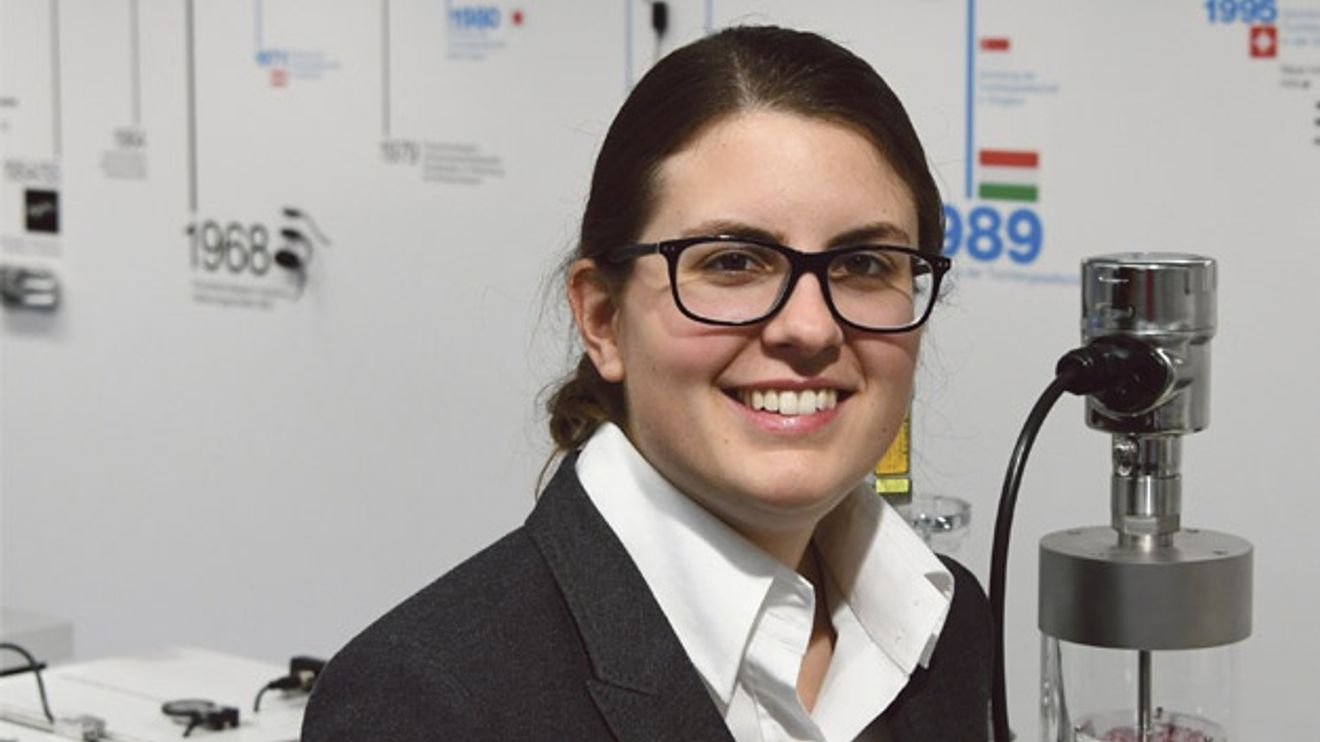
Ms. Wick, why is Balluff focusing on the measurand flow rate?
Julia Wick: The continuous monitoring of process media in machines and systems is ultimately important in order to avoid machine downtime and ensure process reliability. Pressure, temperature and flow sensors support this. We have already been active in this area for many years with our pressure sensor portfolio; expanding the portfolio to include flow measurement technology was therefore a logical next step.
What does the technological implementation look like?
Julia Wick: The flow monitors are suitable for water and aqueous media. Liquids containing solids, such as cooling lubricants with chips, can also be monitored. The sensors work according to the thermodynamic principle: there are two measuring points in the sensor element. The first measuring point measures the temperature of the medium, the second is heated and is a few degrees above the medium temperature. The medium flowing past dissipates heat from the heated measuring point, cooling it down. The sensor electronics evaluate the temperature difference between the two measuring points as an indicator of the flow velocity.
How do the sensors communicate?
Julia Wick: The flow monitor detects whether a preset flow value has been exceeded or not reached and outputs this information as a switching signal. Depending on the variant, there is also a display or a row of LEDs that visualize how high the current flow rate is.
What is special about the flow monitors?
Julia Wick: As there are no moving components that could fail due to corrosion or dirt, maintenance costs are reduced. The screw-in variants can be used universally for different nominal pipe diameters. However, it must be ensured that the entire sensor tip is surrounded by the medium. This allows the user to use more identical parts and save storage space. And in order to be able to monitor media in small pipe diameters, we also have inline versions in our portfolio.
Where are the sensors typically used?
Julia Wick: Depending on where the flow monitor is installed, conclusions can be drawn from the switching signal: For example, a reduction in the flow rate can indicate that a feed pump has failed, a filter is clogged or the pipe system is leaking. Continuous monitoring of the cooling lubricant flow, for example in a machining center, protects tools and workpieces and improves the process reliability of the system. The flow monitor uses the switching signal to indicate a fault in the cooling circuit so that the machining center can be switched off in good time.
What does the future roadmap look like?
Julia Wick: The thermal flow monitors are our first step within flow measurement technology, and other measuring principles will follow. Overall, the process sensor technology portfolio has already been expanded: in addition to pressure and flow measurement technology, we have recently added an initial portfolio of temperature sensors to our range.


You might also be interested in
Satisfied with development in 2018
Balluff will not be able to match the record growth of 21% in 2017 in 2018, but the sensor and automation provider will remain on course for growth in 2018, recording a 6% increase.
 read more...
Rockwell Automation / Schlumberger
Joint venture for the oil and gas industry
Rockwell Automation and Schlumberger, a provider of reservoir characterization, drilling, production and processing technologies for the oil and gas industry, are forming a joint venture called Sensia.
read more...Keysight Expands Test Automation
Keysight is expanding its Eggplant test platform with the "Find by Description" feature. This feature identifies UI elements based on descriptions rather than screenshots, reducing the maintenance effort required for automated tests.
read more...Sensors and measurement technology
Application start for AMA Innovation Award 2026
The AMA Association for Sensors and Measurement (AMA) is inviting scientists and developers from industry and research to apply for the AMA Innovation Award 2026. We are looking for research and development results in sensor and measurement...
read more...Change in management
Althen Mess- und Sensortechnik will be managed by Edwin Goezinne in the future. He succeeds Dr. Timo Hartmann, who was at the helm of the company in Germany for six years.
read more...New composition of the Executive Board
The Management Board of the ifm group of companies presents itself in its new composition for the first time.
read more...A new generation of condition monitoring solution
With 'ibaCMS', Iba is presenting a completely revised condition monitoring solution following the acquisition of Hainzl's condition monitoring division in summer 2023.
read more...Test digital simulation live
On September 26 and 27, students at Amberg-Weiden University of Applied Sciences will be able to find out how computer simulation can be applied directly to research and development projects. CADFEM and Ansys invite you to the big live simulation...
read more...Standard-compliant, agile verification and validation
Model-based design simplifies the development of mechatronic systems by using virtual models from the outset. The second part of the article series highlights methods and functions in the area of software testing - also in relation to the IEC 61508...
read more...