
Industrial metaverse
The six layers of the Metaverse
In the last week of June, Siemens and Nvidia announced their intention to create an industrial metaverse. But what are the cornerstones of such a digital ecosystem? The BVDW has now published a corresponding definition.
On June 29, Siemens and Nvidia announced that they will drive the transformation of the manufacturing industry through precise visualizations that connect design, manufacturing and operations. As a first step, the companies are linking Siemens' Xcelerator business platform with the Nvidia Omniverse 3D design and collaboration platform. According to the two companies, this will enable an industrial metaverse with physically supported, digital models from Siemens in combination with real-time AI from Nvidia.
The Metaverse department of the German Digital Economy Association (BVDW) has now drawn up a definition for the vision of a metaverse and defined six layers of the metaverse construct.
The Metaverse definition
The ultimate vision of the Metaverse is a decentralized, interoperable, persistent digital ecosystem with unlimited user capacity that can be perceived with all the senses. It will coexist with the physical world in both augmented (AR) and purely virtual reality (VR). The fully developed Metaverse will merge with real life and fundamentally change our society and the way we connect, work, live and interact with brands.
The six layers of the Metaverse
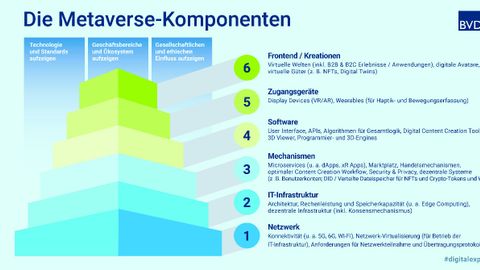
From the department's perspective, the metaverse is made up of six different layers. The network forms the basis. This includes connectivity in order to offer low latency and high bandwidths. The second layer, the IT infrastructure, represents the brain, so to speak, where all connections converge, experiences are stored and which makes it efficient. This includes, for example, the architecture, computing power and storage capacity. The soul of the Metaverse is the third level, the mechanisms. In other words, the processes, privacy and security, but also the apps that are required. The creative content and trading mechanisms, including data storage for the NFTs and tokens, also belong to this level. The software component gives the metaverse the capabilities it needs to function, so to speak. The Interaction Devices level (access devices) is understood as the gateway to the metaverse. This includes the hardware components that the user needs to enter the metaverse and to interact with it. In addition to VR/AR glasses for audio-visual perceptions, this also includes all wearables that will provide a haptic feeling, among other things. The top and final level is the virtual worlds themselves. It forms the world of experience in which all events from the B2B or B2C sector, the avatars and also the virtual goods are contained.


You might also be interested in
Collaboration on generative AI
Siemens and Nvidia deepen their partnership. Supported by Nvidia Omniverse Cloud APIs, Siemens brings immersive visualization to the Siemens Xcelerator platform to advance the use of AI-powered digital twins.
 read more...
Digital first in production
Mercedes-Benz is relying on the digital twin in production for the planning, conversion and start-up of its new MMA platform. Supplemented by the integration of AI and the Mercedes-Benz Operating System, this is set to herald a new era in automotive...
read more...The e-paper for the special issue
Sensor & Vision 2023
Intelligent sensor technology always requires smooth interaction with software and surrounding systems. The examples in this e-paper demonstrate what this can look like in individual cases. This shows that team play counts - in sensor technology as...
read more...AI in the edge area
Current trends and challenges as well as best practices in the field of embedded vision were the topic of a panel discussion at Embedded World 2023 in Nuremberg. An overview of the debate.
read more...The top articles of the year
What do marketplaces, PLC solutions in the cloud, new reading worlds, the abandonment of hardware exclusivity and TSN networks have in common? Quite simply, these topics are among the most-read articles of 2022. We take a look back at them...
read more...Siemens and Nvidia expand partnership
Siemens and Nvida are intensifying their partnership. The aim is to create an industrial metaverse and further advance the use of digital twin technology powered by artificial intelligence.
read more...AI system for machine learning
DFKI accelerates AI research
DFKI is further expanding its computing power to accelerate AI research into learning systems. The aim is to make AI algorithms available for practical use in industry.
read more...AI with IP67 protection
Syslogic is presenting a range of AI-capable embedded computers at the trade fair. These include the 'AI Rugged Computer', which complies with protection class IP67. Florian Egger, Sales Manager at Syslogic, explains the background and highlights...
read more...What deep learning brings to robotics
Today's robots learn, adapt and develop 'autonomously'. The secret behind this: Deep learning.
read more...