
M2M Hotspot
Smart sensors for the IoT
Obtaining usable data from the IoT in mechanical and plant engineering requires appropriate components: so-called 'smart connected sensors' have an internet connection and meet the special security requirements in terms of data protection and IT security.
The IoT is expected to connect well over 25 billion objects by 2020. Numerous 'connected things' will be used for data collection tasks. Each 'Thing' contains at least one sensor that supplies the Things provider with data. This data is then used to offer the user special additional functions. Providers can thus create new business models in order to become less dependent on constantly falling hardware profit margins. However, such a digital transformation requires special sensors in the industrial environment.
However, the current range of products offered by sensor manufacturers is not yet prepared for this challenge. This is why the data hype in consumer electronics has so far passed industrial electronics by more or less without a trace. Industrial electronics require a 'Smart Connected Sensor' (SCS), i.e. a sensor with an Internet connection and corresponding additional functions.
What is a 'Smart Connected Sensor'?
In addition to the actual measured variable acquisition, such an SCS contains the complete signal preparation and signal processing in the same housing. It usually has a digital interface (e.g. Modbus, CAN, CANopen, IO-Link, Ethernet) for communication with higher-level systems. The market even offers variants with an integrated mobile radio modem.
However, an SCS always includes a special cloud service platform to which the sensor can transfer data without the need for additional engineering. A virtual data image of the sensor is created on the service platform and supplied with current data. In addition, an API is available for authorized access to the data image. Valuable additional functions can be implemented via the cloud, such as comparing the measured variable received from the sensor with an IT database in order to place the measured variable in an application context and send an alarm or notification if required.
An example of this could be a fill level sensor in a system that sends the measured fill level to a cloud service platform on the internet whenever there is a change. There, the measured value is received by a software component assigned to the SCS and checked against certain limit values. If, for example, the value falls below the minimum fill level, the service platform sends a refill notification to the ERP system of a service partner to initiate a container refill.
Direct or indirect cloud connection
An SCS can communicate with the cloud service platform in different ways. In the simplest case, the sensor has an integrated 2G/3G/4G cellular modem with SIM card and can reach the cloud via the cellular network of a network provider. This solution enables complete pre-configuration ex works so that the sensor only needs to be installed in the field. No further on-site configuration is required, so mass roll-outs would be possible without any problems. An integrated Wi-Fi interface is also conceivable.

An SCS with a direct Internet connection delivers measurement data to the cloud service platform via TCP/IP or using a Short-Range Wireless Network (SRWN).
© SSVIn this case, however, the SCS must at least be configured locally for the respective 'Wi-Fi access point', which also requires a special configuration interface. In both cases (mobile radio and Wi-Fi), a complete TCP/IP stack and special security modules are required directly in the SCS to defend against cyber attacks. However, a 'wireless sensing' SCS variant is also possible, which communicates via a short-range wireless network (SRWN, e.g. ZigBee) with a special gateway that forwards the sensor measurements to the cloud service platform. In this case, TCP/IP plus security is only required in the gateway. The individual wireless sensing node would then be much cheaper to implement.
For many applications, it is sufficient if the sensor only has an inexpensive Bluetooth Low Energy (BLE) interface and is supplied together with a smartphone app. The sensor itself then has no direct connection to the cloud. This is realized via the app. The app can pre-process, modify and temporarily store sensor data and visualize it on site. For example, it is possible to visualize the actual status by directly querying the sensor measured variables using BLE. At the same time, a history can be displayed by requesting historical data for the relevant sensor via the cloud service platform.
SCS as a data supplier
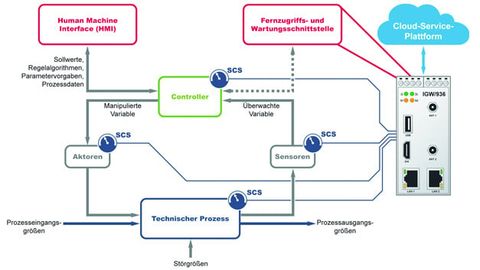
Valuable data can also be obtained in existing machines and systems by retrofitting suitable SCS. Forwarding the sensor data to a cloud service can enable condition monitoring, for example.
© SSVA business process can be automated with a single SCS - for example as a fill level sensor. Several SCSs installed in a machine or environment even enable service-oriented business models. However, this requires extensive data images and long-term data storage (history).
If, for example, the failure of individual system components is to be predicted for a predictive maintenance service with the help of SCS, a corresponding SCS is required at all neuralgic system points. All sensors together then provide a condition monitoring image in the cloud. In order to apply the predictive analysis tools of a cloud service platform to the SCS data, the most comprehensive and meaningful condition monitoring history possible is first required. Machine learning can then be used to derive a prediction model from this data, which can predict the probability of failure of individual assemblies using predictive analytics. Even changes in the quality of the items produced can be predicted if, for example, the tools used are included in the SCS data image.
Developing digital business models
Suppliers of sensors, machines or systems should immediately develop a digital business model and start offering SCS extensions with data-based services for existing products as soon as possible. Service version '1.0' does not necessarily have to be perfect. The winner will be the one who can generate valuable information from data and recognize further patterns for their own customers. This will certainly require several iterations.
Author: Klaus-Dieter Walter is a member of the management team at SSV Software.
Intensive seminar on the topic of IoT
The seminar with Klaus-Dieter Walter from June 8 to 9, 2016 in Munich provides comprehensive answers and examples of both consumer electronics-oriented IoT and the Industrial Internet of Things (IIoT).
The combination of theory and practical exercises, which will be carried out using an IoT developer kit, will give participants a thematically structured insight into the subject matter. The examples range from smart homes to smart factories. Further information can be found at: www.training-for-professionals.de.


You might also be interested in
Hans Seifert to Become Chief Sales Officer
Sigmatek has appointed Hans Seifert as Chief Sales Officer (CSO). His area of responsibility includes international sales, marketing, application engineering, and support.
 read more...
Rethinking disaggregated infrastructure
Dell Technologies presents innovations for disaggregated data centers. They cover the areas of storage, cyber resilience, software and integrated partner systems. These infrastructures combine computing, storage and network resources in pools and...
read more...Autonomous AI shapes the future
The latest edition of "Accenture Technology Vision" predicts a new era of digitalization: AI systems are increasingly acting autonomously and thus transforming the reality of work in companies. The key success factor here is the trustworthiness of...
read more...Zebra Technologies at Vision 2024
Deep learning tools for image processing
Zebra will showcase end-to-end machine vision solutions with AI at Vision 2024. It will demonstrate how industrial manufacturers can equip their engineers, programmers and data scientists with flexible deep learning machine vision solutions - on...
read more...ChatGPT in the industry - Part 8
Evaluate and improve code structures
Are gpt-4o and Google Gemini also suitable for evaluating code quality and code structures? Or would developers be better off using traditional software tools? Questions that are worth a closer look.
read more...Software from the cloud conquers industry
Software from the cloud is becoming the standard in industrial companies. This is shown by the current study "Spotlight Future 2024" commissioned by PLM provider Aras.
read more...Test digital simulation live
On September 26 and 27, students at Amberg-Weiden University of Applied Sciences will be able to find out how computer simulation can be applied directly to research and development projects. CADFEM and Ansys invite you to the big live simulation...
read more...New Managing Director of Proalpha Switzerland
Stefan Inderbitzin took over the management of the Swiss branch of ERP software provider Proalpha on August 1, 2024. With his expertise in the technology sector, he will further strengthen the company's position on the Swiss market.
read more...New threat to industrial control systems
FrostyGoop is the name of a new malware variant that specializes in industrial control systems (ICS). It poses a threat to critical infrastructures worldwide. OT cyber security expert Dragos has identified FrostyGoop.
read more...