
Fraunhofer IZM
New EU Toolkit for sustainable Electronic Products
The European research project 'Increace' is setting a milestone for the circular economy: a network of universities, research institutes and industry partners has presented a comprehensive set of basic principles and a new evaluation tool that should significantly advance the use of recycled plastics in electronic products.
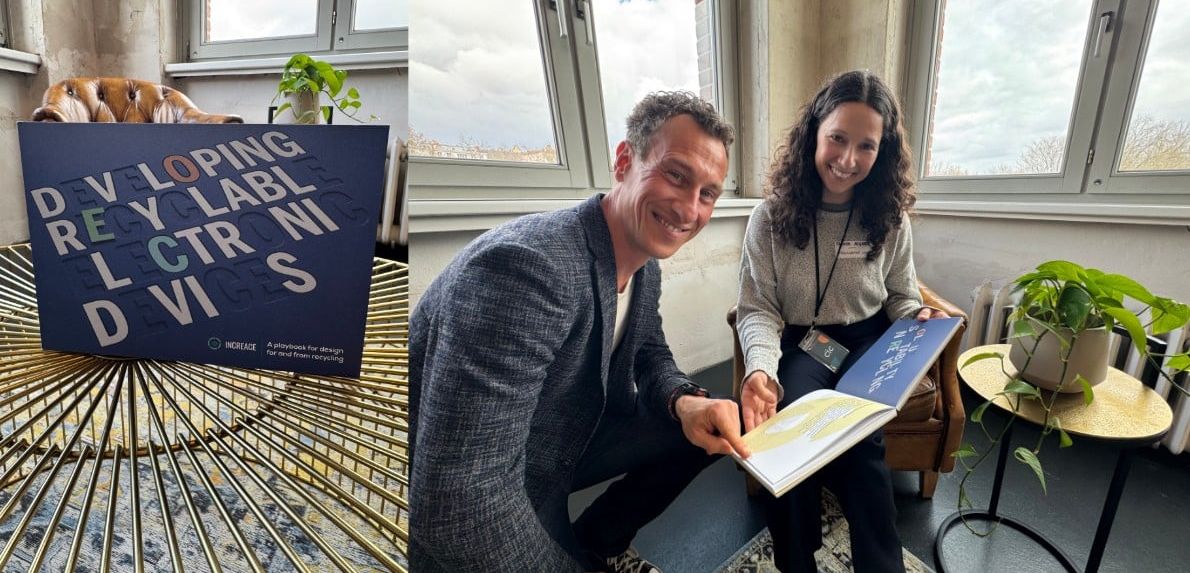
With "Developing Recyclable Electronic Devices: A playbook for design for & from recycling", Theresa Aigner (Fraunhofer IZM) and Thijs Feenstra (Pezy Group) present a book that reveals the reality of circular product design - and shows concrete ways in which design, material development and recycling can move closer together. The publication is intended as a playbook: a collection of practical recommendations that show that recyclability does not begin at the end of a product's life, but with the first design decision.
A playbook for circular electronics
The book combines four years of research, cross-industry collaboration and practical tests and makes it clear why circular electronics often fails less due to a lack of ambition than due to a lack of coordination between the players. In five practical case studies, stakeholders along the entire value chain - from recycling to product design - have recorded real-life tips, practical guidelines and advice for the work of designers, engineers and product developers in the playbook. This allows them to get straight into the implementation of circular devices without the development teams having to become recycling experts themselves. The E Book is a publication of the Horizon Europe-funded Increace project. It is available for free download at: https://increace-project.eu/increace-results/increace-book/.1
New evaluation tool for product development
In addition to the book, the Increace consortium has developed a practice-oriented tool for circular product design as part of the project: the Recyclability Assessment Tool (RAT). The RAT is used for the independent and standardized assessment of the recyclability of electronic products. It was developed by Philips and Pezy and tested and optimized by industry partners. It enables design and development teams to identify critical factors that could affect the recyclability of their products - such as problematic materials, compounds or surface treatments - at an early stage of the development process in order to find possible alternatives.
Significance for the EU plastics strategy
Together, the book and the tool form a new foundation for the circular development of electronic products in Europe. The measures and publications of the Increace consortium, such as the playbook and the RAT tool, show once again how important it is for the EU's plastics strategy to consider recycling right from the design phase and to provide the public with guidelines for product development.
The ceremonial conclusion of the Increace project will take place on May 20, 2026 in Brussels at Hoek 38 - a venue and meeting place for research and knowledge run by the FWO (Fonds voor Wetenschappelijk Onderzoek - Vlaanderen).


You might also be interested in
IT Partnership in the Energy Market
CGI and Schneider Electric cooperate
CGI and Schneider Electric are expanding their collaboration in the DACH region. The aim is to support energy suppliers with grid modernization, digitalization and regulatory requirements. The focus is on ADMS-, GIS- and AI-based solutions.
 read more...
Up to 140 TWh of Electricity Savings Possible with Frequency Converters
The targeted use of frequency converters could save up to 140 terawatt-hours of electricity per year in the EU. Researchers at Fraunhofer see significant potential especially for pumps, fans, and compressors with variable loads.
read more...Why Retrofit Makes Sense for Industrial Companies
Many industrial machines are technologically outdated, even though mechanically they are still in good condition. Retrofitting enables cost-effective modernization of existing equipment—conserving resources, improving energy efficiency, and enabling...
read more...AMD's new Efficiency Targets for AI Nodes by 2030
Growth in the areas of artificial intelligence and data-intensive applications is leading to a drastic increase in energy consumption. This requires a rethink in the technology industry. AMD is meeting this challenge with ambitious efficiency...
read more...Growing pressure on the European energy grid
As the proportion of renewable energies increases, the pressure on the European electricity system is growing. For the Association for Electrical, Electronic & Information Technologies (VDE), this is the right time to bring technical clarity to...
read more...Components made from renewable raw materials
Schurter is expanding its portfolio of 'Green Line' products to include components with housings made from plant-based raw materials. New products include the 4797 appliance inlet, the 4798 and 6080 appliance plugs and the 4782 reconnectable...
read more...The winners of the SET Award
Five winning start-ups were honored by dena as part of the Berlin Energy Transition Dialogue (BETD). The SET Award promotes innovative ideas and solutions for a sustainable energy future. Start-ups were honored in the categories "Clean Energy &...
read more...CSRD-compliant sustainability report published
With the publication of the Sustainability Report 2024, the Schaeffler Group is creating transparency for its stakeholders. In accordance with the EU's Corporate Sustainability Reporting Directive (CSRD), the Sustainability Report is part of the...
read more...Participation in 6G projects
Keysight Technologies is involved in two projects that are part of the 6G Smart Networks and Services Joint Undertaking (SNS-JU). The aim is to develop a sustainable and scalable AI-native architecture for 6G networks.
read more...