
Yaskawa Europe
Vipa integrated - reorganized
Yaskawa Europe is setting a new course - both organizationally and on the product side, particularly in terms of control technology and software. CEO Manfred Stern explains the details.

"We will by no means forget the Vipa history," says Manfred Stern, CEO of Yaskawa Europe.
© Yaskawa EuropeMr Stern, Yaskawa Europe has had a new organizational structure since March. What exactly does this look like?
Manfred Stern: Firstly, as of March 1, we merged the previously separate 'Drives & Motion' and 'Vipa Controls' divisions into the new 'Drives Motion & Controls' division - DMC for short. We are convinced that this new structure will enable us to make much more efficient progress in these segments and, above all, to offer customers an even better and more standardized service. The DMC division will be headed by Norbert Gauss, who was already responsible for Drives & Motion in the past.
Secondly, we have created a completely new business unit - the Environmental Energy division, consisting of the three business units 'Wind', 'Marine' and 'Turbo Motors & Industry'. With the latter, we are targeting the market for high-performance pumps and compressors, among other things, where special, very high-speed and particularly powerful motors are required. This division will be headed by Jukka-Pekka Mäkinen, the former CEO of the Yaskwa subsidiary 'The Switch' based in Finland.
Together with the existing Robotics Division, our business will therefore be based on three fundamental pillars in future. Mr. Linkenbach, who previously headed Vipa, has taken over the task of organizational development at the European headquarters.
So five years after the purchase of Vipa, the control technology provider from Herzogenaurach is now fully integrated into Yaskawa?
Manfred Stern: Correct. Although Vipa GmbH still exists - i.e. the legal merger has not yet been completed - the name Vipa will no longer be promoted externally in the future, as the organization has been merged into DMC. However, this does not mean that we are forgetting the history of Vipa! On the contrary: we will continue to actively market the original Vipa products - especially the 300 control class with its look and feel. We simply see a huge demand for them in the coming years. This is one of the reasons why we introduced the 300S plus last year with even more CPU power and some new features.
In short, the 300 series is not a product that is just a sideline for us, but remains one of our core components. At the same time, however, we are working flat out on new product lines, into which we are currently investing the majority of our development resources.
What new products are we talking about here?
Manfred Stern: On the one hand, it's about the further development of the smart I/O system SLIO and the MicroPLC, which was only launched a year ago and for which we have released the extensions for analog I/Os in recent weeks. In addition, both SLIO and MicroPLC have recently been equipped with an integrated web server.
However, our biggest project at the moment, which is also a global project within Yaskawa, is the development of a completely new generation of controllers with the internal designation 'Unified Controller'. This is a standardized and modular HW platform that can be used in the future for motion control, PLC applications and also for robotics applications - with the exception of very specific applications such as welding. The 'heart' or intelligence of this hardware platform is a new SoC, which is currently being developed jointly by colleagues from Vipa subsidiary Profichip in Herzogenaurach and our R&D headquarters in Kokura, Japan.
Finally, the hardware is based on completely new software based on IEC 61131-3 and, last but not least, the necessary components for Industry 4.0 compatibility - i.e. OPC UA and everything else associated with it - are located one level above this.
Incidentally, we also recently launched our new communication ASIC Antaios, also developed by Profichip - interestingly, as the first in Japan! The reason: in addition to the protocols established in Europe, this ASIC supports the Mechatrolink protocol, which is very popular in Japan and China, which helps us immensely to harmonize the global Yaskawa world with Western communication systems. This component is also freely available on the market via Profichip.
Wasn't the initial plan to use the Speed7 Studio software, originally designed by Vipa as a counterpart to Siemens' TIA portal, as a comprehensive software framework for all Yaskawa platforms?
Manfred Stern: We will certainly be able to incorporate some features of Speed7 Studio as modules in the new software environment; however, this will not be Speed7 Studio in the original sense. As you said, Speed7 Studio was born in the Vipa era and therefore did not yet have the global view of Yaskawa with all its product lines, including robotics. In this respect, the development specification goes beyond the original planning. One aspect in which the colleagues from Herzogenaurach and the Motion division from Eschborn are closely involved is the development of the integrated safety technology for the upcoming control platform.
What is the roadmap for the 'Unified Controller'?
Manfred Stern: We want to start rolling out the products in 2020/2021, particularly with regard to the hardware basis. Products for integrated safety technology, which can also interact with SLIO, will be available a year earlier.
The Hannover Messe 2018 will be starting soon - with Yaskawa as an exhibitor again after a long absence. What prompted you to return?
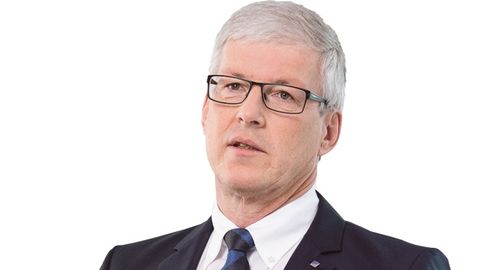
"We don't have to and don't want to hide when it comes to Industry 4.0," says Manfred Stern.
© Yaskawa EuropeManfred Stern: That's right, the last time Yaskawa was represented at the trade fair as a group - apart from our joint trade fair appearance with Vipa in recent years - was in 2007. Our return in 2018 is primarily due to the fact that I am convinced that the Hannover Messe is de facto developing into a 'showcase' for Industry 4.0. With our presence in Hall 17, we want to emphasize that Yaskawa can and wants to make a contribution to this topic.
What exactly will your trade fair presence look like?
Manfred Stern: Our presentation will be under the overarching motto 'i3 Mechatronics'. The three 'i's stand for innovative, integrated and intelligent. In Hanover, we will be demonstrating what this actually means by showing the interaction of our main product lines - robots, servos, inverters and, last but not least, controllers - with the so-called 'Yaskawa Cockpit'. The latter is also a completely newly developed platform of intelligent software components - with a central database, modules for collecting, evaluating and displaying data, web server, alarm via email and standard interfaces such as OPC UA and HTTP to higher-level systems.
In short, the Yaskawa cockpit is where all the threads come together to draw the appropriate conclusions from data generated at various points - for example, to enable asset management, predictive maintenance, quality management or alarm handling or to increase throughput in production. With this objective in mind, external tools can also be docked onto the cockpit - think of artificial intelligence, for example. In this regard, we are already working with partners in Japan - including IBM Watson - to ensure that IBM processes or evaluates the data supplied by our devices accordingly and then feeds the results back into the cockpit.
If Industry 4.0 is so important to Yaskawa, why are you exhibiting in Hall 17 in the robotics area and not in Hall 9 in the control and automation technology area?
Manfred Stern: When people talk about Industry 4.0 today, the topic of robotics is also becoming increasingly present - so Hall 17 is not a bad choice in itself. If we wanted to be 'properly' positioned with all our product areas, we would have to be present in several halls in Hanover - but that makes no sense. This is also the reason why Vipa, or rather the control technology, will no longer be located in Hall 9 this year. The message we ultimately want to send out: Our trade fair appearance in Hanover is not a robotics event, but a platform to demonstrate the complete automation portfolio.


You might also be interested in
Bernecker + Rainer (B&R) / ABB
ABB invests 100 million euros at B&R headquarters
One year after announcing the takeover of B&R, the Swiss ABB Group will invest 100 million euros in Austria. The innovation and education campus being built at B&R's headquarters in Eggelsberg will create the basis for around 1,000 new...
 read more...
The 'incredible machine'
100 years ago, in a workshop in Esslingen am Neckar, Festo founder Gottlieb Stoll asked himself how technology could make work easier. To mark the company's 100th anniversary, Festo has now designed and built a machine that shows the fascinating...
read more...SmartFactory-KL at the Hannover Messe
The production island_Phuket
AI applications increase the performance, efficiency and productivity of robots, machines and production systems and also help to save a lot of money because they significantly reduce material usage, energy requirements, CO2 emissions and set-up and...
read more...ZVEI at the Hannover Messe 2025
ZVEI criticizes high regulatory hurdles
At the start of Hannover Messe 2025, the German Electrical and Electronic Manufacturers' Association (ZVEI) described the economic situation in the German electrical and digital industry as challenging.
read more...BDI at the Hannover Messe 2025
Industry in crisis
At the start of Hannover Messe 2025, leading industry associations BDI, VDMA and ZVEI described the economic situation in Germany as worrying. According to BDI President Peter Leibinger, the mood in many companies is worse than ever before.
read more...VDMA at the Hannover Messe 2025
Mechanical engineering calls for far-reaching reforms
At Hannover Messe 2025, the mechanical and plant engineering industry emphasized the need for comprehensive reforms in order to strengthen industrial competitiveness in Germany and Europe. The VDMA believes that the German government and the...
read more...Industry 4.0 - outgrowing its infancy
At Hannover Messe 2019, it became clear that Industry 4.0 has long since left the theoretical stage. Smart factories and future-proof manufacturing concepts characterized the image of the trade fair in many places.
read more...Robotics - safe and cost-effective
Robotics doesn't have to be expensive, complicated and dangerous for workers - this was the message sent by numerous exhibitors at Hannover Messe 2019 to visitors to 'Robot Hall 17'.
read more...AI as the dominant topic
True to the leitmotif of this year's Hannover Messe - Industrial Intelligence - the topic of artificial intelligence was omnipresent at the exhibitors' stands; not only in theory, but also in practice using the example of numerous use cases.
read more...