

Industry 4.0
The top dialog
The future-oriented Industry 4.0 project was officially launched at Hannover Messe 2011. The Industry 4.0 platform's research advisory board has now met for a top-level dialog and drafted a twelve-point communiqué on the work still to be done.
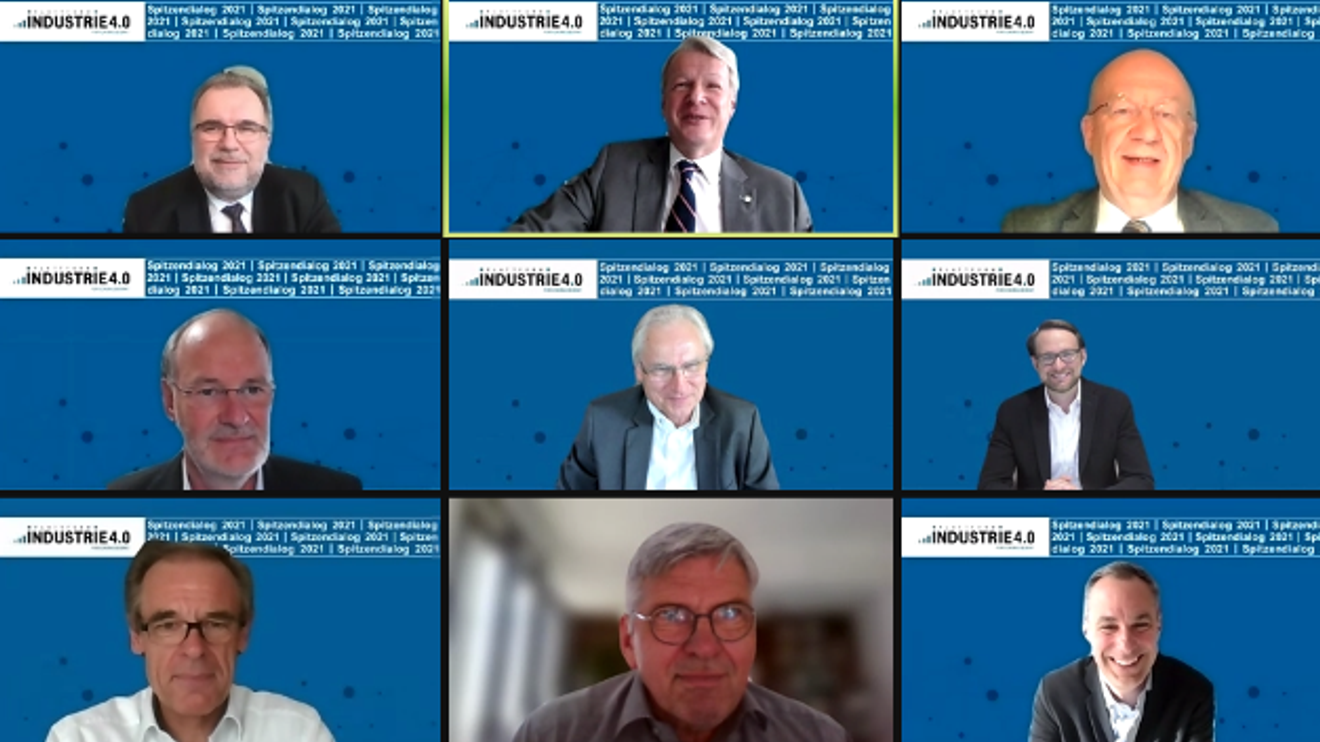
The panel participants (from left to right and from top to bottom): Siegfried Russwurm (President of the BDI), Prof. Peter Liggesmeyer (Scientific Spokesman of the Research Advisory Board), Wolfgang Wahlster (DFKI), Harald Schöning (Industry Spokesman of the Research Advisory Board), Henning Kagermann (Acatech), Thomas Saueressig (Member of the Board of Management of SAP SE), Volkmar Denner (Chairman of the Board of Management of Robert Bosch GmbH), Jörg Hofmann (First Chairman of IG Metall) and Cedrik Neike (Member of the Board of Management of Siemens AG). Not in the picture: Manfred Wittenstein (Chairman of the Supervisory Board of Wittenstein SE) and Frank Possel-Dölken, CDO at Phoenix Contact).
© Computers&AUTOMATIONThe discussion panel began with a critical review of Germany's status quo as a leading provider of Industry 4.0. The future-oriented Industry 4.0 project emerged in 2010 from the research union to accompany the German government's high-tech strategy. The motivation behind the top-level dialog that has now been held: In the face of increasing global competition, further steps urgently need to be taken to drive forward the implementation of Industry 4.0. The panelists discussed and formulated 12 impulses that they believe are crucial for the success of Industry 4.0.
1. competitiveness
Countries such as the USA, China, Japan and Korea are investing heavily in key technologies and are putting pressure on the global competitiveness of the European and German innovation systems. Germany's international competitiveness must therefore be further expanded so that Germany becomes a leading provider for the export of Industry 4.0 solutions and the efficient production of physical goods of the highest quality remains a backbone of our economy. This will secure jobs in the long term and create a basis for shaping the labor market for the future.
2. potential of Industry 4.0
The potential of Industry 4.0 is far from exhausted and Industry 4.0 has not yet been implemented in all companies and sectors. Industry 4.0 must therefore be pursued with commitment by the future German government and corresponding research and implementation initiatives must be anchored in the coalition agreement for the 20th legislative period.
3. the future of work
In the course of Industry 4.0, the industrial world of work is also changing fundamentally. New ways of collaboration between humans and machines are constantly emerging. The human-centered approach of Industry 4.0 ensures good industrial work and makes it sustainable - now and in the future.
4. sustainability
Resource and energy efficiency has been a key objective of Industry 4.0 from the outset. Industry 4.0 has the potential to support a resource-efficient and climate-friendly circular economy.
5 Technological sovereignty
Our technological sovereignty will be significantly strengthened by Industry 4.0. This also requires appropriate IT security.
6. new business models
Industry 4.0 is leading to new, primarily data-driven and platform-based business models. Data is therefore becoming an economic asset. In the short term, "industrial artificial intelligence" offers enormous opportunities as a future field that builds on Germany's strengths.
7. resilient value creation networks
Industry 4.0 is transforming value creation networks into dynamic ecosystems with global entrepreneurs, SMEs and start-ups. The prerequisite for this is an international data space for Industry 4.0 applications.
8. interoperability
The compatibility and interoperability of Industry 4.0 solutions must be achieved. International standardization and certification offer strategic tools for this. Proactive involvement in shaping international standardization and certification processes is of great importance here.
9. innovation
Industry 4.0 represents a backbone for innovations on integration topics (such as artificial intelligence in Industry 4.0) and application topics (such as sustainable CO2-neutral production through Industry 4.0). Such innovation directions should be expanded.
10. education and research
Pre-competitive funding through transfer and joint research programs as well as the training and further education of specialists and managers for Industry 4.0 must be expanded through corresponding programs and initiatives.
11. cooperation
The synergetic cooperation between science, trade unions, politics and industry, including the BDI, BITKOM, VDMA and ZVEI associations, has created an outstanding ecosystem with the Industrie 4.0 platform. This form of cooperation must be further strengthened and promoted.
12. design instrument
Industry 4.0 is an internationally recognized benchmark and brand for digitalization in industry, with numerous implementation successes. Against this backdrop, the importance of Industry 4.0 must be further strengthened so that the fourth industrial revolution can be successfully implemented worldwide starting from Germany.
The Research Advisory Board of the Industry 4.0 platform
The Research Advisory Board of Plattform Industrie 4.0, which emerged from the Scientific Advisory Board Industrie 4.0 from 2013, was reconstituted in its current composition in 2018. The Research Advisory Board consists of 19 representatives from the scientific community and 13 representatives from industry to provide independent advice to Plattform Industrie 4.0, its working groups and the federal ministries, in particular the Federal Ministry of Education and Research (BMBF). The work of the Research Advisory Council aims to promote the further development and implementation planning of Industrie 4.0 in the German economy by developing science-based research recommendations. The Research Advisory Council sees itself as a source of inspiration for future research topics and an advisor on the implementation of Industrie 4.0. The work of the Research Advisory Council is coordinated by acatech - National Academy of Science and Engineering and funded by the Federal Ministry of Education and Research.
Next year, the Industry 4.0 Research Advisory Board will be inviting politicians to a top-level meeting to continue the discussion and exchange.


You might also be interested in
Digital Competence Center in Saarbrücken
Huawei Technologies Germany is now opening a Digital Competence Center in Saarbrücken. Experts from the fields of artificial intelligence and cyber security will work from here with partners from research, science and industry.
 read more...
The most viewed videos in the first half of 2021
German automation companies have used their vision to achieve technological leadership and have had a far-sighted influence on a wide range of industries. This development is also reflected in the top 5 videos from the first half of the year.
read more...followed up! With Prof. Rahman Jamal
10 years of Industry 4.0 - and now?
The future-oriented Industry 4.0 project was officially launched at Hannover Messe 2011. What has already been achieved after ten years? What should the next important steps be? Prof. Rahman Jamal has witnessed the entire development and sums it up.
read more...A milestone on the road to implementation?
The implementation of the vision of Industry 4.0 is still slow! The 1.0 release of the open source reference implementation Eclipse BaSyx is set to give the transformation wings with immediate effect - an application report.
read more...The German-Emirati Institute
RWTH Aachen University is establishing the new German-Emirati Institute in Germany to promote scientific and economic exchange between the United Arab Emirates (UAE) and the Federal Republic of Germany.
read more...Portfolio expanded
Siemens is adding new servomotors to its 'Sinamics S210' single-cable servo drive system.
read more...Software for switch cabinet construction
The engineering software clipx Engineer from Phoenix Contact makes it possible to plan and order terminal strips, assembled mounting plates and terminal boxes and seamlessly transfer the data to production.
read more...5G in Hall 9
Siemens will equip Hall 9 at the Hannover Exhibition Center with a 5G campus network by September, according to a joint announcement in mid-February. Marcus Eibach, Senior Vice President, Deutsche Messe AG, explains what this means in concrete terms...
read more...ifak & Paper Technology Foundation PTS
Practical test of standards
Customized Industry 4.0 solutions - this can also be implemented in conservative industries. Ifak and PTS demonstrate this with an example in the paper industry.
read more...