

PNO
On the way to becoming an Industry 4.0 enabler
The PNO has long been trying to expand its range of tasks beyond the fieldbus topic. The development of the Omlox positioning service points the way in a direction that is now being continued with the projects on MTP and a robot interface.
For the Profibus user organization PI - Profibus & Profinet International - cooperation with other organizations and associations is not a new task. With FDI - Field Device Integration - it has already been proving for 10 years that successful technologies can be brought to market more quickly through cooperation between different organizations. And Karsten Schneider, CEO of PI, not only wants to stick to this approach, he wants to systematically expand it: "PI is undergoing a transformation from a fieldbus organization to a real enabler for Industry 4.0 in production," he says with conviction.

Omlox - the strategy driver
The development of the Omlox location standard laid the foundation for PI's claim to leadership in such tasks. With Omlox, the user organization wants to prove that holistic and seamless tracking of equipment and resources does not have to be complex and expensive. This is because the Omlox positioning standard will allow more cost-efficient use of positioning technologies in the future than before. This is because open interfaces guarantee technology and manufacturer independence and enable the embedding of existing tracking systems.
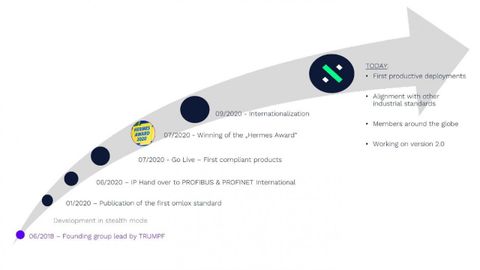
Karsten Schneider's roadmap for standard generation proves that PI has these processes under control: In recent months, the specification documents for omlox hub - a modern positioning middleware - and core zone - an open ultrawideband system - have been completed in the technical working groups based on a collection of requirements from the Use Cases working group. All members were able to check the documents in review and approval processes. They are now available in a final version for all members to download. To control the quality of Omlox products, a test and certification service will be created over the next few months in accordance with the processes proven in PI. The first versions of the test specifications have been created in the meantime. Work on corresponding test software and the establishment of PI test laboratories for Omlox is underway.
The robot interface
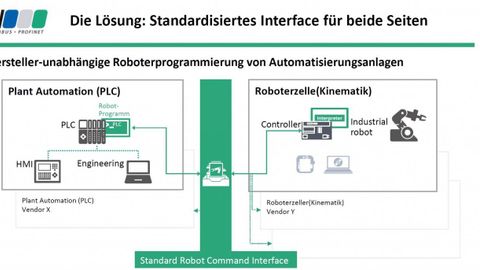
In the next step, Karsten Schneider now wants to transfer this project experience to the robot world. Together with robot and controller manufacturers, a standard interface between the programmable logic controllers and the robot controllers is to be developed. The aim is to achieve manufacturer-independent robot programming of automation systems. Renowned robot manufacturers such as ABB, Comau, Fanuc, Kuka, Stäubli and Yaskawa have pledged their support. A corresponding working group has already been established, which is open to robot and controller manufacturers.
The Module Type Package
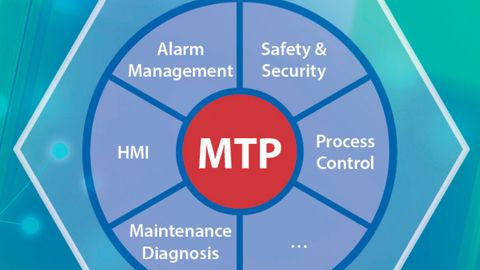
MTP is designed to improve key KPIs for plants. On average, experts assume that the time to market can be halved, engineering costs can be reduced by 70 percent and flexibility can be increased by 80 percent.
© PNOAnd yet another project is now being launched: MTP - the Module Type Package technology. This project was originally launched by Namur and ZVEI. The associations have now brought Profibus & Profinet International on board for the further development, quality assurance and international distribution of MTP.
The background to MTP is that the production of modern goods requires increasingly complex production systems. The effort required for planning, configuration and commissioning is increasing, as are the costs. This is where the Module Type Package technology comes in. Modularization of a production plant enables the use of standardized plant components. This also increases flexibility. Changes to production systems can be made more easily.
Namur and the ZVEI will continue to play a key role in MTP and set out the requirements for the technology. However, PI will then take these up and specify them in detail in technology and marketing working groups, lead them into national and international standardization and ensure their dissemination on the market. In addition, PI intends to contribute its experience in training and certification: training courses will enable both manufacturers of MTP solutions and users of the technology to become familiar with it more quickly; a well-developed certification concept is the basis for cross-manufacturer interoperability. "We see MTP as an ideal complement to our technology," says Karsten Schneider, adding: "We unite the manufacturers of automation solutions in the manufacturing automation and process industry like no other organization!"


You might also be interested in
"Practical suitability has been achieved!"
About five years ago, B&R was one of the co-initiators of the "Shapers" - in other words, a supporter of the TSN movement for the industry from the very beginning. What has happened since then in terms of TSN at B&R? Elmar Zimmerling...
 read more...
Profibus & Profinet International
New profile for robot systems
In addition to the Profisafe, Profidrive, Profienergy and PA profiles, Profibus & Profinet International (PI) is expanding its technology portfolio with the profile for robot systems. The 'Profile for Robot Systems' working group is responsible...
read more...Breaking the 100 million barrier
The total number of Profibus and Profinet products installed in systems has exceeded an impressive threshold of 104 million. Profinet has reached its highest annual figure to date with 7.3 million products launched on the market.
read more...Second test laboratory in China
At the end of May 2024, the China-based company Nanjing Loyst Industrial Networks was recognized as a new IO-Link test lab. This brings the number of IO-Link test labs worldwide to four.
read more...Second Test Lab in China
At the end of May 2024, the China-based company Nanjing Loyst Industrial Networks was recognized as a new IO-Link test lab. This brings the number of IO-Link test labs worldwide to four.
read more...With a focus on intralogistics
The e-paper of issue 04/23
In issue 4 for the Hannover Messe, we present the winners of the "Products of the Year 2023" readers' poll. Also in the magazine: the focus topic of intralogistics at Logimat.
read more...PI Magazine 1/2023
As part of our current April issue, we would like to share the latest supplement from the Profibus Nutzerorganisation e.V. with you. You can find the PI magazine as an e-paper here.
read more...Profibus User Organization e.V.
PI Conference 2023 will take place in Frankfurt
On March 22 and 23, 2023, the 8th PI Conference will take place at the House of Logistics and Mobility (HOLM) in Frankfurt am Main. This year's event of the Profibus Nutzerorganisation e.V. will be held under the motto "PI technologies for digital...
read more...PNO with dual leadership
Dietmar Bohn has been Managing Director of the Profibus Nutzerorganisation e.V. (PNO) since 1 January 2023 and, together with Dr. Peter Wenzel, is now in charge of the PNO office and the PI (Profibus & Profinet International) Support Center in...
read more...