
Mechanical engineering
Beckhoff takes over Schirmer
Automation technology provider Beckhoff is joining the ranks of machine manufacturers. At the Hannover Messe 2016, company CEO Hans Beckhoff explained the background to the acquisition of Schirmer Maschinen at the beginning of April.
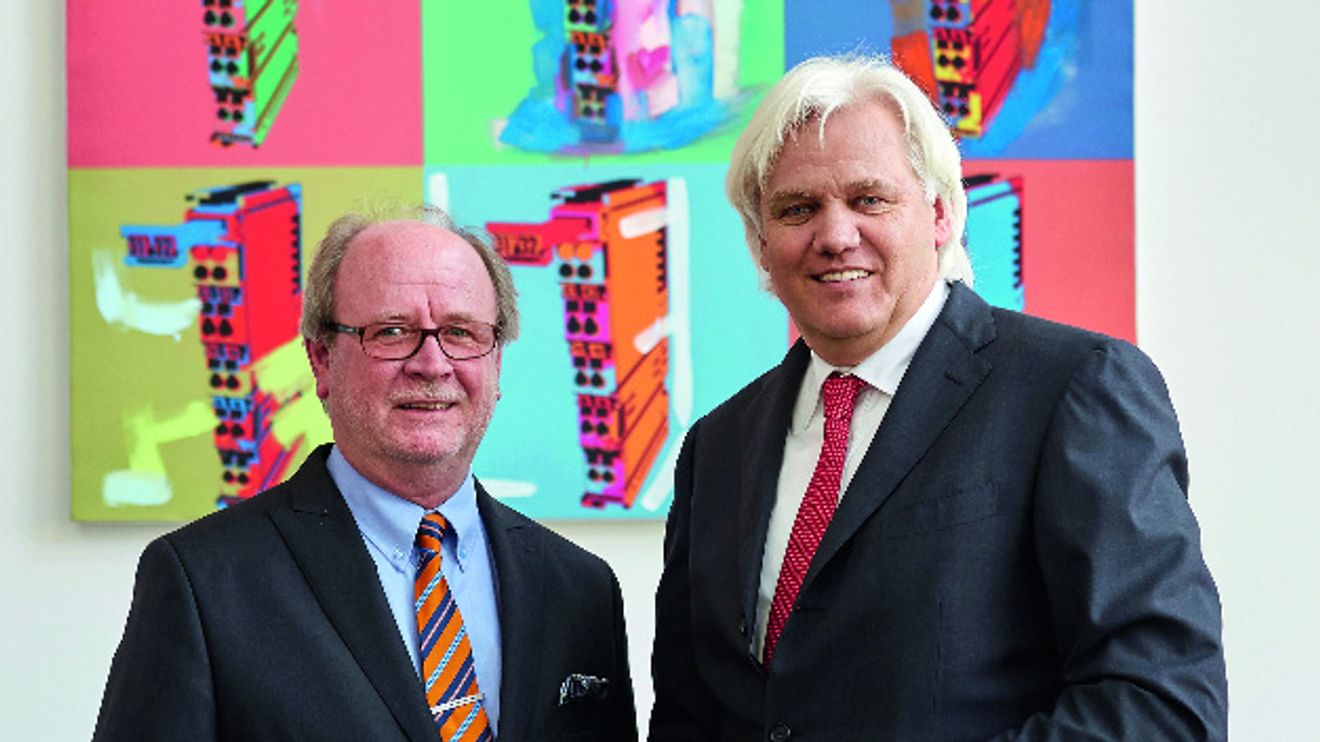
On April 4, the Beckhoff Automation Group acquired the manufacturer of highly automated production lines and profile processing machines for materials such as plastic, steel and aluminum, which is also based in Verl. In the 2015 financial year, Schirmer generated sales of 27 million euros and currently employs 120 people. Schirmer and Beckhoff Automation have been working closely together since the very beginning. For 35 years, Beckhoff has been supplying the complete control technology for the Verl-based machine manufacturer. According to Hans Beckhoff, both companies started out as a 'one-man show' in the garage and Schirmer was Beckhoff's very first series customer.
But what exactly motivated Beckhoff as an automation technology provider to invest in a mechanical engineering company? Hans Beckhoff's answer: "Schirmer has installed around 2000 systems to date, of which around 800 are still in the field. By taking over Schirmer, we now have the opportunity to test our latest control technologies in our own 'house' or on our own machinery." In other words, both companies expect the new constellation to result in an even better integration of mechanical engineering and automation. Hans Beckhoff continues: "Together we have already introduced many inventions and occasionally a few real technical revolutions to the market. We will continue this development and it will be of great benefit to both Schirmer's customers and Beckhoff's mechanical engineering customers. Especially against the background of the new possibilities offered by Industry 4.0 and the mechatronic coupling of mechanical engineering and electronics, both companies expect considerable synergies."
First steps towards cloud-based control
Keyword Industry 4.0: One of the many trade fair innovations from Verler was the EK9160 IoT bus coupler for Ethercat terminals. It allows all control and I/O data to be easily transferred to all common cloud systems, including time stamps, via the integrated web server using plug & play. Thanks to its implementation as a bus coupler solution, neither control nor programming is required. A simple configuration for the I/O terminals, cloud services and security functions used is sufficient. Advanced mechanisms are also available, such as local buffering of I/O data on a micro SD card (2 GB) if the internet connection is interrupted.
Using the IoT protocols AMQP, MQTT and OPC UA (over AMQP), the solution supports common cloud systems such as Microsoft Azure, Amazon Web Services (AWS), SAP Hana and also private cloud systems in the company's own network. The EK9160 is also 'Microsoft Azure Certified' and enables communication with multiple clouds thanks to its multi-cloud capability.
The data communication of the IoT bus coupler uses the publisher/subscriber communication principle. This means that the EK9160 sends the data to the cloud as a publisher and another application can access the information as a subscriber. If required, this application can then publish data itself, which the IoT bus coupler can then access. As the devices do not need to know each other or their IP addresses, but only the central message broker, the individual applications work decoupled.
According to company boss Hans Beckhoff, the benefits can be used in all areas of mechanical engineering and building technology. In conjunction with the wide range of Ethercat I/O terminals, the IoT bus coupler can be used to transfer a wide variety of machine and building data to the cloud - for example on temperature, pressure, vibrations or energy consumption. It is also possible to monitor the connected fieldbuses. This means that the I/O signals can be collected not only via Ethercat, but also via a monitor operating mode of the CANopen or Profibus Ethercat terminals and then analyzed by external specialists, for example.
This approach can also be used to implement the concept of cloud-based control. Here, Twincat is located as an IoT controller in the cloud, which acts as an MQTT message broker. The necessary data is supplied by the IoT devices, which can be distributed worldwide if required. In this case, the IoT fieldbus, which was implemented by Beckhoff based on the MQTT protocol, provides the necessary publisher/subscriber communication. This provides all the prerequisites for easily and reliably transferring control and data analysis processes to Twincat in the cloud.
According to Hans Beckhoff, response times of around 60 ms can already be achieved with this approach - as tested using the Twincat runtime environment hosted on a server in the USA. One thing is clear: Industrial applications with their high demands on the determinism of transmission cannot be sensibly controlled with this - but for less demanding applications, for example in the field of building automation, this may well be sufficient. However, even the visionary Hans Beckhoff does not assume that it will be possible to use the cloud approach to reduce response times to an industrial level of just a few milliseconds within the next five years - but the direction we are heading in is clear!
Beckhoff - the 2015 financial year
Beckhoff Automation closed the 2015 financial year with global sales of EUR 620 million; this corresponds to an increase of EUR 110 million (+22%) compared to the previous year. Taking into account a currency adjustment, according to Hans Beckhoff, this results in "further impressive growth of 17%". Beckhoff is now represented by 34 subsidiaries and distributors in over 75 countries. Exports accounted for 65% of total sales in 2015. The company currently employs 3,000 people worldwide, of which almost 2,100 work in Germany and around 1,900 at the Verl site.
Hans Beckhoff is also positive about 2016 and is hoping for double-digit sales growth: "We have a good order intake with growth trends." To ensure that the company is prepared for future growth rates, the operating area of the company headquarters in Verl will be expanded by a further 27,000m2 in 2016. Existing neighboring industrial buildings have already been rented for this purpose, which will provide additional storage and production space after renovation in the second half of the year. "On the production side, we are thus prepared for two more years of growth," says Hans Beckhoff confidently.


You might also be interested in
The 'incredible machine'
100 years ago, in a workshop in Esslingen am Neckar, Festo founder Gottlieb Stoll asked himself how technology could make work easier. To mark the company's 100th anniversary, Festo has now designed and built a machine that shows the fascinating...
 read more...
SmartFactory-KL at the Hannover Messe
The production island_Phuket
AI applications increase the performance, efficiency and productivity of robots, machines and production systems and also help to save a lot of money because they significantly reduce material usage, energy requirements, CO2 emissions and set-up and...
read more...ZVEI at the Hannover Messe 2025
ZVEI criticizes high regulatory hurdles
At the start of Hannover Messe 2025, the German Electrical and Electronic Manufacturers' Association (ZVEI) described the economic situation in the German electrical and digital industry as challenging.
read more...BDI at the Hannover Messe 2025
Industry in crisis
At the start of Hannover Messe 2025, leading industry associations BDI, VDMA and ZVEI described the economic situation in Germany as worrying. According to BDI President Peter Leibinger, the mood in many companies is worse than ever before.
read more...VDMA at the Hannover Messe 2025
Mechanical engineering calls for far-reaching reforms
At Hannover Messe 2025, the mechanical and plant engineering industry emphasized the need for comprehensive reforms in order to strengthen industrial competitiveness in Germany and Europe. The VDMA believes that the German government and the...
read more...Industry 4.0 - outgrowing its infancy
At Hannover Messe 2019, it became clear that Industry 4.0 has long since left the theoretical stage. Smart factories and future-proof manufacturing concepts characterized the image of the trade fair in many places.
read more...Robotics - safe and cost-effective
Robotics doesn't have to be expensive, complicated and dangerous for workers - this was the message sent by numerous exhibitors at Hannover Messe 2019 to visitors to 'Robot Hall 17'.
read more...AI as the dominant topic
True to the leitmotif of this year's Hannover Messe - Industrial Intelligence - the topic of artificial intelligence was omnipresent at the exhibitors' stands; not only in theory, but also in practice using the example of numerous use cases.
read more...The video review
"Integrated Industry - Industrial Intelligence" was the guiding theme of this year's world's largest industrial trade fair. Which topics were particularly in focus this year? Computer&AUTOMATION was on site with a camera.
read more...