
Beckhoff
The evolution of the IPC
In 1986, Beckhoff delivered the first PC-based machine controller. What has happened since then in the evolution of the PC and where do we go from here? A review and outlook from the perspective of one of the IPC pioneers.
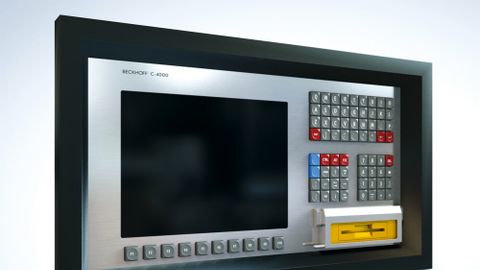
The first PC-based machine controller delivered by Beckhoff Automation in 1986 was a simple controller for a double mitre saw, which included a single-axis positioning controller with some machine sequence functions. The saw was a standard machine that became a sales success for the machine manufacturer thanks to the then new PC-based control technology. The combination of IT functions and automation technology in one control system was a revolution. For example, research data could be read directly into the machine control system using floppy disks. This was a real step forward in productivity in 1986.
The PC-based control concept was expanded in the following years: Multi-axis NC functionality and a complete, integrated software PLC enabled the PC-based control of even highly complex machines and systems. Nothing fundamental has changed in this concept since then: The abstraction of the control function from the device hardware and the consistent use of mainstream technologies from the IT world to converge with the principles of automation technology lead to an ever-increasing increase in performance and functionality on the one hand and to continuous cost reduction on the other.
The birth of the PC as an initial spark
The development of PC-based control systems went hand in hand with the general progress in PC technology and found its expression in a variety of devices that made the flexibility and universality of this platform available to the industrial world. The birth of the PC as we know it today was in 1981, when IBM launched the first PC with an x86 CPU: the IBM PC type 5150 had an 8088 processor with a clock frequency of
4.77 MHz clock frequency. At the time, IBM opted for this processor for cost reasons, as it allowed the connection of low-cost 8-bit peripherals, in contrast to the more powerful 8086. It was also intended to counter the increasing market success of the Z80 and Motorola 68000 processors. The x86 architecture became increasingly popular because it promised a large community with compatible and easy-to-use hardware and software, including a gigantic 10 MB hard disk for mass storage at the time. This meant that the tedious task of storing programs on audio cassettes was finally a thing of the past. The new DOS operating system from Microsoft also contributed to the success, which allegedly only found its way onto the IBM PC because IBM and Digital Research (the manufacturer of CP/M) could not agree to sign a so-called NDA (Non-Disclosure Agreement).

In addition to IBM, there is another name that immediately springs to mind in connection with the PC: Intel, founded in 1968 by Gordon Moore and Robert Noyce. The two original founders were joined shortly afterwards by Andy Grove, who served Intel as CEO until 1998 and as Chairman of the Board until 2004. He initiated the decisive change from a manufacturer of memory chips to the development and production of processors. This new path began with the first processor 4004 (4-bit, 1971), followed by the 8-bit successor 8008 (1972) and the first PC processor 8080 (1974). The first x86 processor was the 16-bit processor 8086, which appeared in 1978, but for cost reasons - the 16-bit peripherals were still too expensive at the time - it was not until 1979 that it found its way onto the PC mass market in a slimmed-down 8-bit format, as the 8088 processor.
IPC technology with own motherboards
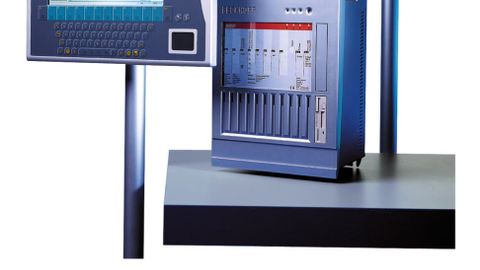
The aim of PC-based control technology has always been to combine the best of two worlds - information technology and automation technology. Powerful Industrial PCs form the hardware basis for this. Beckhoff was one of the first to implement the complete machine control functions with a PC: the PLC function for sequence control, motion control, communication, data storage and the HMI for operator guidance. Today, even image processing and artificial intelligence in the form of machine learning
are integrated.
To achieve this, the PC had to be designed for industrial use. Beckhoff made the decision to develop and manufacture its own motherboards for this purpose in 1989, as it was clear that different requirements had to be met for industrial applications than for office applications. This could be taken into account much better with in-house motherboard development than by buying in. Beckhoff was able to realize more special boards and more compact form factors, i.e. integrate more functions on one board. This in turn resulted in housing designs that were more suitable for industrial applications, as well as better coordination with customer requirements in terms of performance and safety in monitoring.
IPCs plus software
With the first control programs that could run on a PC, Beckhoff provided its customers with PLC and motion control functions, including CNC, as early as 1988. The real-time capability of the PCs under the DOS operating system was achieved by a self-developed real-time extension. The actual controller was programmed in a programming language similar to Step 5. Even then, parts of the application, such as the visualization, could be written in C. The switch to the Windows operating system and a new programming philosophy began in 1995. Since 1996, Beckhoff has bundled the entire world of automation, from the I/O level to PLC, motion and CNC, in the TwinCAT platform. The platform realizes real-time, i.e. the deterministic, virtually jitter-free execution of tasks on a PC with a Windows operating system.
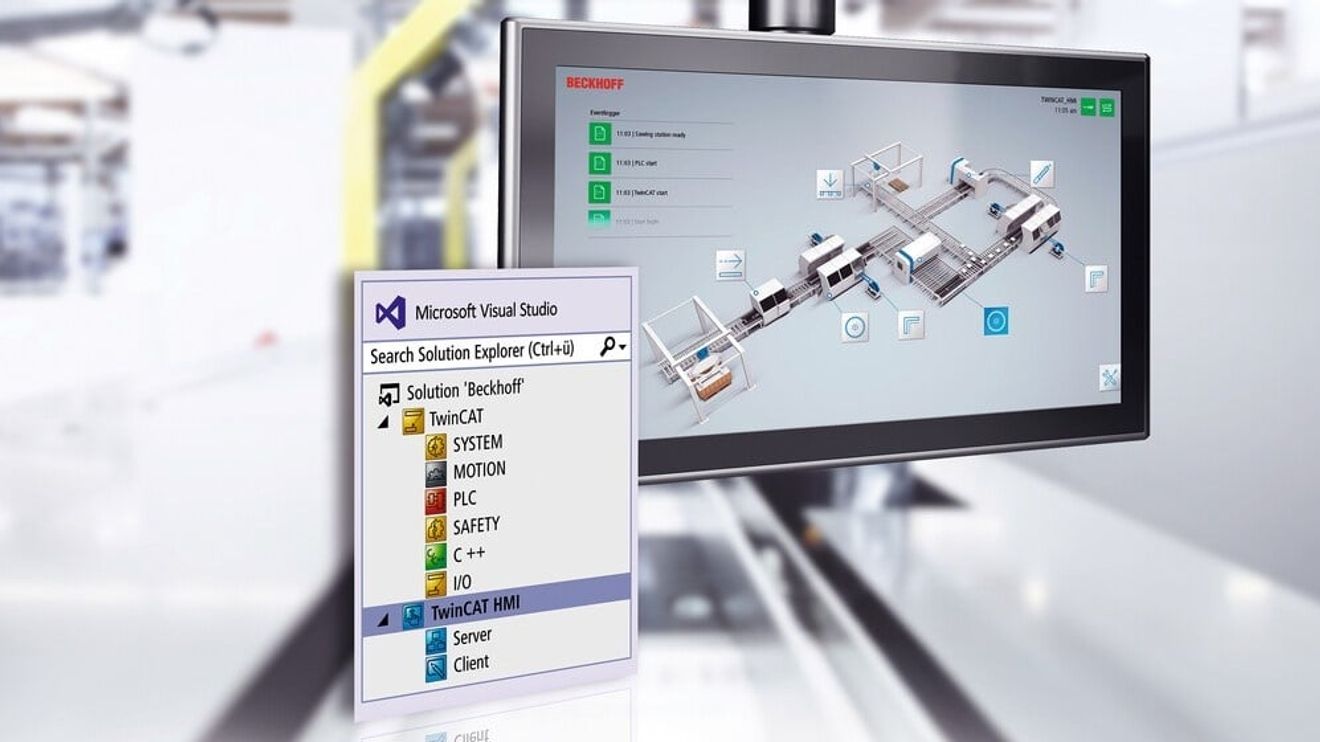
A revolution in the engineering sector is the use of Microsoft Visual Studio, which Beckhoff uses as a framework for the TwinCAT engineering tools. The globally accepted Visual Studio integrates the TwinCAT components for system configuration and PLC programming and allows the use of existing languages, such as C and C++, for real-time tasks. This means that extensive existing source codes in C/C++ can be used. The .Net programming languages, such as C# or VB.Net, are also available for non-real-time applications in the same programming environment. This means consistent engineering for the user: Visual Studio forms the common framework for all languages and all configurators. In addition, a range of add-ins are available for Visual Studio, such as the option of source code management.
IPC with many faces
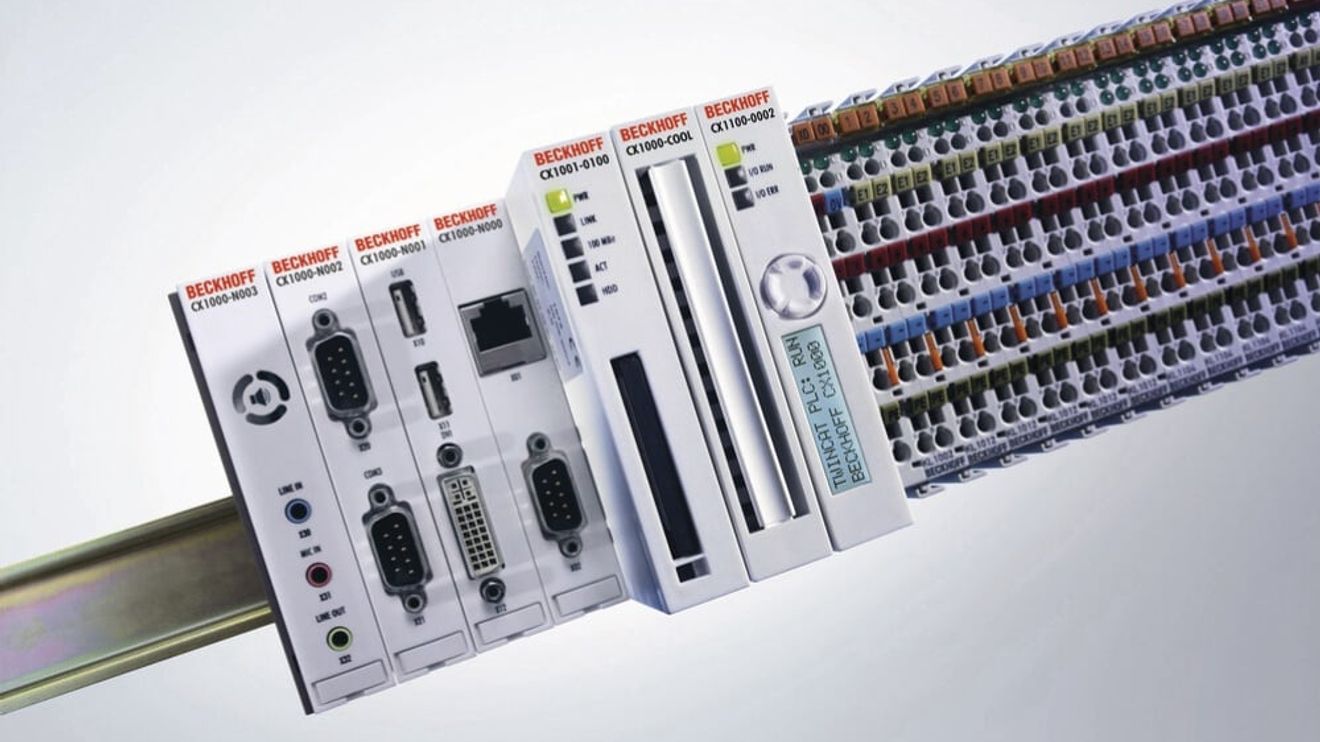
The IPC entered the industry in various form factors and functional focuses. Embedded PCs are a prime example. In 2002, DIN rail-mountable embedded PCs were launched on the automation market for the first time, a form factor that has established itself as a compact controller across all manufacturers. Together with modular I/O modules that can be bayed, these embedded PCs create a space-saving industrial controller on the DIN rail - an absolute novelty 21 years ago with decisive advantages: The direct connection option for I/O systems eliminates the cost of additional couplers, significantly reducing the amount of wiring and space required in the control cabinet. As a result, control cabinets and terminal boxes could be built smaller and more economically with this new system.
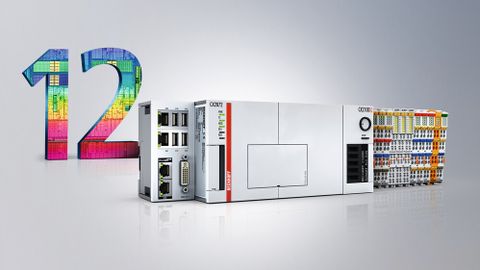
2016: The embedded PC with up to 12 CPU cores brings Manycore and thus maximum computing power to the DIN rail.
© BeckhoffControl and operation often form a single unit. So-called control panels conquered factories 25 years ago. Eleven years ago, multi-touch technology was added to control panels and panel PCs, another example of the convergence of IT and OT. Highest computing power for more intelligence in the Smart Factory is also aimed at and implemented with the IPC. Beckhoff calls this product group Manycore Control. Manycore computers are used in the area of IT servers for complex and high-performance computing actions. Since 2016, Manycore has also been available for an Embedded PC series in a compact design for the DIN rail - with up to 12 processor cores and a graphics card with separate 2 GB RAM memory.
IPC development trends
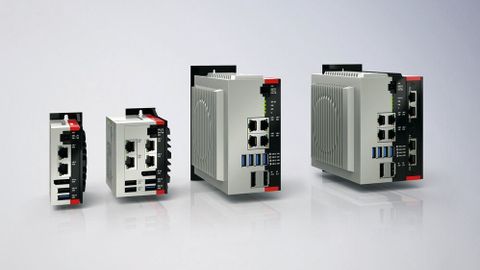
2017: The ultra-compact industrial PC marks the launch of a complete IPC series in a completely new form factor.
© BeckhoffThe future of IPC technology in control and automation technology will continue to be a successful one, but will be subject to continuous diversification. It is foreseeable that this will happen in both the hardware and software sectors. In the CPU sector, ARM and RISC-V are developing strong alternatives to the tried-and-tested Intel and AMD processors. The trend towards multiple CPU cores and the increasing installation of special accelerators for AI applications continues unabated. Many providers have also established themselves in the field of operating systems, where the issue of real-time processing can be considered solved either natively or through additional drivers. AI is expected to lead to a sharp increase in the requirements for local computing capacity. A flexibly programmable and powerful system is fit for the future, but one must ask oneself whether the abbreviation "IPC" is then still appropriate.hap


You might also be interested in
The e-paper of issue 07/2024
Read in the current issue of Computer&Automation how ChatGPT can provide support in the conception phase, how LLMs are used in code analysis and whether TSN can be considered as a backbone for virtualized control systems.
 read more...
Consistent multicore and multitask support
Beckhoff relies on consistent multicore and multitask support in its current 'TwinCAT MC3' Motion Control generation. Thanks to its modular architecture, axes implemented with 'TwinCAT NC2' can also be seamlessly integrated.
read more...Consistent Multi-Core and Multitask Support
Beckhoff relies on consistent multicore and multitask support in its current 'TwinCAT MC3' Motion Control generation. Thanks to its modular architecture, axes implemented with 'TwinCAT NC2' can also be seamlessly integrated.
read more...Beckhoff simplifies AI training
An evolutionary development every year, a revolutionary leap every five to seven years - this is how Beckhoff aims to secure its technological leadership. At the press conference, the company from Verl also presented some technological highlights.
read more...AI training made easier
An evolutionary development every year, a revolutionary leap every five to seven years - this is how Beckhoff aims to secure its technological leadership. At Hannover Messe, the company from Verl also presented some technological highlights.
read more...HANNOVER MESSE DAILY Day 4
The top news from the fourth issue: Robert Habeck at the trade fair tour +++ Technological AI highlights from Beckhoff +++ Radar sensor technology in focus at Pepperl+Fuchs +++ ASi-5 counter module as an active distributor from Bihl+Wiedemann +++...
read more...These are your winners!
We put 96 products in twelve categories to your vote in December, and now the winners have been chosen! The trophies were presented at a 'Winner's Dinner' at the Seehaus in Munich. These are your "Products of the Year 2024"!
read more...Embedded Computing & IPC - The winners
A 'classic', a 'scene product' and a 'pragmatic approach' convinced the readers of Computer&Automation in the 'Embedded Computing & IPC' category.
read more...Drive technology - The winners
In the 'Drive Technology' category, a product with a very top target group came out on top.
read more...