
Industrial PCs
Standardized processor modules for rackmount servers
Constantly reinvesting in data center performance costs money - more money than would actually be necessary. If standardized processor modules are used as an alternative, costs can be saved immensely.
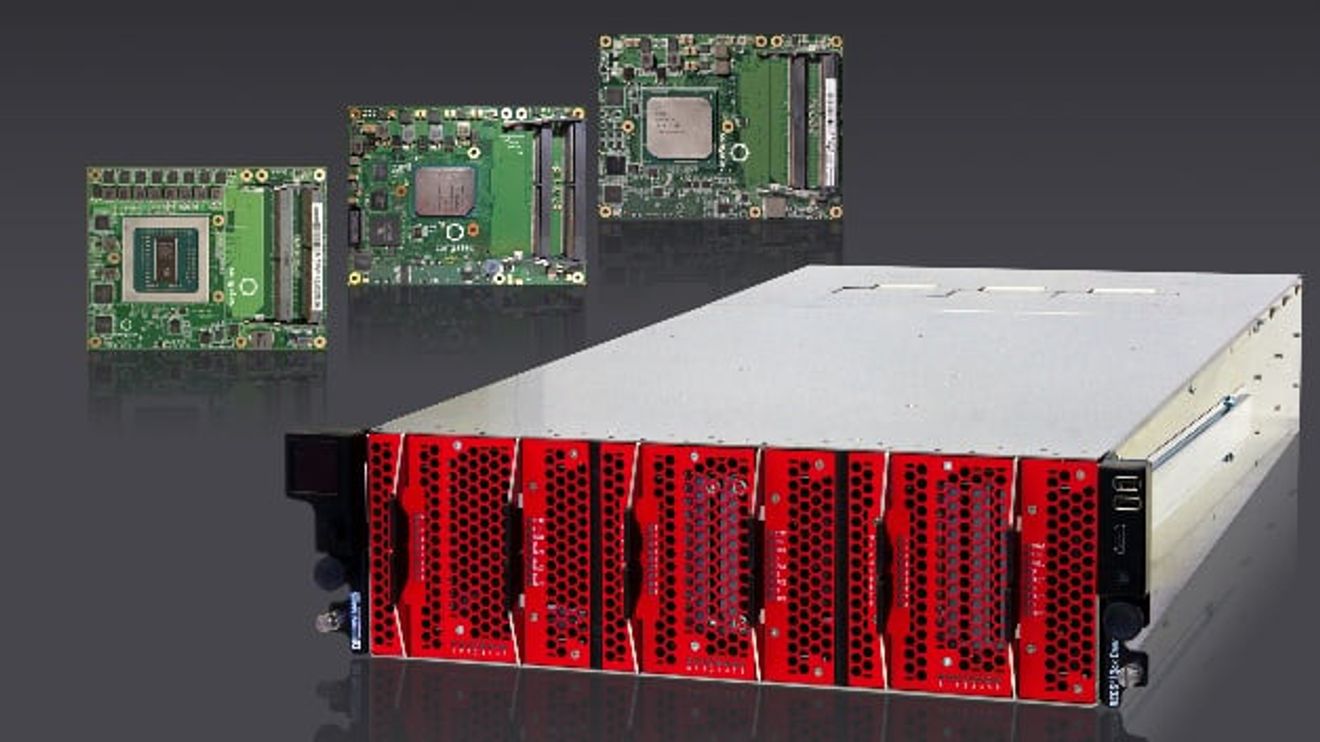
It is not only the telecommunications market that is struggling with the fact that revenues per gigabit of data transfer are constantly falling, while performance requirements are constantly increasing. The same applies to on-premise cloud and server applications and even more so in the industrial server and energy-sensitive microserver segment, where space is often even more limited. Here too, IIoT and Industry 4.0-related installations have to overcome increasingly complex challenges without being able to scale the server space in the control cabinet rack as required. Consequently, more and more performance must be available in the same microserver space. And without additional scope for thermal design.

This 3U rackmount system from Christmann can host up to 27 high-performance micro servers. Up to three COM Express Type 7 Server-on-Modules from Congatec are used per carrier blade
© ChristmannWhen installing a new generation of microserver, it is therefore already clear that the next generation will have to follow in a period of three to five years in order to keep pace with requirements. But how can this next performance upgrade be implemented as cost-effectively as possible?
Christmann has taken an innovative approach to this. In order to set up a new generation of modular rackmount servers in the 2U and 3U class, the company is relying on the new COM Express standard for server-on-modules, which was developed as part of the EU-funded M2DC project. The modules can be flexibly equipped with up to 27 CPU micro-servers with x86 or optionally ARM architecture. They also offer standardized modular options for parallel processing in the form of GPGPU cards and FPGA modules, which the company also physically designs in the COM Express Basic Footprint.
The M2DC project
On the one hand, the M2DC project aimed to develop commercially ready-to-use hardware that is as precise as possible and can meet all the requirements of future high-performance applications - from cost-effective cloud designs to extremely efficient hardware-accelerated special computers for supercomputing. For this purpose, it should also be possible to freely combine all the different computing architectures in one housing. Modularization was therefore the order of the day from the outset in order to be able to provide the right COTS solution for every requirement without engineering effort - even for heterogeneous designs.

The standard system structure of the 2U system provides for three carrier blades that can be equipped with COM Express microserver modules - if required, also in combination with FPGA and ARM modules.
© ChristmannSecondly, the new class of 2U and 3U rackmount servers should enable the lowest possible investment costs and sustainably high energy efficiency. Modular designs also provide the right basis for this, as the next generation of microserver processor technology enables new leaps in performance with the same thermal design power (TDP). So if only the microserver module needs to be replaced, performance leaps are possible at a given TDP for the smallest investment.
Christmann assumes that the migration costs for an update to a second generation of boards are only around 50% - including all the services that need to be provided for new configurations, qualification and installation. Over three innovation cycles, the estimated investment amounts to around 67% of the investment required to date.

The smart carrier blades recognize whether a COM Express Type 7 or Type 6 module has been plugged in. This makes replacing the microserver modules particularly easy.
© ChristmannThe modular concept of the RECS Box 4.0 server family is extremely scalable in terms of processor performance: it can host both COM Express Type 6 and COM Express Type 7 modules, which enables a flexible module selection ranging from simple Intel Atom C3000 processor modules to Intel Xeon D1500 and AMD EPYC Embedded 3000 processors. The blade carriers can automatically recognize whether a COM Express Type 7 or a COM Express Type 6 module is plugged in via coding on the plug contacts. The routing to the backplane is thus automatically set to the appropriate configuration. This also makes module replacement particularly easy. The COM Express footprint was also used for ARM and FPGA modules so that mixed configurations can be implemented on a single blade carrier. GPGPUs can also be used via classic PEG slots, making the new rackmount servers a perfect COTS platform for any edge server requirements.
In addition to the integrated 10/40 Gbit Ethernet switch, an optional PCIe switch is available in the system, which allows the individual micro-servers to communicate seamlessly with each other with extremely short latencies - a solid basis for fast and real-time capable data processing of applications that want to have several micro-servers computing in parallel.
Author: Zeljko Loncaric is Marketing Engineer at congatec
What are the benefits of the COM-HPC specification?
Current Server-on-Modules in the COM Express Type 6 or Type 7 layout have a limited capacity of memory support, as only up to 96 gigabytes of RAM can currently be installed on the COM Express modules in the basic form factor. This is sufficient for the extremely energy-saving embedded server processors. However, up to 1 terabyte is already possible with the AMD EPYC Embedded 3000 processors. This requires larger footprints, which the COM Express standard has already specified. However, the decisive bottleneck for more performance and better interface support is also the current COM Express connector, which offers 440 pins and is fully utilized with PCIe Gen 3.0. The upcoming COM-HPC specification, which is significantly higher than COM Express in terms of performance parameters, uses new high-speed connectors for around twice as many interfaces and supports higher frequencies, as required by the upcoming PCIe Gen 4.0 and subsequent versions. This means that manufacturer-independent modules could also become available in the microserver performance range beyond 100 watts TDP per processor in the future.
The new COM-HPC specification is expected to be available in 2019. The first series products are expected to follow at the beginning of 2020. It is therefore to be expected that established server manufacturers will also take advantage of this momentum, precisely at the time when they are also converting their business models to rental services. New business models are clearly moving in the direction of subscription-based services, with software providers such as Zuora even seeing an end to the age of ownership. Only time will tell whether these billing and revenue automation experts are right. For server-as-a-service providers, however, the module approach should offer immense scope for contribution margins.
The M2DC project
The EU project M2DC (Modular Microserver DataCentre) was launched in 2016 with the aim of developing cost- and energy-efficient complete solutions for use in the data center of the future. The Lower Saxony-based company Christmann Informationstechnik is supplying the hardware basis for this with the RECS Box 4.0 microserver and is also involved in central software components of the project.
The project partners developed a server architecture that meets different needs in data centers: from cost-effective cloud designs to extremely efficient hardware-accelerated special computers for supercomputing. One of the aims of the project was to develop 'turnkey' solutions for different application areas.
The M2DC project was intended to benefit from European innovation in the field of embedded system design and to use the latest computing resources and technologies to develop tailor-made, turnkey - and commercially available - hardware that meets all the requirements of future high-performance applications and is intended for use in a real data center environment. The project started in January 2016 and was scheduled to run for 36 months. The participants were: Christmann Informationstechnik+Medien, ARM Limited, Huawei Technologies, Bielefeld University, Poznan Supercomputing and Networking Center, Commissariat for Atomic Energy and Alternative Energies (France), OFFIS e.v., XLAB,Vodafone Automotive, Polytechnic University of Milan, CEWE, BEYOND, ReFLEX CES and Alliance Services Plus.


You might also be interested in
SMARC modules with up to eight cores
Congatec is launching robust SMARC modules based on the Intel Atom x7000RE processor series (codenamed Amston Lake) and Intel Core i3 processor, which have been specially developed for industrial requirements.
 read more...
Next-generation AI computing for the edge
Congatec introduces COM Express Compact modules based on Intel Core Ultra processors. The new modules combine heterogeneous computing units such as CPU, GPU and NPU and are therefore particularly suitable for executing demanding AI workloads at the...
read more...New man in the management team
Congatec, a provider of embedded and edge computing technology, has appointed Dominik Reßing as its new CEO.
read more...The decisive factor is the performance class
It is not easy for developers to correctly evaluate the different form factors of the standardization bodies. Depending on the performance class, only a single standard is usually recommended for new system designs. However, there are also...
read more...Choose your cover photo favorite of the year 2022
Which cover picture did you like best this year? Take part in a short survey and optionally in the prize draw for great prizes.
read more...The top articles in October 2022
The top articles in October are outside the norm, showing the advantages of scalability, intelligent robots and the role of AI in control. In addition, the top article from September remains a perennial favorite. Read for yourself.
read more...Functionally secure with x86 multicore
Power-hungry sensor technology in applications with functional safety (FuSi) means that embedded computing platforms must also increase their performance - multicore processors are therefore increasingly coming into focus.
read more...Five new COM-HPC Server Size D modules
Congatec is expanding its portfolio with five new COM-HPC Server Size D modules with Intel Xeon D-2700 processors.
read more...Congatec tackles the safety market
At embedded world, Congatec announced that it was investing heavily in functional safety. The motivation behind this is that functionally secure embedded computing platforms are needed in many new applications.
read more...