

Flash memory
Robust in production
Flash modules score points for space savings and stability compared to mechanical hard disks. But is data really safe in the event of power failure, vibration and temperature fluctuations?
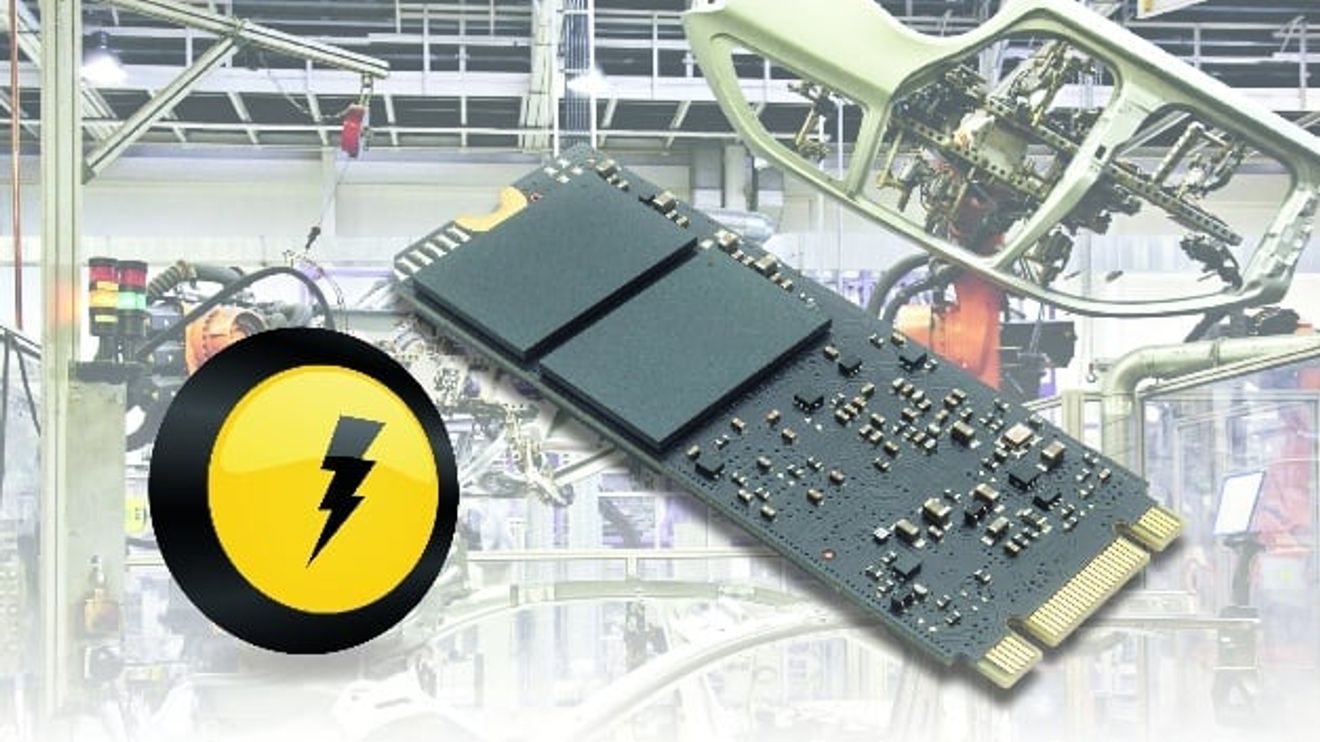
Flash memory, as we know it from cell phones, USB sticks and SD cards, is often used for fast data storage in trade, industry and research. Unlike in the consumer sector, however, there are a few things to consider in industrial applications: What happens in the event of a brief voltage drop during the write process? What about data security in the event of vibration or shock to the memory and in what temperature range do they still work reliably?
USB sticks are very inexpensive today and are almost disposable products that are given away as advertising media like ballpoint pens. You should not entrust important data to such data carriers, as the differences in the quality of the storage devices are enormous. Cheap mass-produced goods are not technically up to date and sometimes even use recycled memory components from old cell phones. For commercial or industrial use, the electronics specialists at Hy-Line offer special, particularly robust SSD flash memory from Cervoz. Choosing the right memory for the application requirements ensures that they will function reliably for a long time, even under adverse environmental conditions.
The practical requirements
When using modern flash modules, there are various pitfalls depending on the application: power failures, vibration, shock and temperature fluctuations can never be ruled out in industry, but also in applications in measuring devices for medicine, trade or research and even electronic cash registers.

The PLP function can ensure a power supply to the storage unit that is around 40 times longer than usual.
© Hy-LineA solution with 'hardened' storage systems, as in the military sector, is too expensive for commercial use and is usually not necessary. It is more economical to find the right storage system for the respective application. However, there are properties that are required for all applications. Hy-Line, for example, attaches great importance to the long-term, reliable function of the components, which still have the same specifications when purchased years later. The memories are therefore equipped with different controller and memory chips of the same type - depending on the configuration (form factor, size, speed) - but always the same over the product's service life. This guarantees the same performance, such as read and write speed, compared to modified chips or chips from different manufacturers. This means that important data from production, for example in quality assurance, is written at the same speed even at high write speeds - for both old and newly purchased memories.
In addition, with excessive memory usage, it should be noted that the maximum number of write operations, also known as endurance, is significantly lower than with hard disks.
SSDs have an average expected lifespan, which is determined by counting the total amount of data written to the SSD, also known as TBW (terabytes written). But what does this mean in practice?
SSDs, like any semiconductor, can fail due to physical and manufacturing problems when circuits are energized over a period of time. However, this usually happens quickly and is usually covered by the warranty. This leaves 'wear and tear' during normal operation. An example quickly shows the actual relevance of this endurance: The average user stores around 5 GByte/day - only a very small percentage reaches the 50 GByte/day mark.
Roughly simplified, this means that if you use a 100 GB SSD, you will rewrite the drive less than 1000 times in five years, even if you belong to the group of storage-heavy users with 50 GB/day.
Replace before failure
Another important point is the controller. It regularly checks all memory blocks for their function and capacity. If an error is detected, it transfers the memory area to another from the reserve and marks the faulty one as 'unusable'. With the help of special software tools (SMART = Self-Monitoring, Analysis and Reporting Technology), the user can track this ageing of the storage medium and replace it preventively if necessary. This allows the user to react before a failure occurs. The controller also uses 'wear leveling', i.e. it uses all the physical blocks of the memory 'in turn', even if the operating system always wants to access the same logical block for the medium's table of contents. This method also further improves service life and reliability.
Mobile devices can also be dropped, causing the battery to briefly detach from the contact spring. Even more common, however, are cases where the power fails in industrial applications, the mains voltage fluctuates greatly or is lost via the mains plug or (emergency) switch before the device is shut down. Such a power failure during the storage process can lead to data loss. Robust SSD storage devices from Cervoz with Power Loss Protection (PLP), for example, provide a remedy. Tantalum capacitors on the memory board take over the power supply in the event of voltage fluctuations and ensure that a write process can always be completed. The PLP function can ensure that the memory is supplied with power for around 40 times longer than usual. This protects critical applications and areas of use in vehicles, medical devices or industry from data loss. Depending on the requirements, the current-supported memory is available with a storage capacity of 32 to 128 GB.
In an industrial environment, a device falling to the ground, shock or increased vibration in the field occur relatively often. Over time, this can cause connections such as solder joints to come loose or cracks to form on the circuit board and tracks.
Anti-vibration filling

The application of a synthetic resin between the edges of the PCB and semiconductor chips prevents soldered connections from coming loose in the event of vibration or shock.
© Hy-LineBoth can lead to uncontrollable memory failures. Mechanically particularly robust memories therefore use an anti-vibration filling to reliably protect components, solder joints and the circuit board. An epoxy resin is applied between the edges of the circuit board and semiconductor chips to prevent solder joints from coming loose. At the same time, the resin bead has a stabilizing and damping effect on the PCB body. The 'anti-vibration fill' thus extends the service life in applications with vibrations, such as vehicle electronics, machine automation or mobile devices. Temperature fluctuations can also cause problems. Today, a lot of data is collected and processed in construction and agricultural vehicles and equipment. The applications range from self-supply filling stations to precision farming (editor's note: the term 'precision farming' refers to a method of spatially differentiated and targeted cultivation of agricultural land). In extreme cold or heat and high humidity or condensing moisture, standard storage tanks often perform poorly; in contrast, versions designed for commercial use can withstand -40 to +85 °C in use.
The humidity can be up to 95 % at +55 °C, as opposed to only 90 % at +40 °C in the standard version. This means that alternating use between the office and cold store or winter operation outdoors is no problem. Thermal shock or thermal cycles within the specification have no influence on the service life and reliability of the storage function. Only selected components for the extended temperature range are used by Toshiba and the finished memory is tested.
For commercial applications, it is therefore worth taking a closer look at the requirements. The right memory with a robust design already makes up for the apparent cost advantage through a longer service life, not to mention the risk of data loss and the associated damage to a machine manufacturer's image.
Authors: Rudolf Sosnowsky is Head of Technology at Hy-Line and Andreas Zeiff works in the Stutensee editorial office.


You might also be interested in
The deterministic IIoT
Network and real-time specialist TTTech is working flat out to further optimize its TSN solution for broad rollout - and link it to its growing IIoT platform. An interview with Georg Kroiss, Business Development Manager Industrial.
 read more...
For a wide range of applications
As operating stations, panel PCs are right at the heart of the production process. Depending on the industry, the devices must therefore meet certain minimum requirements - for example with regard to protection class, hygiene and glove operation.
read more...When botnets attack
The fact that IoT systems are very easy to attack has not only been proven by countless live hacks, but also by real botnet attacks. Service access points are proving to be a serious weak point.
read more...Agile development - even for safety projects?
The aim of agile software development methods is to make the development process more flexible and leaner - compared to the classic V-model approach. Are these methods also suitable for functionally safe systems?
read more...Real-time for Fog Server
In the age of Industry 4.0, real-time communication between machines and systems and their supply and removal systems is required. Virtualized fog servers in a redundant design are predestined for this. Computer-on-Modules with 10 GbE real-time...
read more...The IIoT alternative
AllJoyn is an open source IoT initiative aimed at the consumer electronics market. The aim is for devices and systems to recognize and interact with each other independently. The first AllJoyn connections for CAN-based products also make the...
read more...Controller for the IIOT
National Instruments is now presenting a family of industrial controllers that are predestined for use on 'smart machines' and in intelligent systems for the Industrial Internet of Things. Rahman Jamal, Global Technology & Marketing Director,...
read more...The new role of single-board computers
The Raspberry Pi was originally developed to get children interested in programming and spark their interest in a job in the electronics industry. But its success has also sparked the creativity of professional engineers, who use the Pi to bring...
read more...The path to the IoT
The IoT is a challenge for developers: the need to develop, deploy and maintain embedded applications quickly is challenging the tools and methods used to date. A platform concept including an IoT operating system helps engineers to implement and...
read more...